
Paperboy — Sega Genesis (Tengen, North American/European release) — Strategy Guide
Complete, platform-specific strategy for Tengen’s original Sega Genesis/Mega Drive port of Paperboy. Learn the Genesis controls, subscriber and scoring rules, hazard management, Training Course technique and weekday route discipline needed to complete the full Monday-through-Sunday campaign, clear every daily Training Course and improve scores through repeatable practice.

Find a copy
Paperboy Sega Genesis / Mega Drive
We may earn a commission if you buy through these links, at no extra cost to you. As an Amazon Associate I earn from qualifying purchases.
Opens retailer search results. Check the model, edition, seller, availability and current price before buying.
Before you begin
This guide covers the original Tengen Paperboy port for Sega Genesis in the North American and European release family.
The Genesis conversion uses an isometric roadside perspective and centers on one core loop: steer the paperboy along the route, throw limited papers to subscriber porches and paperboxes, avoid hazards, pick up bundles and complete each weekday route to reach the Training Course.
The Genesis pad uses Left and Right for lateral steering, Up to accelerate, Down to brake, and A, B or C to throw a paper.
This walkthrough stays specific to the original Genesis port and does not import remake or later-port mechanics.
It explains the control feel, weekday progression, Training Course strategy, delivery priorities, failure recovery and repeatable aiming tactics needed to complete the Monday-through-Sunday campaign and improve later runs.
Set yourself up for the run
Confirm the Genesis controls before starting: Left and Right steer laterally, Up accelerates, Down brakes, and A, B or C throws a paper.
Practice diagonal movement with Up/Left or Up/Right, then release the direction or press Down to slow before a delivery or obstacle cluster.
Study the opening neighborhood display so you know which houses are subscribers and which are optional non-subscriber targets.
Begin with Easy Street while learning the route; move to Middle Road after steering and braking become consistent, then use Hard Way for higher-risk score practice.
Use the first Training Course to practice stable alignment, ramp approaches and controlled throws.
Preserve lives and papers early. A clean delivery day is more valuable than optional window points when learning.
Plan short practice sessions around one weekday route and its recurring landmarks.
Collect paper bundles only when the approach and exit path are clear.
Skip dangerous pickups and optional targets when they would require crossing traffic or entering an obstacle cluster.
Controls, HUD and Core Mechanics
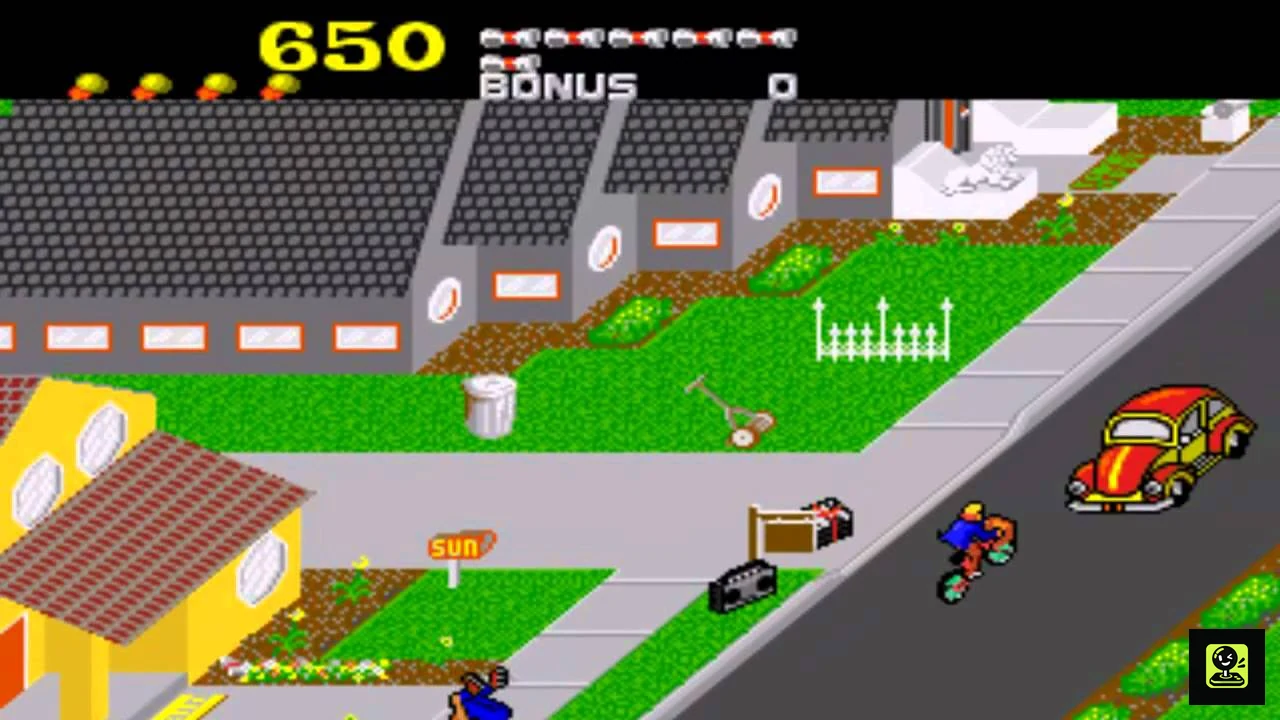
Paperboy on Sega Genesis is a constant-motion delivery game. The Control Pad moves the bike laterally or diagonally, Up accelerates, Down applies the brakes, and A, B or C throws a paper. Because the bike continues moving, accurate deliveries come from slowing before the target and making small steering corrections rather than trying to park. At the start of each day, the route display identifies subscribers and non-subscribers, and the houses retain those visual distinctions during play. The HUD tracks score, lives and remaining papers. Required subscriber deliveries go to the paperbox, porch or door; non-subscriber windows and environmental targets are optional scoring opportunities. A perfect delivery is the confirmed reliable way to add a subscriber through the Daily Report. Missing a subscriber or damaging that subscriber’s house can remove the subscription for the following day. References for the Genesis version disagree about whether damaging a non-subscriber directly converts that house, so do not depend on that outcome.
Learn movement and speed control
The bike advances automatically along the route. Press Left or Right to move laterally, Up to accelerate and Down to apply the brakes. Up/Left and Up/Right move diagonally, which is useful when shifting between the sidewalk and road or correcting your line toward a house. Releasing the directional input does not stop the bike; it produces a gradual slowdown. Treat braking as controlled deceleration, not as a way to park.
Use short directional taps instead of holding a turn through an entire block. On an open stretch, accelerate only enough to maintain progress. When a subscriber house, obstacle or crossing appears, release Up early and press Down to reduce speed. Then make a small lateral or diagonal correction, release the direction to settle the bike and reassess the next hazard. This creates a slower, nearly stationary-looking throwing approach without claiming that the bike can fully stop.
Practice the basic rhythm on the first route: accelerate through a clear section, release Up, tap Left, Right, Up/Left or Up/Right to line up with the target, brake as the house approaches, throw once and steer away before reaching the property. This rhythm is safer than trying to correct sharply while already beside the house.
- Left and Right move the bike laterally.
- Up/Left and Up/Right provide diagonal movement.
- Up accelerates.
- Down applies the brakes.
- Releasing the directional input causes a gradual slowdown.
- The bike keeps moving, so braking replaces a fully stationary throwing position.
Throw papers with A, B or C
Press A, B or C to throw a paper. The Genesis control reference lists all three face buttons for the same basic throwing action, so choose the button that lets you keep your thumb comfortable while controlling the pad. Every throw uses part of the available paper supply, so repeated attempts at one house can leave you short later in the route.
For a required subscriber delivery, begin slowing before the house reaches the throwing position. Aim at the paperbox when its line is clear because that is the most precise target. If the box is difficult to reach safely, aim for the porch or door instead. Make one deliberate throw, then steer away from the house. Do not continue firing as you pass it: extra papers can waste supply or strike a subscriber’s window.
A slow approach also improves defensive throws, but do not assume every obstacle responds to a paper. Spend papers offensively only when the target is known to react and the throw will not interfere with the next required delivery.
- A, B and C throw papers in the Genesis version.
- Each throw reduces the available paper supply.
- Slow down before a precise paperbox or porch shot.
- Prioritize one deliberate attempt over repeated throws.
- Do not spend papers automatically on every obstacle.
Read the route display, house colors and HUD
Before the route begins, study the neighborhood display. It shows the order of the houses and distinguishes subscribers from non-subscribers. During the route, the houses retain their status-indicating colors, so use both the opening display and the houses themselves to identify where required deliveries must be made. Do not treat every visible window as a required target.
During play, monitor the score, remaining lives and paper supply. Lives are your collision margin. Papers cover required deliveries, optional window hits and any defensive throws. If the paper supply is low, stop pursuing optional points and preserve enough for the marked subscriber houses still ahead. A paper bundle is useful only when you can approach it without entering the path of an immediate hazard.
After the Training Course, read the Daily Report. It shows the result of the day and identifies subscriber houses affected by missed deliveries or property damage. A clean delivery result preserves the current route and is the reliable condition for adding a subscriber. Because the exact effect of damaging a non-subscriber is disputed between Genesis references, do not build a route plan around converting one through window damage.
- Use the opening route display to identify subscribers.
- Use house colors as an in-route confirmation.
- Monitor score, lives and remaining papers.
- Collect a paper bundle only when the approach is safe.
- Use the Daily Report to confirm the day’s delivery result.
- Treat a perfect delivery as the dependable route to an additional subscriber.
Separate required deliveries from optional damage
A successful subscriber delivery is a paper reaching that house’s paperbox, porch or door. These are the throws that protect the subscription and satisfy the route objective. A non-subscriber window is an optional score target, not a substitute for delivering to a subscriber. Environmental targets can also provide scoring opportunities, but they should never take priority over a required house or an approaching hazard.
Missing a subscriber or damaging that subscriber’s property can cause the customer to cancel for the following day, which is reflected in the Daily Report. A perfect delivery is the confirmed reliable way to add a subscriber. Some Genesis references disagree about whether damaging a non-subscriber directly causes that house to become a subscriber later; leave that result to the game’s report rather than assuming it will happen.
Use this priority order while learning: deliver to every marked subscriber, avoid damage to subscriber property, preserve lives and papers, collect safe bundles, then attempt non-subscriber windows or environmental targets. If traffic, an obstacle or a low paper count makes an optional throw risky, skip it. Optional points can be recovered on a later replay, while a lost life or cancelled subscriber weakens the current week.
- Paperboxes, porches and doors are the required subscriber targets.
- Non-subscriber windows and environmental targets are optional scoring opportunities.
- Missing or damaging a subscriber can cause cancellation on the following day.
- A perfect delivery is the reliable way to add a subscriber.
- Do not rely on disputed direct conversion from non-subscriber damage.
- Prioritize required deliveries, survival and paper conservation over optional points.
Before you move on
- You can accelerate, decelerate and steer laterally without drifting into the next hazard.
- You can use diagonal movement when a straight lateral correction is insufficient.
- You understand that the bike keeps moving and that braking creates a controlled throwing approach.
- You can use A, B or C for a deliberate paper throw.
- You can identify subscriber houses on the opening route display and by their route colors.
- You can monitor score, lives and paper supply during the route.
- You can distinguish a paperbox, porch or door delivery from optional non-subscriber window damage.
- You understand that missing or damaging a subscriber can cause cancellation on the following day.
- You understand that a perfect delivery is the reliable way to add a subscriber through the Daily Report.
- You know that Genesis references disagree about any direct subscriber conversion caused by damaging a non-subscriber, so you do not rely on it.
Scoring, Subscribers and Fail-State Rules
Paperboy’s safest scoring plan is to protect the subscriber route first and pursue optional targets only when they do not endanger the bike or paper supply. Deliver each active subscriber’s paper to the paperbox, porch or door. Non-subscriber windows and environmental objects can provide extra points, but they are not replacements for required deliveries. Missing a subscriber or damaging that subscriber’s house can cause a cancellation on the next day. A complete, undamaged delivery day can preserve the route and add a subscriber. Genesis-specific references do not agree on every possible non-subscriber conversion behavior, so do not rely on it. Route collisions cost lives, paper bundles replenish the supply, and losing all lives or the remaining subscriber route ends the attempt. Use the Daily Report to check the result of each day, then adjust the next route around the subscribers who remain.
Separate required deliveries from optional scoring
Subscriber houses are the required targets. Identify them from the opening route display and aim for the paperbox, porch or door rather than deliberately throwing through the window. A controlled delivery protects that house from the most common cancellation risk and contributes to the day’s delivery result. Approach on a stable line, slow when the house is close, and make one deliberate throw instead of scattering papers while crossing the street.
Non-subscriber houses are optional scoring opportunities. Their windows may be broken for points, but doing so does not count as serving a subscriber. A non-subscriber shot also consumes a paper and can pull you toward traffic or the next obstacle. During an early attempt, skip the shot unless the target is already aligned and the throw will not interfere with the next required delivery.
- Deliver active subscribers at the paperbox, porch or door.
- Do not count a subscriber window hit as a reliable delivery.
- Treat non-subscriber windows as optional points only.
Use the correct scoring priorities
Required delivery and optional damage are separate scoring categories. A paperbox shot is the strongest delivery target described for the Genesis version, while a porch or door hit can also complete the service. The precise value of each target is not necessary for completing the week, so prioritize a reliable delivery over a risky attempt at a higher-value location.
The route also contains optional objects such as non-subscriber windows and environmental targets. These can reward accurate throws, but they do not replace a subscriber delivery. If a target requires crossing into traffic, braking beside an obstacle or spending several papers, leave it alone. Score improvement should begin only after the required route is dependable.
- Prioritize subscriber service before bonus targets.
- Use one controlled throw whenever possible.
- Avoid chasing optional points across traffic or hazards.
Read the Daily Report after every day
After the street route and Training Course, the Daily Report shows the outcome for the day. A subscriber who did not receive a paper, or whose house was damaged, can cancel for the following day. That reduces the number of houses on the route, but it also moves the run closer to losing the remaining subscriber route entirely.
If all current subscribers are served without damaging their houses, the game can preserve the customer list and add a subscriber for the next day. Treat this as the dependable route-building strategy. Genesis-specific references differ on whether some non-subscriber actions can directly influence future subscriptions, so do not make such a conversion part of your plan. Use the report to confirm which houses remain active before beginning the next route.
- Inspect the Daily Report after the Training Course.
- Expect a missed or damaged subscriber to be at risk of cancellation.
- Build the route through complete, undamaged delivery days.
Manage papers as a limited resource
Every throw uses one newspaper from the route supply. Paper bundles placed along the street replenish your supply when you ride over them, making them important when several subscriber houses remain ahead. Do not cut across a vehicle, obstacle or dangerous lane merely to collect one. A bundle is useful only if reaching it does not create a greater chance of losing a life.
When the paper count becomes low, stop taking non-subscriber windows and scenery targets. Reserve the remaining papers for the next active subscribers. If a bundle is poorly positioned, continue along the safer line and accept the missed refill rather than risking a collision that can also disrupt later deliveries.
- Check the paper supply before optional throws.
- Collect bundles only when the approach is clear.
- Reserve papers for active subscriber houses.
Understand collision and route failure
A collision on the main street route costs a life. Cars, moving hazards and fixed obstacles can all punish a line that is too aggressive, so do not trade a life for a difficult target or a dangerous bundle. A crash can also leave the bike exposed to another hazard, making recovery more important than immediately attempting the missed throw.
After a collision, steer toward the clearest open section, reduce speed and rebuild a stable line. Abandon the optional target that caused the mistake if another hazard is approaching. Losing all lives ends the attempt. The route can also end if cancellations remove the remaining subscriber base, even if lives remain, so survival and subscriber protection must be managed together.
- Treat every street collision as a life loss.
- Re-center in an open line before throwing again.
- Protect both lives and the remaining subscriber route.
Treat the Training Course as bonus scoring
Completing the street route leads to the Training Course, a separate obstacle-and-target section. It can award bonus points through target throws and successful movement through ramps and obstacles, but it does not replace a missed subscriber delivery. Enter it with the goal of reaching the finish safely before attempting difficult shots.
Use the course to practice controlled throws and obstacle judgment. Take targets that are already aligned, preserve enough steering control for the next obstacle, and abandon a throw when it threatens the finish. The course is valuable for score improvement, but the Daily Report that follows is where you check subscriber losses and additions.
- Reach the Training Course by surviving the street route.
- Finish safely before attempting risky bonus throws.
- Check the Daily Report after the course.
Adopt a survival-first scoring policy
For a first full-week attempt, measure success by reaching later days with lives, papers and subscribers intact. Complete the required deliveries, collect safe bundles and take optional targets only when they do not change your route line. A clean delivery day gives you a stronger foundation than an early high score followed by cancellations or crashes.
After you can consistently reach Sunday, add optional scoring in stages. First improve subscriber delivery reliability. Then take safe non-subscriber windows or environmental targets that lie directly along the route. Finally attempt more demanding Training Course shots. The campaign objective is secured by surviving Sunday’s route and completing its Training Course, not by maximizing optional damage on every day.
- Reach later days before pursuing aggressive score routes.
- Keep at least one life and enough papers for upcoming deliveries.
- Finish Sunday’s Training Course to confirm the full-week attempt.
Before you move on
- Complete a route and inspect the Daily Report for missed or damaged subscribers.
- Finish at least one route with every active subscriber served and no subscriber house deliberately damaged.
- Collect paper bundles when the approach is safe and retain a life for later routes.
- Survive through Sunday and complete its Training Course.
- Confirm that the successful run reaches the full-week objective without exhausting all lives or losing the subscriber route.
Route Structure: Weekdays and Bonus Training Courses
The original Sega Genesis version of Paperboy organizes its main campaign into seven daily routes, beginning on Monday and ending on Sunday. Each completed residential route leads to a separate Training Course where you navigate obstacles, throw papers at targets and earn bonus points. The route and course have different priorities: the route tests subscriber deliveries, paper management and survival, while the course gives you a separate opportunity to practice movement and throwing. For this guide, a day counts only after both its residential route and its Training Course are finished. Sunday is the seventh and final scheduled route. Complete the Sunday route, reach the end of the Sunday Training Course and allow the results information to appear. Any later attempt is for improving score, subscriber retention, delivery consistency or course performance; do not treat an unsupported eighth day or post-Sunday cycle as required progress.
Play the seven routes in weekday order
Begin with Monday and continue through Tuesday, Wednesday, Thursday, Friday, Saturday and Sunday. Each day presents a residential delivery route with subscriber houses, non-subscriber houses, hazards and papers to manage. Your immediate objective is to reach the end of the route while delivering to subscribers and avoiding crashes.
Treat the weekdays as one campaign sequence rather than unrelated stages. A missed subscriber delivery or damage to a subscriber house can affect the following day, while clean deliveries help preserve your route. Optional window hits and environmental targets can raise the score, but they are never more important than protecting a subscriber delivery or keeping the bike on a safe line.
- Start on Monday.
- Play the days in order through Sunday.
- Protect subscriber deliveries before attempting optional targets.
- Reach the end of each residential route.
Enter the separate Training Course after each completed route
After a route is completed, Paperboy enters that day's Training Course. This is a separate obstacle-and-target bonus section, not another subscriber street. Use it to practice throwing while moving, read the isometric approach to obstacles and collect additional points by taking targets that are safely aligned.
Choose a stable line before attempting a target. Steer around obstacles rather than making a late correction, and throw only when the target is clearly positioned relative to the bike. The Genesis sources confirm the course's obstacle, target and bonus-point role, but they do not establish every supply or failure rule for this edition. Do not assume unlimited papers, replenishment, exact target values or ramp behavior from another version.
For this guide, count the Training Course as complete only when Paperboy reaches its finish. Entering the course or scoring during its opening section is not enough to mark that day cleared.
- Enter the Training Course after each completed route.
- Treat it as a separate obstacle-and-target section.
- Use stable approaches for ramps, targets and obstacles.
- Reach the finish before counting the course as cleared.
Use the results information to separate route progress from bonus performance
After the route and Training Course sequence, review the results information before starting the next day. Use it to identify subscriber losses, missed deliveries and other mistakes that need correcting. Do not judge the run only by its course score: a strong bonus section does not repair a missed subscriber delivery.
Record the two parts of the day independently. If the route was completed but the Training Course was not finished, the day is not complete for this guide. If the course was finished but subscriber deliveries were poor, the campaign can continue, but the next day's subscriber situation may be worse. This distinction makes it easier to choose between route practice and throwing practice.
- Allow the day's results information to appear.
- Review subscriber and delivery outcomes.
- Record route completion separately from course completion.
- Choose the next practice priority from the result.
Expect the same route-to-course structure as the week becomes harder
The broad sequence remains consistent across the week: residential route first, Training Course afterward, then results information. Later days demand more careful steering and hazard reading, but they do not introduce a separate campaign type or a new progression path. Use the early days to establish a repeatable rhythm that can survive the denser hazards later in the week.
On every route, accelerate only across clear space, brake before a hazard rather than beside it and make one deliberate subscriber throw instead of repeatedly correcting a rushed attempt. Skip optional targets whenever they would pull you toward traffic, a fixed obstacle or an awkward delivery angle.
- Remember the route, Training Course and results sequence.
- Expect later routes to require more careful hazard management.
- Build a repeatable delivery rhythm on early days.
- Skip optional scoring when it threatens survival.
Reach Sunday as the final scheduled route
Sunday is the seventh residential route and the end of the scheduled weekday sequence. The Genesis version uses heavier Sunday papers, so use smaller steering corrections and avoid abrupt lateral movements while lining up deliveries or passing hazards. Entering Sunday with extra lives and papers is useful preparation, but it is a strategy goal rather than a separate progression requirement.
During the route, set up subscriber throws before reaching the delivery point. If a porch or paperbox is beside traffic or another obstacle, make one controlled attempt and return immediately to a safe line. Do not chase a non-subscriber window when the detour could cause a crash or leave the next subscriber approach misaligned.
- Reach Sunday as the seventh route.
- Adjust to the heavier Sunday paper handling.
- Complete the subscriber deliveries that remain.
- Survive the route and enter the final Training Course.
Finish Sunday’s Training Course and confirm the full clear
After the Sunday residential route, play the final Training Course with the same survival-first approach used on earlier days. Select stable paths through the obstacles, take clearly aligned targets and preserve the line toward the finish. The completion goal requires reaching the end of this course, not merely entering it or earning points during part of the attempt.
When the Sunday course is finished, allow the results information to appear. Confirm that the run contains seven completed residential routes and seven finished Training Courses: Monday, Tuesday, Wednesday, Thursday, Friday, Saturday and Sunday. That completes the scheduled campaign scope for this guide. Replay only to improve the score, preserve more subscribers, refine delivery lines or make the Training Courses more consistent.
- Complete the Sunday residential route.
- Reach the Sunday Training Course finish.
- Allow the Sunday results information to appear.
- Confirm seven completed routes and seven finished Training Courses.
- Treat later attempts as replay and score improvement.
Before you move on
- Monday residential route completed.
- Monday Training Course finish reached.
- Tuesday residential route completed.
- Tuesday Training Course finish reached.
- Wednesday residential route completed.
- Wednesday Training Course finish reached.
- Thursday residential route completed.
- Thursday Training Course finish reached.
- Friday residential route completed.
- Friday Training Course finish reached.
- Saturday residential route completed.
- Saturday Training Course finish reached.
- Sunday residential route completed.
- Sunday Training Course finish reached.
- Sunday results information allowed to appear.
- The final run contains seven completed residential routes and seven finished Training Courses.
- No unsupported eighth day or post-Sunday campaign cycle was required.
Starting Out: Monday — Basic Route and Safe Lines
Monday is the best day to build a repeatable delivery rhythm before later routes add denser hazards. Select the easiest of the three difficulty choices while learning, then use the subscriber display to identify which houses require deliveries. Keep a central line on the sidewalk when it is open, brake before delivery clusters and obstacles, and make one deliberate throw at each subscriber’s paperbox, door or porch. Do not treat every house as a target: non-subscriber windows are optional score opportunities and are not worth risking a subscriber or a life. Collect newspaper bundles only when they lie on a clear line, and recover from mistakes by re-centering before attempting another throw. The goal is to finish Monday with subscribers preserved, papers in reserve and enough control practice to make Tuesday manageable.
1. Select Monday and read the subscriber display
Start on Monday and choose the easiest available difficulty while learning the route. The Genesis version offers three difficulty choices, so use the least demanding option until your steering and braking are consistent. Before the ride begins, study the displayed houses and identify the subscribers you must serve. Subscriber houses are the delivery priority; darker non-subscriber houses are optional targets for breakage points.
Do not try to memorize an unsupported tile-by-tile route. Instead, remember the order of landmarks that appear as you advance: driveways, mailboxes, parked cars, trash cans and unusual yards. Use the landmark immediately before a subscriber house as your visual reminder to slow down and prepare the throw.
- Choose the easiest difficulty while learning.
- Identify subscriber houses before the bicycle begins moving.
- Use landmarks rather than attempting to memorize exact tile positions.
2. Establish a controlled sidewalk line
Begin near the middle of the open sidewalk rather than scraping the curb. The curb-side edge is often where parked cars, mailboxes and other obstructions compress your path, while drifting too far inward can send you into yards or buildings. Make small Left or Right corrections, and use diagonal direction inputs when you need to shift while continuing up the route.
Up accelerates the bicycle and Down applies the brakes. Releasing the direction pad does not stop the ride instantly; it lets the bicycle slow gradually. Use that natural slowdown before a house cluster, then apply Down when you need a firmer reduction in speed. If the sidewalk is blocked, move toward the grass or roadway early and return to the sidewalk after the obstruction instead of making a last-second diagonal cut.
- Keep a modest amount of space from the curb.
- Use small steering corrections.
- Release the direction pad or press Down before narrow sections.
3. Deliver to subscriber paperboxes and doors
As a subscriber comes into view, reduce speed and line up with the delivery side of the street. The preferred target is the subscriber’s paperbox. A paper that reaches the porch or door can also count, but a throw through the window is not a successful delivery and can cost that subscriber. Press A, B or C once for a controlled throw, then steer back toward your clear line.
Avoid repeated presses while passing the same house. Every unnecessary throw consumes part of your limited supply and increases the chance of striking property. If the next house is a non-subscriber, leave it alone unless the path is completely safe and you are intentionally taking an optional breakage shot. Survival and subscriber preservation are more valuable than early window points.
- Aim for the paperbox first, then the door or porch if that is the safer line.
- Use one deliberate throw per delivery.
- Do not vandalize a subscriber house for points.
4. Pass parked cars, trash cans and dogs
A parked car narrows the sidewalk, so brake before reaching it and choose the open side while you still have room to steer. Trash cans should normally be avoided rather than challenged. Shift early, pass with lateral space and return toward the sidewalk center once the object is behind you. Keep checking the road while doing this, because traffic can turn a sidewalk detour into a collision.
Dogs are moving hazards, not automatic paper targets. Watch their approach and either brake to let the timing change or steer around them using the clearest available side. Do not spend a paper on a dog unless the game clearly presents a safe, responsive throw and making that throw is less dangerous than dodging. On Monday, learning the avoidance line is more useful than chasing bonus points.
- Brake before parked cars and narrow trash-can gaps.
- Avoid dogs unless a defensive throw is clearly safer than steering away.
- Look beyond the immediate obstacle before changing lanes.
5. Collect bundles only on a clear approach
Extra newspaper bundles appear along the route and replenish your supply. Treat each bundle as an opportunity, not a command to cross traffic. Collect one when it lies naturally along your current line or when the road ahead is visibly open. Slow enough to pass over it cleanly, then immediately prepare for the next subscriber.
If a bundle sits beside a moving car, dog or tightly packed obstacle group, leave it behind. A risky pickup can cost a life and remove more future deliveries than the extra papers are worth. Monday is the right day to learn which bundles can be collected without changing lanes sharply; later routes reward that discipline.
- Take bundles from straight, open approaches.
- Do not cross into danger for a marginal paper refill.
- After a pickup, look immediately for the next delivery or obstacle.
6. Recover after a collision or missed delivery
After a collision, first re-center in the clearest lane and reduce speed if another obstacle is close. Do not throw immediately just because a subscriber is on screen; confirm both the delivery target and the path in front of the bicycle. A panic throw can waste papers or damage the next subscriber’s property.
If a delivery is missed, continue forward and use the next driveway, mailbox or distinctive yard to recover your rhythm. Do not make a dangerous reverse correction. The Genesis route keeps advancing, so accepting one missed house is safer than turning a mistake into another crash. Finish the route, enter the training course, and use that separate obstacle section to practice one brake-and-throw sequence before Tuesday.
- Re-center and scan after every crash.
- Do not attempt a hazardous correction for a missed house.
- Reach the training course and practice controlled braking and throwing.
Before you move on
- Complete Monday’s delivery route and enter the training course.
- Preserve enough lives to continue into Tuesday.
- Deliver successfully to several subscriber paperboxes, doors or porches without intentionally striking subscriber windows.
- Collect at least one safe newspaper bundle when the approach is clear, while leaving dangerous bundles behind.
- Finish the training course and perform at least one controlled brake-and-throw practice sequence before starting Tuesday.
Tuesday–Thursday: Intermediate Hazards and Traffic Management
Tuesday through Thursday retain the Genesis version’s basic delivery loop while making the route less forgiving through denser combinations of moving hazards, houses and obstacles. The evidence supports recurring threats such as cars, motorcycles, dogs, lawnmowers, grates, skateboarders, breakdancers, fighters, drunkards and hearses, but does not establish a reliable fixed hazard script for each individual day. Play these routes by reading the next visible hazard, preserving a stable line and braking before crowded sections. Deliver a reachable subscriber house with one deliberate throw, then re-center before preparing the next throw. Optional window damage is never worth entering traffic or spending papers needed for subscribers. When a moving hazard blocks the normal sidewalk line, steer early into the visible open space and return only after the hazard has passed.
1. Begin each day at a controlled pace
Use the D-pad to establish a comfortable forward speed rather than immediately holding the fastest movement. The Genesis version gives you direct speed control and braking, so use the opening stretch to settle into a repeatable rhythm: move forward, make small left or right corrections, and release or press Down when the route becomes crowded.
Do not assume that Tuesday, Wednesday or Thursday introduces one specific new obstacle in a fixed location. Instead, identify the next subscriber house, the next moving hazard and the next open escape space. This keeps the route plan valid when the same day presents a different-looking combination of objects or when you replay at another difficulty.
- Use small steering corrections instead of broad zigzags.
- Brake before a crowded group, not after entering it.
- Read the next house and hazard together before throwing.
2. Separate moving hazards from fixed obstacles
Cars and motorcycles should be avoided by creating space early. Watch the object’s travel direction, reduce speed if the available gap is narrow, and steer toward the clearest visible side of the route. Do not cut across the object’s path at the last moment to reach a house.
Dogs, lawnmowers, skateboarders and similar moving objects should also be treated as timing problems. Hold a predictable line while you observe their approach, then pass through the open space after braking or steering early. The Genesis-specific material confirms these hazards, but it does not support treating every one as stoppable with a thrown paper.
Grates, breakdancers, fighters, drunkards and hearses can turn a normal delivery line into a blocked section. If a fixed or slow-moving obstacle occupies the direct path, use the visible open pavement or yard space rather than forcing a throw from an unsafe angle. Return to the delivery line only after the obstruction is behind you.
- Avoid cars and motorcycles; do not test them with papers.
- Use braking and early steering against dogs and lawnmowers.
- Treat grates, hearses and sidewalk activity as route-blocking hazards when they occupy your line.
3. Deliver through a cluster without oversteering
When several subscriber houses appear close together, choose the nearest reachable porch, door or paperbox from your current line. Slow slightly, align the bicycle with the target side and press A, B or C once. After the throw, keep moving forward and re-center; do not make a sharp reverse correction merely to set up a second house.
A subscriber delivery is the priority. The Genesis port rewards damaging non-subscriber houses, but a window shot is optional and does not justify crossing traffic, entering an obstacle or using several papers on one difficult target. If a non-subscriber window is already beside your safe line, take the shot only after the subscriber delivery is secure.
- Take the safest reachable subscriber target first.
- Use one controlled throw rather than repeated guesses.
- Attempt a non-subscriber window only from an already safe position.
4. Use straight sections to reset your position
A short clear stretch is a recovery point. Release excess speed, return to a stable part of the route and scan for the next car, motorcycle, dog or lawnmower before accelerating again. The Genesis port does not require constant maximum speed; controlled forward movement gives more time to read the isometric road.
If a hazard approaches while you are preparing a delivery, abandon the throw and steer for survival. Missing one target is preferable to crashing, losing a life and beginning the next section out of position. After a collision, first regain a clear line, then resume deliveries. Do not immediately chase a paper bundle or optional window if the next hazard is still close.
- Use clear straightaways to stabilize speed and alignment.
- Cancel a risky throw when a moving hazard enters the same space.
- After a crash, re-center before collecting papers or attacking another target.
5. Finish Thursday by preserving the run
The route objective is to reach the end of Thursday and enter its training course, not to maximize every available window. Keep enough papers for subscriber houses, avoid spending multiple throws on targets that are moving away, and choose survival whenever the direct delivery line is blocked.
At the end of the route, use the training course as a controlled practice opportunity. It is separate from the street hazards and is intended for throwing at targets while avoiding obstacles. Do not take unnecessary street-route risks late in the day merely to improve the score; completing the day preserves the week’s progress and lets you continue to Friday.
- Reach the Thursday route finish rather than chasing optional points.
- Enter the bonus training course with papers and a life intact when possible.
- Treat the training course as practice for aim and movement, not as a requirement to prove a specific score.
Before you move on
- Complete Tuesday, Wednesday and Thursday and reach the bonus training course after each route.
- Demonstrate a consistent response to cars, motorcycles, dogs and lawnmowers by braking, creating space or steering around them rather than relying on unverified paper effects.
- Deliver reachable subscriber houses with deliberate A, B or C throws while avoiding unnecessary repeated attempts.
- Finish Thursday with enough route discipline to continue into Friday without treating optional non-subscriber window damage as a progression requirement.
Friday–Saturday: Heavy Traffic, Risk-Reward, and Newspaper Management
Friday and Saturday are the point where reliable survival matters more than destroying every non-subscriber house. Later-week routes place greater pressure on steering, traffic awareness and paper management, so treat subscriber deliveries as mandatory and window damage as optional. Collect paper bundles only when the approach and the space beyond them are clear. Use Down before hazards, make one controlled steering correction, then return to a stable sidewalk line. By the end of Saturday, the goal is a completed route, preserved subscribers, disciplined paper use and a specific correction to carry into Sunday’s heavier paper handling.
1. Establish a safe line before chasing points
At the beginning of Friday and Saturday, review the route display and note which houses are subscribers. During the run, keep the rider close to the sidewalk or curb-side line that gives the clearest view of the next house and obstacle. The Genesis controls use Left and Right for lateral movement, Up to increase speed and Down to brake. Releasing the direction allows the bicycle to slow gradually, but it continues moving along the route.
Later days introduce greater hazard pressure, so do not treat every visible target as an obligation. If a non-subscriber window requires moving toward traffic or crossing the path of an obstacle, stay on the safe line and let it go. A missed bonus target costs points; a collision costs a life and may leave the bicycle badly positioned for the next hazard.
- Review the subscriber order before the route begins.
- Use the clearest sidewalk-side line as the default.
- Brake before a hazard becomes level with the bicycle.
2. Protect subscriber deliveries
Subscriber houses are the priority. Aim for the paperbox when one is visible; otherwise aim for the porch or door. Slow slightly before the frontage so the throw can be judged against the isometric angle, then make one measured attempt. A subscriber who is missed or whose house is damaged can cancel for the following day, so do not use a subscriber window as a convenient target.
Non-subscriber windows are optional score opportunities. Attempt one only when the bicycle is already aligned and the throw does not compromise the next delivery. If the angle is poor, keep riding. Do not spend several papers trying to repair one missed shot while subscriber houses remain ahead.
- Deliver to subscriber paperboxes, porches or doors first.
- Never deliberately target a subscriber window.
- Skip optional window damage when the line is unsafe.
3. Pick up bundles without entering a collision line
Paper bundles replenish the route supply, but they are not worth a blind turn. Before moving toward one, look beyond it for cars, fixed obstacles and the next subscriber frontage. Use a shallow lateral adjustment and brake if needed, then pass over the bundle while preserving room to steer away from the following hazard. If the bundle requires a last-second diagonal cut across traffic, leave it and continue with the papers already in hand.
When a bundle lies beside a subscriber house, combine the actions only when they use the same safe approach. Ride over the bundle, stabilize the bicycle and throw toward the paperbox or porch as the frontage enters range. If the delivery requires a large sideways movement, prioritize the delivery line or survival instead of forcing both actions.
- Inspect the space beyond every bundle before turning.
- Approach with a shallow movement and an escape lane.
- Combine pickup and delivery only when the same line serves both.
4. Brake before moving hazards and intersections
When a car or other moving hazard approaches, press Down early to reduce forward movement. Watch its path, then make one deliberate dodge rather than several quick corrections. At intersections, slowing gives more time to judge crossing traffic. Once the hazard has passed, ease back toward the sidewalk and regain a predictable line before attempting another throw.
Some moving threats, including dogs and certain riders or vehicles, can respond to a well-placed paper. Use a defensive throw only when the threat is aligned and the paper will not be needed for an upcoming subscriber. Papers are not a universal defense: fixed barriers, grates, parked objects and broad obstacle groups should be handled with braking and steering.
- Slow before an intersection or large steering change.
- Use one clean dodge whenever possible.
- Do not assume every hazard can be stopped with a paper.
5. Tighten paper management on Saturday
Check the remaining-paper indicator after each group of houses. When the supply begins to fall, stop taking optional window shots and reserve papers for subscriber boxes, porches and doors. Do not throw while the target is still too far away; wait until the frontage is readable and one controlled toss has a realistic chance to land.
If traffic or an obstacle partly blocks a subscriber house, slow down and wait for a safer opening rather than throwing blindly. A missed subscriber can affect the next day’s route, while skipping a non-subscriber window sacrifices only bonus points. The safest score improvement comes from accurate deliveries and successful bundle pickups, not repeated attempts at one difficult window.
- Monitor the paper supply throughout Saturday.
- Reserve the remaining papers for subscribers when supplies shrink.
- Throw from a clear, readable approach rather than from long range.
6. Finish Saturday without spending the run
Once the final houses are behind you, avoid turning a successful route into a needless collision while chasing one last window or bundle. The route leads to the Training Course, where targets and jumps provide bonus scoring and practice without the normal route-life penalty. Use the course to rehearse controlled throws, but stop forcing attempts when the approach is poor.
After Saturday, identify the two mistakes that caused the most trouble on Friday and Saturday. Examples include braking too late, turning toward a bundle without checking ahead or spending papers on optional windows. Carry a simple correction into Sunday: brake sooner, keep the outside line, or abandon bonus damage whenever the shot is not immediately safe. Sunday’s heavier paper stack makes stable alignment and deliberate handling more important than reckless speed.
- Complete Saturday’s route and Training Course.
- Preserve subscribers instead of forcing a final bonus shot.
- Enter Sunday with a specific correction for your most common mistake.
Before you move on
- Friday and Saturday routes are completed with subscriber deliveries prioritized over optional window damage.
- Paper bundles are collected only when the approach and the space beyond them are visible.
- Down is used to slow before intersections, moving hazards and difficult approach lines.
- When paper supplies shrink, optional window shots are abandoned in favor of subscriber deliveries.
- The Saturday route and Training Course are completed without an avoidable final collision.
- A concrete Sunday adjustment is identified, such as earlier braking, a steadier sidewalk line or stricter paper conservation.
Sunday: Heavy Papers and Survival Strategies
Sunday is the seventh and final delivery route. Its papers are heavier than those used earlier in the week, so they travel more slowly after a throw and require earlier, more deliberate deliveries. The bicycle keeps its normal Genesis controls; the difficulty comes from having less time to complete a throw, steer away, and recover when a target is near an obstacle. Begin Sunday with at least one life preserved and enough papers reserved for subscriber houses. Treat busy driveways, long stretches with moving traffic, and ramp-and-obstacle combinations as survival sections: hold a predictable line, brake before committing, and make only one controlled correction after danger passes. Prioritize subscriber deliveries over optional windows and dangerous bundle pickups. Reaching the end of Sunday leads to the final Training Course. Treat that section as a separate obstacle-and-target bonus stage, prioritize reaching its finish, and skip difficult shots when they threaten your line. Completing both Sunday’s delivery route and its Training Course satisfies this guide’s full-clear objective.
1. Enter Sunday with a reserve
Start Sunday with survival as the priority. Preserve at least one life and keep enough papers available for subscriber houses. Missing a subscriber or damaging that subscriber’s house can affect the next day’s route, so the final scheduled route is a poor place to spend papers on optional windows or uncertain defensive throws.
Do not leave a safe line merely to collect a bundle. Pick up a bundle only when it lies directly on your current path and the approach is clear. A missed optional pickup is preferable to a collision that costs a life or leaves you badly positioned for the next hazard.
- At least one life remains when Sunday begins.
- Papers are reserved for subscriber deliveries.
- Bundles requiring a dangerous crossing are skipped.
2. Adjust for slower Sunday throws
Sunday papers are heavier and travel more slowly after they leave the bicycle. This changes delivery timing, not the basic steering controls. Give a porch, door, or paperbox more lead room than you would on an earlier day, especially when the target is close to a driveway or moving hazard.
Use a steady rhythm: align with the delivery side, reduce speed when necessary, throw once, and immediately return your attention to the route. Do not repeatedly fire at a target after a mistimed attempt. Extra throws waste the supply needed later and can distract you from an approaching vehicle or obstacle.
- Allow more travel time for every Sunday paper.
- Stabilize your line before throwing.
- Avoid repeated attempts at one target.
3. Cross busy driveways defensively
A busy driveway can combine a subscriber house, a vehicle path, and a narrow escape route. Check the opening before committing to the delivery. If a car is entering or the approach is blocked, hold your current line and pass through instead of swerving across the route for a porch shot.
Keep lateral space available for an evasive move. When the approach is clear, make the delivery from the lane you already occupy, then re-center only after the driveway and vehicle path are behind you. A safe miss is better than a collision followed by a second mistake.
- Look for vehicle movement before throwing.
- Keep an escape lane open.
- Accept a missed delivery when the approach is blocked.
4. Use long straightaways to reset
After avoiding a car, dog, motorcycle, pedestrian, or another moving hazard, use the next open stretch to restore a predictable line. Maintain a steady pace instead of alternating rapidly between acceleration and braking. During this reset, identify the next subscriber cluster and decide whether the nearest bundle is genuinely safe to collect.
Do not make an immediate second lateral move after a dodge. Another hazard may follow the first, and a hurried correction can place the bicycle directly in its path. Let the screen clear, make one deliberate adjustment, and then prepare for the next throw.
- Re-center during open roadway.
- Wait before collecting a nearby bundle.
- Avoid weaving immediately after an evasive move.
5. Treat ramp-and-obstacle combinations as survival sections
When a ramp appears with a wall, gap, ditch, narrow turn, or another obstacle, choose your entry and exit line before entering the sequence. Hold a steady direction through the section and avoid last-second steering. Throw only when the target is clearly outside the obstacle path and the delivery will not compromise your route through the hazard.
If you emerge off-line, brake and make one measured correction after clearing the obstruction. Do not chain several rapid direction changes. Use the open space beyond the section to settle the bicycle before attempting the next subscriber delivery or bundle pickup.
- Choose the line before entering the obstacle sequence.
- Avoid last-second steering changes.
- Correct your position only after clearing the danger.
6. Finish Sunday and complete the final Training Course
Reaching the end of Sunday leads to the Training Course, a separate obstacle-and-target bonus section. Treat it as a final test of controlled movement and throwing rather than as a reason to take unnecessary risks. Choose stable lines, throw at targets that are clearly aligned, and skip a difficult target if the attempt could send you into an obstacle.
Keep moving toward the finish. Do not stop progressing because one target was missed, and do not assume that reaching the course entrance completes the week. For this guide’s full-clear objective, finish the Sunday Training Course after completing the Sunday delivery route.
- The Sunday delivery route is complete.
- The final Training Course has been entered.
- Stable lines are used through the bonus section.
- Risky target attempts are skipped when necessary.
- The Sunday Training Course is completed.
- Both Sunday and the final course are finished.
Before you move on
- Sunday is completed with at least one life preserved for the final route.
- Sunday’s heavier papers are handled with earlier throws and stable delivery lines.
- Subscriber deliveries are attempted from controlled approaches rather than through traffic.
- Busy driveways and long traffic stretches are crossed without unnecessary swerving.
- Ramp-and-obstacle combinations are cleared with deliberate steering.
- The final Training Course is reached.
- The final Training Course is completed by reaching its finish.
- The Monday-through-Sunday run and final course are both finished.
- Future score attempts can target two or three recurring Sunday hazards while keeping survival ahead of optional points.
The Bonus Training Course: How to Maximize Points
After each completed Paperboy delivery route, the Genesis version sends you to a separate Training Course. This bonus section combines ramps, targets and other obstacles, so it should be approached differently from a subscriber route. Establish a stable line toward the finish first, then attempt only targets that are close to that line and clearly visible. Use the course to practice straight throws, depth judgment in the isometric view, controlled steering and ramp alignment. Learn the forward route before adding optional detours. Once you can finish consistently, improve the score by adding nearby targets one at a time. Do not assume that every course has identical target placement, that papers are replenished, or that a failed attempt follows a particular recovery sequence. The dependable strategy is to finish safely, then expand your scoring route without allowing optional throws or jumps to disrupt your control.
Secure a forward line before chasing points
The Training Course begins after the day’s newspaper route and changes the objective from serving houses to crossing a separate obstacle section. At the opening, identify the clearest path toward the finish and keep the bicycle pointed along it. Use small steering corrections rather than sweeping across the course, especially where barriers, ramp edges or other obstacles narrow the available space.
On your first attempts, treat every target as optional. A missed target costs less than abandoning the forward route. Continue ahead whenever a target demands a sharp turn, a blind approach or a risky crossing of another obstacle. Learn the course’s safe line and its narrow sections before trying to add score opportunities.
- Choose a forward route immediately.
- Use small steering corrections in narrow sections.
- Skip any target that would break your safe line.
Take targets only from stable approaches
Targets are bonus opportunities, not delivery requirements. Approach a clearly visible target with the bicycle moving predictably, then throw while your line is stable. The Genesis game uses an isometric view, so judge the target by its apparent depth and lateral position rather than aiming only at the point where it appears on the screen.
Begin with targets beside the route you already know. After several reliable finishes, add one target from a slightly wider line and decide whether the extra points justify the added steering. If an obstacle partly hides the target, or the target sits beside a ramp edge, stay on the forward route instead of making a blind throw.
- Start with targets next to the established route.
- Throw while the bicycle is under control.
- Avoid targets hidden by obstacles or positioned beside unsafe edges.
Align with ramps before committing
Ramps are part of the obstacle course and may carry the bicycle over walls, gaps, water or other hazards. Line up with the usable face of a ramp before reaching it. Look beyond the ramp toward the landing area, because a successful jump can still leave the bicycle facing a barrier or another immediate obstacle.
If the ramp is poorly aligned, use a visible alternate path when one is available. Do not cut across the course at the last moment merely to force a jump. For an angled or crowded approach, make the steering correction early, then keep the bicycle steady through the ramp and landing.
- Align before reaching the ramp.
- Inspect the landing area and the next obstacle.
- Take an alternate route when the jump is not safely lined up.
Separate stationary and moving-target practice
For a stationary target, ride straight and throw while its position is easy to judge. This creates a repeatable reference for distance and angle. Repeat similar shots until you can make the throw without needing a large steering correction afterward.
If a moving target is visibly present in a particular course section, watch its direction before throwing and place the paper slightly ahead of its current position. Treat this as a separate drill from stationary targets: first learn the movement, then attempt the lead while preserving a safe riding line. Do not leave the forward route merely to search for a target that is not clearly available.
- Master a straight throw at a visible stationary target.
- Lead a moving target only when its motion is clear.
- Keep the next obstacle in view before throwing.
Abandon risky detours early
A course attempt becomes less useful when a target chase leaves the bicycle out of position for the next obstacle. If a detour requires a late turn, a blind landing or a sharp cross-course move, return to the safest forward line instead. Reaching the finish gives you a dependable base for later score improvement.
Near the final section, favor forward movement over last-second throws. Attempt a target near the finish only when the bicycle is already aligned and the throw will not interfere with the approach. Treat every optional jump or detour as a risk decision: take it only when the landing and recovery line are plainly safe.
- Return to the main line when a detour becomes awkward.
- Do not force a last-second jump or throw.
- Keep the finish route clear during the final section.
Build a repeatable scoring drill
After an unsuccessful attempt, identify the first decision that caused the problem: a late turn, poor ramp angle, blind throw or detour that disrupted the route. On the next attempt, change that one decision while keeping the rest of the approach familiar. This isolates the mistake instead of replacing the entire route with guesswork.
Once finishing is reliable, set a personal score goal based on a previous run. Add targets one at a time and stop expanding the route when the extra scoring attempt begins to reduce completion consistency. The strongest long-term routine is a dependable finish followed by controlled target practice, not an attempt to force every visible object.
- Identify the first mistake after each failed attempt.
- Change one technique on the next run.
- Add optional targets only after the finish is reliable.
Before you move on
- You can enter the Training Course and immediately choose a stable line toward the finish.
- You can reach the finish consistently without allowing optional targets to disrupt the route.
- You can hit nearby stationary targets without a sharp steering correction.
- You can judge a visibly moving target and lead the throw while maintaining a safe line.
- You can align with a ramp and inspect the landing before committing to it.
- You know when to abandon an optional target or detour to preserve forward progress.
- You can improve a course score by adding safe targets without making completion unreliable.
References for this chapter
Common Obstacles and How to Counter Them
The Genesis version mixes hazards that can sometimes be affected by a paper with threats that must be avoided through steering and speed control. Dogs, people and some moving hazards may be worth a defensive throw when the line is clear, but no throw should replace dodging cars, motorcycles, skateboarders, grates, hedges, tombstones, tornadoes or the Grim Reaper. After a crash, stabilize first, then resume deliveries; chasing a loose paper or bundle immediately can cause a second collision.
1. Establish a defensive line before the hazard reaches you
Use the D-pad to keep the bicycle in an open part of the route instead of hugging the curb or drifting into the street without a reason. Maintain a speed that leaves time to move sideways. When the path tightens, release forward input or press back briefly so you can make a controlled lane change rather than a panic turn.
Look beyond the nearest object. Cars, motorcycles, skateboarders and moving characters can push you toward a second hazard. If the route ahead contains two overlapping threats, prioritize the widest clear opening and accept a missed delivery rather than forcing a porch shot through danger.
- Keep an escape lane available.
- Reduce speed before a narrow section.
- Look past the first obstacle before choosing a direction.
2. Handle dogs with a throw only when the line is clear
Dogs are moving threats and can chase into your path. If a dog is approaching and there is open space around you, aim a single paper at the dog as a defensive attempt. Do not assume that one hit will always stop it in the Genesis version; the reliable response is still to create distance and steer away from the dog’s approach.
Never keep throwing while the bicycle is drifting toward a grate, hedge, tombstone or vehicle. If the dog is beside another hazard, abandon the throw and move around the entire cluster. Papers are limited during the route, so use a defensive throw only when it protects your line or avoids an immediate collision.
- Use one deliberate defensive throw at most.
- Keep steering priority over paper throwing.
- Dodge the whole cluster when a dog overlaps another hazard.
3. Dodge cars, motorcycles and skateboarders
Cars and motorcycles are collision hazards, not targets to neutralize. Slow down when one crosses your intended line and move toward the side with the most open pavement. If a vehicle is already close, braking is safer than accelerating through the gap. Do not drift toward traffic while trying to reach a subscriber’s porch or paperbox.
Skateboarders and similar fast-moving characters require the same treatment. Watch their direction, leave room for their approach and cross behind them only when the path is visibly open. A missed delivery costs less than a life, and a collision can leave you positioned for another impact.
- Brake for crossing vehicles.
- Choose the open side of the route.
- Do not throw at cars or motorcycles as if they were stoppable enemies.
4. Go around breakdancers, grates and fixed obstructions
Breakdancers and other moving sidewalk figures are safest to bypass with a wide turn. Their animation can make the collision area difficult to judge, so do not attempt a last-second pass through a narrow gap. Slow down, move around the outside and return to the delivery line after clearing them.
Grates, hedges and tombstones are fixed hazards. They cannot be solved by throwing a paper. Line up deliveries early when a clear angle exists, but steer away if the obstacle blocks the route. Treat the subscriber paperbox as a target to hit, not as an obstruction; reaching it is optional when the approach would cause a crash.
- Give breakdancers extra clearance.
- Steer around grates, hedges and tombstones.
- Do not sacrifice a life for a blocked delivery angle.
5. Escape tornadoes and the Grim Reaper
A tornado or dust devil is an emergency hazard that approaches from behind and can close the route quickly. Do not stop to aim at it. Increase forward speed when the path ahead is open, then make only the sideways movements needed to avoid the next fixed obstacle. Full-speed escape is useful only if it does not send you into a car, grate or tombstone.
The Grim Reaper can move into the route and block the sidewalk. Treat it as a moving barrier: slow enough to read the opening, then pass through the clearest side. If the tornado is behind you at the same time, prioritize the open route ahead and avoid turning back toward either threat.
- Do not throw at a tornado.
- Use speed to create distance when the lane is open.
- Read the next opening before committing to a turn.
6. Recover correctly after a crash
After a collision, first regain control of the bicycle and re-center in the safest open lane. Do not immediately throw at the nearest house or steer toward a paper bundle. Check for traffic, dogs, skateboarders and any hazard still moving through the screen before resuming deliveries.
Collect a newspaper bundle only when both the approach and the exit are clear. The extra papers are valuable, but crossing traffic or entering a hazard cluster for them can cost another life. Once stable, prioritize subscriber porches and paperboxes. Leave non-subscriber windows and optional target throws until the route is safe again.
- Re-center before throwing.
- Scan for a second collision after every crash.
- Collect bundles only when the exit is clear.
- Resume with subscriber deliveries before score targets.
Before you move on
- You can separate optional defensive throws from hazards that require steering or braking.
- You can survive a dog encounter without drifting into a second obstacle.
- You can bypass cars, motorcycles, skateboarders, breakdancers, grates, hedges and tombstones without wasting papers.
- You can escape a tornado or Grim Reaper encounter by choosing the clearest route ahead.
- After a crash, you regain a safe lane before collecting papers or attempting another delivery.
- You can reach the end of a route with enough papers and lives to enter the training course.
References for this chapter
- Paperboy Instruction Manual, Genesis/Mega Drive USA-Europe scan listing
- Paperboy Review for Genesis: Extra Extra: Paperboy killed by Grim Reaper, tornadoes
- Paperboy Genesis review and route mechanics reference
- Paperboy Genesis/Mega Drive release listing and manual scans
- Official Sega Genesis and Game Gear Strategies – Paperboy section
Advanced Throwing: Angles, Lead and Timing
The Genesis version reduces Paperboy’s arcade throwing controls to a single paper-throw action: A, B, and C all throw a paper. Reliable deliveries therefore come from bicycle position, speed, and release timing rather than separate throw heights or directions. Use the isometric sidewalk and house frontage as your alignment guides. Slow before a porch or mailbox reaches the delivery line, make small steering corrections, and throw once instead of spraying papers. Moving hazards require lead: aim at the space they are entering, not their current position. Practice first with stationary subscriber houses, then repeat one moving dog or pedestrian encounter until the same visual cue produces a consistent result.
1. Read the isometric lane before throwing
The diagonal camera makes screen position deceptive. A house that appears beside the bicycle may still be farther up the route, while a porch near the bottom of the screen may already be passing your delivery line. Use the sidewalk edge and the house frontage as your main references. First place the bicycle on the correct side-to-side line, then judge when the target has reached the proper depth for the throw.
The Genesis port uses left and right to steer, Up to increase speed, Down to slow the bicycle, and A, B, or C to throw a paper. The three face buttons perform the same throwing function. Do not look for separate high, low, left, or right paper commands. Change the bicycle’s position and release timing instead.
- Use the sidewalk and frontage to judge depth.
- Align the bicycle before worrying about release timing.
- Treat A, B, and C as interchangeable throw buttons.
2. Set up a stationary subscriber delivery
Approach a subscriber house on the side of the street where its porch or mailbox is visible. Do not hold Up continuously as the target approaches. Release Up early enough to create a controllable approach, then tap Down if the bicycle is still moving too quickly. Braking is preferable to a large steering correction because a sharp turn can carry you into the road, a hedge, or the next hazard.
Throw when the porch or mailbox is directly in the paper’s travel line. The paper must land on the delivery target, not merely reach the property. A porch shot and a mailbox shot are both valid subscriber deliveries, so choose the one with the clearer path. If an obstacle blocks one option, continue along the route rather than wasting several papers on a difficult angle.
- Slow before reaching the house.
- Keep the bicycle aligned with the target’s frontage.
- Use one deliberate throw when the path is clear.
3. Correct depth and side-angle errors
If the paper lands short, the bicycle was probably too far from the target or the release came too early. If it sails behind the house, the release was probably late or the bicycle was moving too quickly. If it goes wide, adjust the bicycle’s lateral position before changing the timing. Make only a small left or right nudge; a full movement across the sidewalk usually creates a new problem instead of fixing the original one.
For diagonally presented houses, follow the near edge of the sidewalk as a reference. Move slightly toward the side where the porch or mailbox opens into the paper’s path, then stabilize the bicycle before throwing. Repeating the same approach on several similar houses is more useful than trying to correct every miss with a different button press.
- Classify the miss as short, late, or wide.
- Change one variable at a time.
- Prefer small steering nudges over sweeping movements.
4. Lead moving dogs and pedestrians
A moving dog or pedestrian changes position while the paper travels. Aim into the open space ahead of the target, with the amount of lead based on its direction and your bicycle’s speed. A target crossing your path needs more side lead than one moving almost directly toward or away from you. Begin with a modest adjustment; throwing far beyond the target wastes a paper and can leave you exposed to the next obstacle.
Speed changes alter the moment of interception. A brief acceleration can bring the throw point forward, while a short brake lets the moving hazard travel farther before you release. Use the speed change to create a predictable visual cue, not to rush through the encounter. Keep an escape lane available after the throw, because a successful hit does not make every nearby obstacle safe.
- Aim where the target is going.
- Use short speed changes to alter timing.
- Leave room to steer away after the throw.
5. Stationary porch-shot drill
Choose a clear subscriber house early in a route. On the first attempt, ignore non-subscriber windows and other score opportunities. Approach at a moderate speed, align the bicycle with the porch or mailbox, release Up, brake lightly if necessary, and throw one paper. Watch the delivery result before attempting the next house.
Repeat the sequence on several straightforward subscriber targets. Change only one variable at a time: first approach distance, then speed, then lateral position. If a throw misses, do not panic-throw while passing the house. Note whether the paper was short, wide, or late, and apply one matching correction at the next suitable target. This creates a repeatable visual reference for the route.
- Make several single-paper subscriber attempts.
- Identify the direction and timing of each miss.
- Practice deliveries before chasing bonus windows.
6. Moving-target drill and route application
Use one recurring dog or pedestrian as a dedicated moving-target drill. Stay in a safe lane and watch the same approach several times. Start by throwing with a small lead. If the paper consistently trails behind, increase the lead slightly; if it passes well ahead, reduce it. Keep the bicycle speed steady until the release cue becomes familiar, then repeat the encounter while braking briefly before the throw.
Apply advanced lead only when it does not jeopardize a subscriber delivery or your escape route. Subscriber houses are the priority. A difficult defensive throw is not worthwhile if it forces you into traffic, causes a missed delivery, or leaves you unable to avoid the following hazard. After practicing the moving target, return to the normal rhythm: align, slow, deliver, and reposition.
- Repeat one moving encounter until the release cue is familiar.
- Practice at steady speed and with a brief brake.
- Return to subscriber deliveries after the drill.
Before you move on
- You can align with a stationary subscriber porch or mailbox, reduce speed, and make a reliable delivery with one paper.
- You can identify whether a miss came from position, speed, or timing and apply one deliberate correction.
- You can lead a moving dog or pedestrian while keeping a safe recovery lane.
- You understand that the Genesis port’s throw accuracy comes from bicycle placement and release timing, not separate throw-height controls.
Route Memorization and Checkpoints: Landmarks Over Maps
Paperboy’s Genesis routes are easiest to learn as sequences of visible landmarks and decisions, not as fixed screen coordinates. Before each day begins, use the neighborhood map to identify subscriber groups and the order in which they appear. During the ride, connect each group to a distinctive house, mailbox, driveway, lamp post, or obstacle cluster. Divide the route into entrance, mid-block, and exit sectors, then practice one sector at a time. These are personal practice checkpoints, not formal save points. The goal is to recognize the next landmark early enough to choose a lane, brake, dodge, collect papers, or deliver safely. Once you can consistently reach the training course on each day, combine the sectors into complete Monday-through-Sunday runs and return only to the landmarks that still cause failures.
Read the neighborhood map before starting
At the beginning of each day, study the street map instead of immediately treating it as decoration. The Genesis version marks subscribers with colored houses and distinguishes non-subscribers, allowing you to see the day’s delivery pattern before the route starts. Trace the order of subscriber groups from the beginning of the street to the end and note where long gaps separate one group from the next.
Turn that information into a short verbal sequence: opening subscriber group, first hazard section, paper-bundle area, middle subscriber group, final houses, and route exit. You do not need to memorize every house number. You need to know when the next required delivery cluster is approaching so that you can leave room for a porch or paperbox throw without entering a hazard blindly.
- Identify the first subscriber group and the final subscriber group.
- Note long stretches with few or no required deliveries.
- Mark the sections where hazards may compete with delivery space.
- Treat optional destruction targets as secondary to subscriber houses.
Choose landmarks that survive changes in speed
Use visual objects rather than distances measured in screen lengths. A distinctive subscriber house, mailbox, driveway, lamp post, yard ornament, or recognizable obstacle cluster remains useful even when you approach it at a different speed or from a slightly different lane. The isometric view makes exact positions difficult to judge, while a clear landmark gives you an early warning for the next action.
Pair every landmark with a decision. A particular house can mean “prepare the delivery throw.” A driveway can mean “look for traffic before committing to the road.” A mailbox or paper bundle can mean “steady the bike and check the next hazard.” The useful memory unit is landmark, action, and escape direction—not landmark alone.
- Give each important section a visual name.
- Attach one action to each named landmark.
- Remember where you can move if the intended line becomes unsafe.
- Avoid relying on exact tile positions or screen measurements.
Divide each day into entrance, mid-block, and exit
Use three practice sectors for every route. The entrance begins with lane selection and the first subscriber deliveries. Your goal is to establish a controllable speed and avoid wasting papers while learning the opening pattern.
The mid-block is the main rehearsal area. It usually contains the greatest mixture of subscriber groups, paper pickups, driveways, moving hazards, and narrow delivery opportunities. Drill this sector until you can identify the next hazard before it reaches the bike and still leave enough space for required throws.
The exit is the final subscriber stretch and the approach to the route’s end. Do not treat it as automatic once the middle is complete. Rushing the last houses can turn a successful day into a missed delivery or a crash. These sectors are personal checkpoints for practice only; the Genesis game does not provide formal mid-route save points.
- Entrance: establish a safe line and complete the opening deliveries.
- Mid-block: rehearse hazard responses, pickups, and delivery clusters.
- Exit: protect the remaining subscribers and avoid rushing the finish.
Convert crashes into landmark corrections
After a collision, identify the last landmark you recognized before the failure. That landmark is the point at which your next attempt should change. Brake earlier at the driveway, shift lanes before the obstacle cluster, or delay the throw until the bike has cleared the hazard. Do not simply repeat the same approach and hope the obstacle behaves differently.
If you lose a life, first stabilize the bike and re-establish a safe line. Do not immediately chase a missed paper bundle or optional target if doing so places you in the next hazard. Once the route is stable again, resume the delivery sequence. This prevents one mistake from becoming a second crash caused by hurried recovery.
- Name the landmark immediately before every recurring crash.
- Move the correction earlier rather than reacting at the collision point.
- After a crash, stabilize before pursuing a delivery, pickup, or bonus target.
- Record whether the failure came from speed, lane choice, timing, or a mistimed throw.
Use a focused practice schedule
Spend roughly 20 to 30 minutes on one weekday route before moving to another. Begin with attempts focused only on reaching the training course while preserving required deliveries. Once that is reliable, make another pass concentrating on paper-bundle approaches and cleaner porch or paperbox throws. Leave non-subscriber window shots and other optional scoring for later; they are not worth disrupting an unreliable route.
When you can consistently reach that day’s training course, advance to the next weekday and repeat the process. After all seven days are familiar, run complete Monday-through-Sunday attempts instead of spending every session on the opening. Between full runs, return to the two or three landmarks that still cause failures. This produces measurable improvement without claiming that the game itself contains route checkpoints.
- Practice one weekday for approximately 20 to 30 minutes.
- Advance after consistently reaching that day’s training course.
- Prioritize survival and subscriber deliveries before optional scoring.
- During full-week runs, revisit only the landmarks that still cause mistakes.
Before you move on
- You can use the pre-route map to describe the order of subscriber groups for each day.
- You can divide every day into entrance, mid-block, and exit sectors using visible landmarks rather than numerical positions.
- You can identify the next major hazard early enough to choose a lane, brake, dodge, or delivery action.
- You can consistently reach the training course on each practiced weekday.
- You can complete a full Monday-through-Sunday attempt without relying on exact map coordinates or formal checkpoint features.
Two-Player and Alternate Modes: Turning Rivalry into Route Practice
The original Sega Genesis version of Paperboy supports one-player play and alternating two-player play. Only one rider is active at a time; there is no simultaneous co-op, shared route, or second rider who can throw papers. The reliable way to use two-player mode is to treat each turn as an independent attempt on the same weekday sequence. Watch the active rider’s route, note safe lines and hazard cues, then apply one adjustment on your own turn. For fair competition, compare the same displayed results after both players have attempted the same portion of the week. Decide in advance whether survival, subscribers, day reached or score is the priority, because chasing non-subscriber windows and environmental targets can hurt a run even when it raises the score.
1. Start alternating two-player mode and establish the rules
Select the two-player option at the opening menu and connect the second Genesis controller before beginning. The Genesis edition is documented as an alternating game: one player controls the active paperboy while the other waits. Both riders do not appear on the route together, and there is no simultaneous rescue, shared bicycle or cooperative paper supply.
Before starting, agree on the comparison rule. The cleanest choices are farthest weekday reached, subscribers preserved, score at the same stopping point or a combination of those measures. If one player reaches a later day, do not compare that total score directly with a player who stopped earlier. Record the weekday, displayed score and delivery result whenever the game hands control back.
- Connect both controllers before choosing two-player play.
- Confirm that the game is alternating rather than simultaneous.
- Choose the result categories to compare before the first route.
2. Treat each handoff as a fresh route attempt
The verified Genesis references establish alternating turns, but they do not provide a reliable, edition-specific rule saying that the handoff occurs after every individual life loss, only after a complete route, or at one other exact moment. Do not build your strategy around an assumed trigger. When the active attempt ends or the game returns control for the next player, pass the controller and begin the next attempt from the state shown by the game.
Do not combine the riders’ papers, subscribers or route progress unless the game explicitly displays a shared result. Each player should keep a simple record of the score and weekday shown at the end of their own attempt. This avoids importing rules from the NES version or from Paperboy 2, whose two-player explanations are not evidence for this original Genesis release.
- Pass control when the game ends the active attempt or presents the next turn.
- Record each player’s displayed result separately.
- Do not assume that a life-loss handoff rule from another version applies here.
3. Use the waiting turn to memorize landmarks
The waiting player has a useful job: watch the active rider’s position relative to the sidewalk, road and house fronts. Identify landmarks such as a distinctive subscriber house, a mailbox cluster, a driveway, a ramp or the first appearance of a moving hazard. These cues are more useful than calling out a guessed button press several seconds before the danger appears.
Give short warnings only when the hazard is visible. For example, point out an approaching car, a dog entering the route or a narrow delivery angle. After the attempt, discuss one safe decision and one avoidable mistake. The active player should then choose one change for the next run, such as braking earlier, staying farther from the road or skipping a risky window shot.
- Watch for landmarks that repeat on later attempts.
- Call out visible hazards rather than guessing at unseen sections.
- Choose one concrete adjustment after each turn.
4. Choose survival or scoring as the shared objective
For cooperative practice, both players should prioritize subscriber deliveries and route survival. Aim for subscriber porches or paperboxes when the line is clear, preserve papers for required deliveries and avoid unnecessary trips into traffic. Non-subscriber windows and environmental targets are optional; they are not worth ending a promising route merely to match an opponent’s score.
For competitive play, a player may take extra shots at non-subscriber windows or other targets when the road is clear. Keep the distinction clear: a higher score does not automatically mean a better delivery run if it came with lost subscribers or an earlier crash. Use the same scoring priority for both players in a fair comparison, or label the results as survival-focused and score-focused runs.
- Set a survival-focused or score-focused objective before playing.
- Prioritize subscriber deliveries when the route is dangerous.
- Compare score alongside weekday reached and delivery quality.
5. Make bonus-course turns useful without inventing co-op rules
When a player reaches the end-of-day training course, the waiting player can observe the ramp approach, target arrangement and obstacle timing. The active rider should clear the course safely before attempting difficult bonus targets. A missed target costs potential points, while a collision can throw away the opportunity to finish the course cleanly.
After the turn, describe the visual cue that preceded each successful throw or steering change. The next player can then try the same approach on their own attempt. This is observation-based practice, not shared control: neither player can steer the active rider or throw a paper during the other player’s course.
- Let the active rider finish the course before discussing results.
- Use observed ramp and target cues on the next attempt.
- Do not expect both players to act during one bonus course.
Before you move on
- Both players have attempted the same weekday or route segment before their results are compared.
- Each player has recorded the displayed score and the farthest weekday reached.
- The players can identify at least one landmark, safe line or hazard response learned by watching the other attempt.
- The session uses a declared objective, such as subscriber preservation or score maximization.
- At least one attempt reaches a training course with the active player prioritizing a clean finish over a risky target.
Troubleshooting: Recovering from Crashes and Common Failure Patterns
Most Paperboy crashes are caused by an earlier decision: moving toward traffic for an optional target, turning back for a missed paper bundle, or spending papers before required subscriber houses are safe. After a route crash, stabilize your bike, choose the clearest line, and resume deliveries only when the next section is readable. Continue a damaged run when it still offers useful practice; restart when repeated early life losses or poor paper reserves make a later-day attempt unrealistic. Use landmarks to isolate each mistake, drill the corrected line, and add score-chasing throws only after survival is reliable.
1. Diagnose the first mistake, not the final collision
When a collision costs a life, identify the decision that placed you in danger several moments earlier. The obstacle you hit may only be the final link in the chain. An optional window shot can draw you toward traffic, while a missed paper bundle can tempt you to turn around into the next hazard.
On the next attempt, change one behavior at a time. If the crash followed a risky window throw, skip that target and hold your existing line. If it followed a missed bundle, continue forward rather than reversing course. If the same obstacle catches you twice, use the landmark before it as your setup point and begin braking or steering earlier.
- Name the obstacle that caused the collision.
- Identify the earlier speed, steering, or throwing choice that created the danger.
- Change that one choice on the next attempt.
2. Stabilize the route after losing a life
When control returns after a crash, do not throw automatically because a house is visible. First move toward the clearest available part of the route and read the next section. If traffic, a fixed obstacle, or a moving hazard is approaching, prioritize position and survival over an immediate delivery.
Resume throwing only after the path ahead is open. Take the nearest required subscriber delivery from a safe angle instead of forcing a difficult shot. A paper bundle is worth collecting only when both the approach and the exit are clear. If it sits beside traffic or an obstacle cluster, leave it and protect the remaining life and papers.
- Re-center on the safest open line before throwing.
- Do not reverse course for a missed bundle.
- Collect a bundle only when the pickup and the following section are safe.
3. Correct point-chasing in traffic
Breaking non-subscriber windows and striking certain scenery can add points, but those actions do not replace subscriber deliveries. Subscriber houses are identified on the route display and by their subscriber appearance during play. A delivery must reach the house's mailbox or porch; an uncontrolled throw can damage a subscriber's property instead.
Deliver to the subscriber first. Attempt an optional window or environmental target only when it can be reached from your current safe line. Never cross traffic or abandon a stable sidewalk position for a marginal target. Make one attempt, then move on if the throw misses or the next hazard is approaching.
- Secure the required subscriber delivery before attempting optional damage.
- Make bonus throws only from a safe position.
- Stop score chasing when traffic or an obstacle closes the route.
4. Stop wasting papers on low-value throws
Your paper supply is used for required deliveries and optional targets, while bundles placed along the route can restore it. When the paper count is low, prioritize subscriber mailboxes and porches. A missed optional target costs points, but a missed subscriber can remove that customer on the following day.
Do not fire repeatedly at scenery or at a hazard unless you know that target responds to papers and the throw also protects you from an immediate threat. Steering and positioning are safer answers for fixed obstacles and uncertain targets. Preserve enough papers for the subscriber houses still ahead rather than trying to repair a poor score during a dangerous section.
- Check the visible paper supply before optional throws.
- Reserve papers for upcoming subscriber houses.
- Use steering and braking instead of speculative defensive throws.
5. Repair repeated bundle failures
Missing the same bundle repeatedly usually means the approach begins too late or the exit line is poor. Use the landmark before the bundle as your setup point: reduce speed, move into position early, and keep the bike aligned through the pickup. Avoid a sharp correction directly over the bundle if it sends you toward the next obstacle.
If a bundle is missed, continue forward. Turning around or cutting across the route usually creates a second danger while solving the first. On a later attempt, practice the approach without throwing. Once the pickup is reliable, add the nearby subscriber delivery and then test whether an optional target can be attempted without changing the safe line.
- Slow before reaching the bundle rather than at the last moment.
- Align early and hold the pickup line.
- Practice the pickup and following delivery as separate actions.
6. Decide whether to continue or restart
Continue when the run still has enough lives to teach you the remaining route, your paper supply is manageable, and subscriber losses have not made the week's objective unrealistic. A flawed day can still be useful if it reveals a specific hazard that you can correct before the next cycle.
Restart when multiple lives are lost during the first few days through the same uncorrected mistake, or when your paper supply is already too low entering Friday to make Sunday practice worthwhile. This is a training decision, not a special in-game reset rule. Restarting is most useful when the run no longer represents a realistic attempt to reach the later days.
Do not restart merely because an optional window, scenery target, or Training Course target was missed. Restart for structural damage: repeated life losses, inadequate papers, or subscriber losses that prevent the run from serving its practice goal.
- Continue if the run remains useful for learning the later route.
- Restart after repeated early life losses with no correction.
- Consider restarting before Friday when paper reserves are too poor for meaningful Sunday practice.
7. Turn each failure into a targeted drill
After the run, record two or three recurring failure points using landmarks rather than vague descriptions. Examples include the driveway before a traffic crossing, the bundle beside a curb, or the straightaway where a moving hazard enters. On the next session, focus on those points and ignore score chasing until the survival line is consistent.
A successful repair is repeatable: reach the landmark in the intended lane, survive without a last-second correction, and still have enough papers for the following houses. Once that sequence works consistently, add optional throws one at a time. The Training Course is a separate practice and scoring section, so use it to work on obstacle reading and paper placement without assuming a particular crash, timeout, or post-failure result unless the exact Genesis documentation confirms it.
- Choose no more than three practice points.
- Describe each point by its landmark and hazard.
- Add scoring attempts only after the survival line is reliable.
- Treat Training Course failure behavior as edition-specific rather than assumed.
Before you move on
- You can stabilize the bike after a route crash before attempting another delivery.
- You can pass a previously troublesome hazard without a last-second steering correction.
- You can collect a bundle without turning the pickup into a collision.
- You can explain whether a damaged run should continue for practice or restart for a cleaner later-day attempt.
- You finish a route with enough papers reserved for required subscriber deliveries rather than spending them on low-value targets.
- You can describe the Training Course as a separate practice and scoring section without relying on an unverified failure rule.
References for this chapter
- Official Sega Genesis and Game Gear Strategies – Paperboy section
- Paperboy (MS/GEN/GG, 1990-92) – Sega Does
- Paperboy (video game) – Gameplay and progression reference
- Paperboy — GameFAQs Genesis guide and walkthrough archive
- Paperboy Genesis review and route mechanics reference
- Paperboy Genesis/Mega Drive release listing and manual scans
Completion Checklist, Score Targets and Next-Loop Goals
Paperboy’s Genesis campaign runs from Monday through Sunday, with a separate Training Course after each completed delivery route. Reaching a course proves that day’s route was completed, but this guide’s full-clear standard also requires reaching the end of every Training Course, including Sunday’s. Track route completion, course completion, lives, papers, subscribers, and score as separate results. Use the first complete week to establish a baseline, then improve through safer deliveries, better hazard responses, and more reliable bonus-course finishes. Entering Sunday with at least one life is a useful consistency benchmark, not a hidden requirement for reaching the final day. Likewise, a 10–25 percent score increase is a personal improvement target, not a universal success threshold.
Confirm the complete Monday-through-Sunday clear
Treat the campaign as seven delivery routes followed by seven separate Training Courses: Monday, Tuesday, Wednesday, Thursday, Friday, Saturday, and Sunday. After each route, confirm that the game has moved into its obstacle-and-target bonus section before judging that day complete.
For this guide, a day is fully cleared only when its Training Course reaches the finish. Entering the course is not enough, and a strong route score does not replace the course requirement. Do not assume that the bonus section uses the same paper-management rules as the delivery route; the exact Genesis handling of its supply and recovery should not be used as a planning shortcut unless you have confirmed it in your own copy’s documentation.
Sunday is the final scheduled delivery route for the stated objective. The campaign is fully clear only after Sunday’s route and Sunday’s Training Course have both been completed. If a course attempt ends early, record that day as a route completion but not as a full-clear course completion, then use the next attempt to improve the specific obstacle or target section that caused the failure.
- Monday through Saturday delivery routes were completed.
- Sunday’s delivery route was completed.
- A Training Course was entered after each completed route.
- All seven Training Courses reached their finishes.
- Sunday’s Training Course was finished rather than merely entered.
Make subscriber preservation the first improvement target
On the next loop, protect subscriber houses before attempting optional window shots or environmental targets. Deliver the paper to the subscriber’s porch, door area, or paperbox, using the route preview and the house’s identifying color to distinguish required deliveries from optional scoring opportunities.
A missed subscriber delivery or damage to a subscriber house can cost that customer on the following day. Therefore, do not chase a non-subscriber window when the throw could drift toward a required house. If the approach is poor, slow down enough to improve the line when the surrounding hazards allow it; abandoning an optional shot is preferable to damaging a subscriber’s property.
After every route, record which subscriber houses were served, missed, or damaged. Begin with a narrow goal such as making Monday and Tuesday clean, then extend that standard through the later days. A complete and accurate delivery day can improve the following day’s subscriber situation, so reliable required deliveries are a better foundation than indiscriminate throwing.
- Required subscriber houses were identified before the route began.
- Subscriber deliveries were attempted before optional targets.
- Missed or damaged subscriber houses were recorded after the route.
- The next run has a specific subscriber-preservation goal.
Create a personal score baseline
Write down the final score after Sunday’s Training Course and record the selected route difficulty. Easy Street, Middle Road, and Hard Way should not be compared as though they were identical conditions; use the same difficulty when measuring improvement across attempts.
For the next completed week, aim for approximately 10–25 percent above the baseline. Pursue that increase by eliminating avoidable misses, preserving more subscribers, surviving more routes, and completing more Training Courses. Only add deliberate non-subscriber scoring attempts after the delivery line and hazard response are stable.
Keep completion and score as separate measurements. A higher score is not useful if it causes an early game over, loses several subscribers, or prevents a Sunday finish. First make the full week repeatable, then add safe optional targets to the established route.
- The post-Sunday score was recorded.
- The selected difficulty was recorded with the score.
- The next comparison uses the same difficulty.
- A personal target approximately 10–25 percent above the baseline was set.
- Optional scoring attempts are made only after survival and delivery accuracy are stable.
Choose two or three hazards for the next loop
Before restarting, select two or three recurring problems instead of trying to correct every mistake at once. Suitable examples include a vehicle crossing, a dog or pedestrian blocking the sidewalk, a mailbox or tombstone obstructing the preferred line, a dangerous paper-bundle approach, or a Training Course ramp that repeatedly leads into an obstacle.
Give each problem one concrete response. Examples include braking before the hazard, shifting toward the safer side, abandoning a risky delivery attempt, or throwing only when the target or obstacle is known to respond to papers. During the next attempt, record whether that response protected a life, preserved a subscriber, or prevented wasted papers.
Keep the same practice targets until the response becomes repeatable. Once a hazard is consistently handled, replace it with another recurring mistake. This turns repeated campaigns into focused practice rather than unfocused score chasing.
- Two or three recurring hazards were selected.
- Each hazard has a defined steering, braking, or throwing response.
- The next run records whether each response worked.
- Solved hazards are replaced with new practice targets.
Measure repeatability after the first full clear
After completing one full-clear week, test consistency before pursuing a much larger score. A useful personal benchmark is three Monday-through-Sunday campaigns over time, with all seven Training Courses finished and at least one life entering Sunday in each benchmark run. This is a practice goal, not an additional requirement imposed by the Genesis game.
Track four results after every campaign: whether all seven routes were completed, how many Training Courses reached their finishes, how well subscribers were preserved, and the final score. If the score rises while subscriber losses increase, return to delivery accuracy. If subscribers are preserved but one route repeatedly costs a life, drill that route’s hazard cluster. If the routes are reliable but the bonus scores lag, practice safer target lines and obstacle approaches without treating risky bonus attempts as mandatory.
A Sunday finish proves that one attempt succeeded. Repeated full-week clears with stable subscriber, paper, life, and Training Course results show that the routine is dependable enough for continued score improvement.
- Three full Monday-through-Sunday campaigns were completed over time.
- All seven Training Courses were finished in each campaign used for the benchmark.
- At least one life entered Sunday in each target campaign.
- Subscriber preservation, Training Course completion, and score were tracked separately.
Before you move on
- Monday, Tuesday, Wednesday, Thursday, Friday, Saturday, and Sunday delivery routes were completed.
- The Training Course after every route reached its finish, for seven Training Course clears.
- Sunday’s Training Course was finished rather than merely entered.
- At least one life remained when Sunday began, recorded as a consistency benchmark rather than a game requirement.
- Multiple subscriber deliveries were made reliably without deliberately risking subscriber houses for optional points.
- A personal final-score baseline was recorded with the selected difficulty.
- A later campaign received a realistic 10–25 percent improvement target.
- Two or three recurring hazards were identified and assigned specific responses for the next campaign.
Finishing up
Finish the complete Monday-through-Sunday campaign without exhausting all lives or losing all subscribers.
Clear the training course after every completed route, including the Sunday training course.
Demonstrate consistent delivery by making reliable porch, door or paperbox deliveries to multiple subscriber houses on at least one weekday.
Establish a repeatable survival routine for the major recurring hazards and preserve enough resources to complete Sunday.
Choose your next gameScreenshots & video
Game imagery for reference. Follow the written chapters above for the route and strategies.
Sources & references
Our original guide draws on the references below. Check the edition at the top of this page before following controls or unlock requirements.
- Official Sega Genesis and Game Gear Strategies – Paperboy section
- Paperboy – Sega-16
- Paperboy Genesis/Mega Drive release listing and manual scans
- Paperboy Genesis/Mega Drive release and control information
- Paperboy Genesis release data, GameFAQs
- Paperboy – StrategyWiki game reference
- NES Instruction Manuals: Paper Boy, including Daily Report and Training Course rules
- Paperboy Genesis review and route mechanics reference
- Paperboy (1985) — MobyGames
- Paperboy (MS/GEN/GG, 1990-92) – Sega Does
- Paperboy (Sega Genesis cart, model 301029-0150)
- Paperboy – Retro Explore
- Paperboy Instruction Manual, Genesis/Mega Drive USA-Europe scan listing
- Paperboy Review for Genesis: Extra Extra: Paperboy killed by Grim Reaper, tornadoes
- Paperboy Review for Genesis: Boy, what a headache!
- Paperboy Genesis review and game details, GameFAQs
- Paperboy (video game) – Gameplay and progression reference
- Paperboy — GameFAQs Genesis guide and walkthrough archive
- Paperboy – Genesis game detail and controls
About the game & collecting notes
- Platform
- Sega Genesis / Mega Drive
Complete, platform-specific strategy for Tengen’s original Sega Genesis/Mega Drive port of Paperboy. Learn the Genesis controls, subscriber and scoring rules, hazard management, Training Course technique and weekday route discipline needed to complete the full Monday-through-Sunday campaign, clear every daily Training Course and improve scores through repeatable practice.
Darryl Polo
Darryl Polo loves tinkering with emulation and revisiting retro games. He enjoys exploring how old favorites play on different setups and sharing what he learns along the way. At Joking Joystick, he writes about the games, hardware, and small discoveries that keep the hobby fun.
Our editorial standardsFound a step that needs another look? Help us improve this guide.