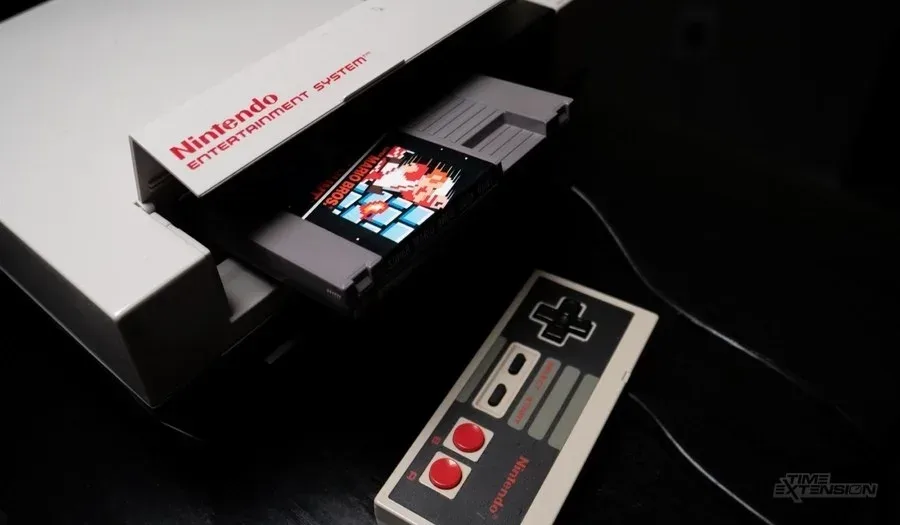
Mike Tyson's Punch-Out!! (NES, Japan/USA Rev A) — Complete Campaign Walkthrough
Step-by-step guidance to climb the WVBA ranks as Little Mac on the original 1987 NES release (Japan/USA Rev A). Learn core mechanics, how to read every opponent's tells, where and when to earn stars for uppercuts, how the password/continue system works, and the route to reach and defeat the original final boss (Mike Tyson) and unlock Title Defense.

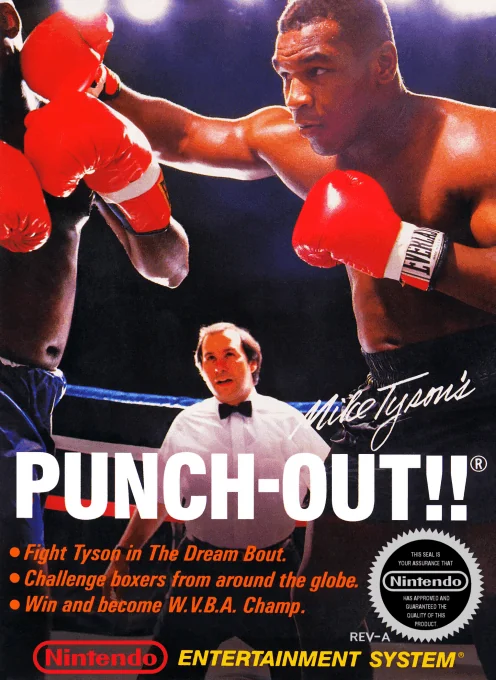
Find a copy
Mike Tyson's Punch-Out!! Nintendo Entertainment System
We may earn a commission if you buy through these links, at no extra cost to you. As an Amazon Associate I earn from qualifying purchases.
Opens retailer search results. Check the model, edition, seller, availability and current price before buying.
Before you begin
You are Little Mac: short, fast and fragile.
This guide assumes you are playing the original Nintendo Entertainment System cartridge identified as Mike Tyson's Punch-Out!!
(original 1987 release, Japan/USA Rev A).
It focuses on the mechanics the NES uses (heart meter, stars, KO/TKO rules, password system) and on practical, repeatable actions for every required opponent so you can progress through the Minor, Major and World circuits to the Dream Fight.
Follow the game systems deliberately: learn each opponent's visual and audio tells, conserve hearts, use stars deliberately for guaranteed or high-damage uppercuts, and use the password/continue rules to practice checkpoints.
This walkthrough keeps to verified NES mechanics and opponent behaviour documented in the original manuals and community-tested guides; it does not conflate later remakes, the Wii remake, or the 1990 re-release that replaced Mike Tyson with Mr.
Dream.
Set yourself up for the run
Verify that the cartridge or ROM is the original NES release titled Mike Tyson's Punch-Out!!, not the later Punch-Out!! Featuring Mr. Dream release.
The original NES game uses fixed-position boxing controls rather than free movement. Learn the controller inputs before starting the campaign.
A and B alone throw body blows. Hold Up while pressing A or B to throw the corresponding face punch; the original NES game does not use held punch buttons to change attacks into jabs or hooks.
Press Left or Right to dodge. Press Down once to block and press Down twice rapidly to duck.
Press Start to begin the game or the next round. During a bout, press Start when at least one star is available to perform the Star Uppercut; Start is not the pause command.
Press Select between rounds for Doc Louis's stamina assistance when available. Do not treat Select as an active-fight menu or Star Uppercut command.
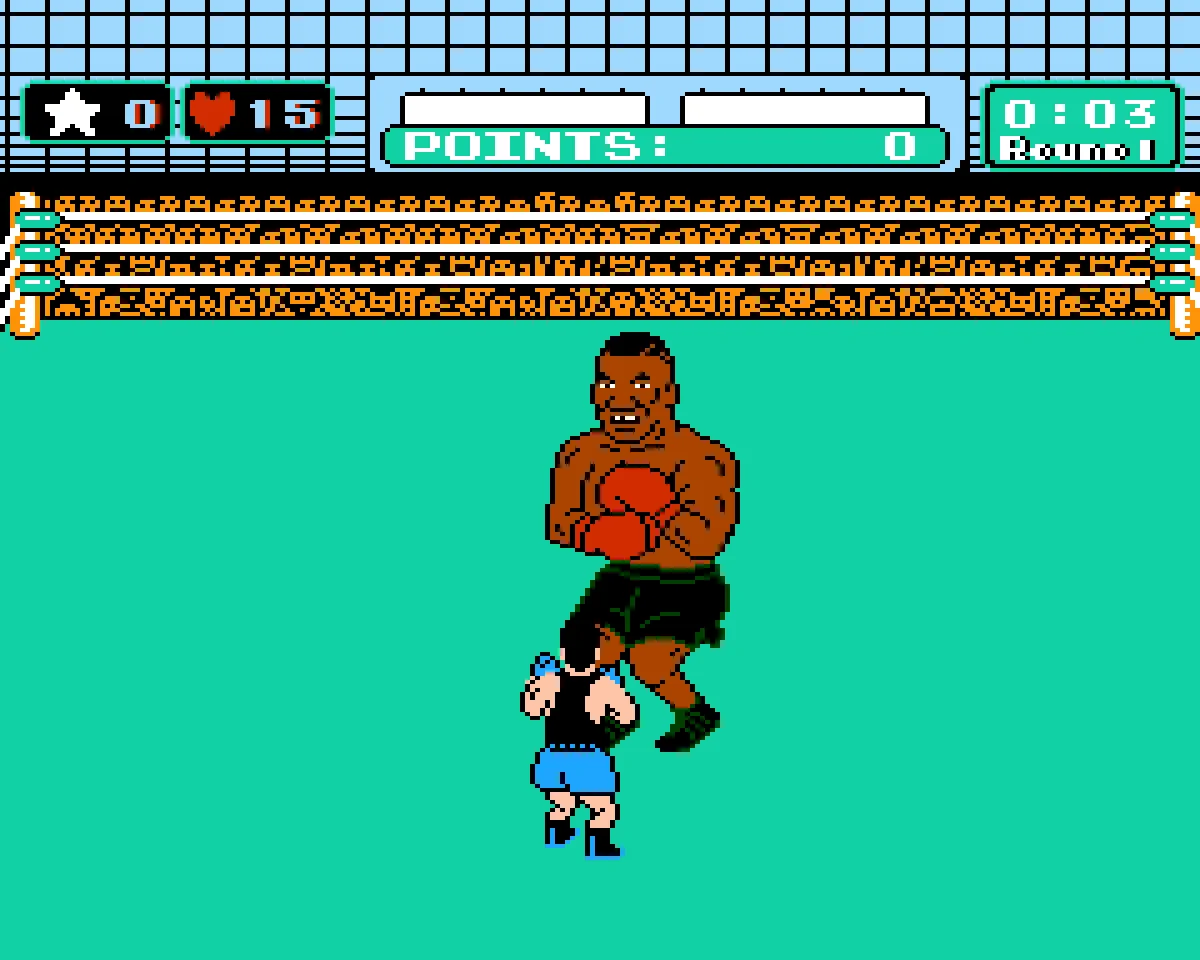
Understand the HUD: hearts control Little Mac's ability to punch, the stamina meters track both boxers, and stars provide Star Uppercut uses.
When the heart meter reaches zero, stop attacking and evade until hearts return. A blocked or dodged Little Mac punch costs a heart, while an opponent's successful punch causes a larger heart loss.
Learn each opponent's visual tells, then use a short counter and return to defense instead of relying on continuous combinations.
Record the pass keys displayed after the Minor and Major Circuit championships. They are circuit checkpoints, not battery-backed saves or individual-fight states.
Do not rely on later releases' training modes or mechanics. The original NES cartridge provides the circuit bouts, interval advice, pass keys, and password challenges described in this guide.
Core Rules and Victory Conditions
Mike Tyson's Punch-Out!! for the original 1987 NES release is won by reading visual tells, defending with the correct movement, and turning brief openings into accurate punches. Before learning individual opponents, understand the three result types, the heart meter, stars, stamina, intervals, and the pass-key system. These rules apply to the Mike Tyson edition and should not be mixed with mechanics from later releases or the NES cartridge that replaced Tyson with Mr. Dream.
Know how a bout ends
A match has three rounds, and each round lasts three minutes. A knockout occurs when a boxer is knocked down and fails to stand before the referee completes the count of 10. A knockdown by itself is not a KO; the boxer can rise and continue. A technical knockout occurs when the same boxer is knocked down three times during one round. The count resets between rounds, so knockdowns from different rounds do not combine for a TKO.
If the third round ends without a KO or TKO, the game determines the winner by match points. Effective punches and uppercuts are especially valuable for scoring. The opponent-specific rules matter: King Hippo, Piston Honda's Minor Circuit title bout, Bald Bull's Major Circuit title bout, Mr. Sandman, and Super Macho Man cannot be won by waiting for a decision. Each of those bouts requires a KO or a three-knockdown TKO.
Mike Tyson is different from those five encounters. In the original Mike Tyson version, he can be defeated by KO, TKO, or a qualifying decision if Little Mac has enough points when time expires. A KO or TKO is the practical target because surviving a full three-round Tyson fight is much harder than finishing him during a reliable opening.
- Watch the round number and elapsed-time display.
- Treat a knockdown as progress rather than an automatic KO.
- Track knockdowns within the current round for TKO purposes.
- Remember that the five listed encounters require a KO or TKO.
- Remember that Tyson can also lose by a qualifying decision.
Manage hearts as your attack permission
Little Mac can punch while he has at least one heart. The heart meter is spent by several different events: a punch from the opponent costs three hearts, a punch that Mac throws and the opponent blocks or dodges costs one heart, and successfully blocking an incoming punch also costs one heart. A missed or ineffective attack therefore has a real cost even when Mac is not struck, and blocking is damage control rather than a free defense.
A successful dodge or duck is the safest way to preserve hearts and recover them. When the meter reaches zero, Mac changes color and cannot punch until he avoids attacks long enough to regain stamina. Do not keep throwing at an opponent who is guarding, and do not stand in front of a committed attack while repeatedly blocking if a dodge or duck is available.
Use a simple rhythm: wait for the opponent's tell, evade the attack, land one or two clean punches, then stop before the opponent recovers. If you lose several hearts, switch completely to defense. Avoid another exchange until the meter has recovered. Blocking is useful against attacks that are difficult to evade, but treat each successful block as a one-heart expense and avoid relying on it when repeated attacks would empty the meter.
- Keep at least one heart before committing to offense.
- Count one heart when Mac's punch is blocked or dodged.
- Count three hearts when an opponent's punch connects.
- Count one heart when Mac blocks an incoming punch.
- Use dodges and ducks to recover hearts.
- When hearts reach zero, stop attacking and defend until Mac recovers.
Earn, protect, and spend stars
A star appears when Mac lands an effective punch at the correct moment. The exact opportunity differs by opponent, but successful counters, taunts, and exposed attack animations are common star windows. Mac can hold up to three stars. A star is not a passive damage bonus; it is one stored Star Uppercut.
Being punched removes one star. Being knocked down removes all stored stars. When at least one star is visible, press Start during the round to perform the Star Uppercut. Do not press Select for this attack. Select is used between rounds for Doc Louis's stamina assistance.
Spend a star only when the uppercut has a clear chance to connect, such as immediately after a successful dodge or during a vulnerable animation. Throwing one into a guard wastes the resource and can leave Mac exposed. If an opponent is recovering from a knockdown, follow the timing of the recovery rather than pressing Start blindly.
- Confirm that at least one star is visible before pressing Start.
- Expect to lose one star when Mac is punched.
- Expect to lose all stars when Mac is knocked down.
- Use Start for the Star Uppercut.
- Reserve stars for a confirmed opening.
Read stamina and recover after knockdowns
The stamina meters show how much strength remains for Mac and his opponent. Punches reduce stamina, and a boxer goes down when the meter reaches zero. After rising, that boxer regains stamina; the amount recovered depends on the count at which he stood up. A knockdown gives you an opening, but it does not permanently remove all of the opponent's stamina.
When an opponent rises, watch the count and animation. The manual specifically recommends an uppercut when the opponent comes up on the count of one, because this can produce another knockdown. Learn the individual timing, then use the follow-up only when the recovery animation leaves the opponent vulnerable.
If Mac is knocked down, rapidly press the controller buttons to help him rise before the count of 10. Once he stands, defend first. Do not immediately attack just because the round continues. Rebuild hearts through successful evasions, watch the next attack tell, and resume offense only after a safe opening.
- Watch both stamina meters before choosing offense or defense.
- Use the count-one rising-opponent opening when it is safe.
- Rapidly press the controller buttons after Mac is knocked down.
- After recovering, defend before attempting another attack.
Use Doc Louis during an interval
Once during each match, pressing Select between rounds allows Doc Louis to give advice that increases Mac's stamina. This is a stamina boost, not a complete restoration, and it does not recover lost hearts or stars. Use it at a round break after Mac has taken meaningful stamina damage rather than spending it while his meter is nearly full.
During the interval, check the current round, both stamina meters, hearts, stars, and the opponent's condition. Press Select if the boost will matter, then press Start to begin the next round. The assistance does not change the opponent's attack pattern, so begin the new round defensively and wait for the first tell.
- Press Select only between rounds.
- Use Doc's assistance once per match when the stamina boost is valuable.
- Do not expect Doc to restore hearts or stars.
- Press Start to begin the next round.
Record pass keys and protect the career
The game displays a pass key when Little Mac becomes Minor Circuit champion and again when he becomes Major Circuit champion. Write each key down exactly as shown. From the title screen, choose Continue, use Left and Right on the Control Pad to select the pass-key position, and press A or B to enter each character. If the entry is wrong, the title screen returns so you can try again.
The Minor Circuit championship key resumes the game from the bottom ranking of the Major Circuit. The Major Circuit championship key resumes it from the bottom ranking of the World Circuit. These are circuit checkpoints rather than individual-fight saves. The pass key preserves the relevant circuit level and match record, but it does not create a battery-backed save file or restore a particular fight in progress.
The normal career ends after Little Mac loses a total of three matches. A loss lowers his ranking and can require a rematch. Use the pass keys to resume a circuit after shutting off the NES, but do not assume they erase losses or remove the three-loss retirement rule.
- Write down the Minor Circuit championship key.
- Write down the Major Circuit championship key.
- Choose Continue before entering a stored key.
- Remember that three total match losses retire Little Mac.
- Treat pass keys as circuit checkpoints, not single-match saves.
Before you move on
- You can distinguish KO, TKO, and decision results.
- You know the five required KO-or-TKO-only encounters.
- You know that Mike Tyson can be defeated by KO, TKO, or a qualifying decision.
- You know that an opponent's successful punch costs three hearts.
- You know that Mac's blocked or dodged punch costs one heart.
- You know that successfully blocking an incoming punch costs one heart.
- You can use dodges and ducks to recover hearts when the meter is empty.
- You can earn a star and spend it with Start during a genuine opening.
- You can use Select once between rounds for Doc Louis's stamina assistance.
- You have written down the Minor and Major Circuit pass keys and can enter them through Continue.
- You understand that three total match losses retire Little Mac.
Controls, Movement and Practical Inputs (NES Controller)
Mike Tyson's Punch-Out!! on NES uses fixed-position boxing controls rather than free movement. A and B select the side of a body blow, holding Up changes the punch into a face punch, and the Control Pad handles dodging, blocking and ducking. Start spends a stored star on the Star Uppercut, while Select can provide Doc Louis's between-round stamina assistance. The key defensive distinction is that blocking an incoming punch costs a heart; dodging or ducking avoids that block penalty, although attacking into an opponent's block or dodge also costs a heart.
1. Learn the four punch combinations
Press A by itself to throw Little Mac's right body blow. Press B by itself to throw his left body blow. These attacks target the opponent's torso and are useful when the body is exposed or when a low counter is required.
Hold Up while pressing A to throw the right face punch. Hold Up while pressing B to throw the left face punch. The NES version does not have separate jab and hook buttons. The attack depends on the button's side and whether Up is held at the same time.
Practise the four inputs before starting serious circuit progress: A for right body, B for left body, Up plus A for right face, and Up plus B for left face. Do not hold a punch button to create a stronger version. Up is the modifier that changes the target from body to face.
- Press A alone for a right body blow.
- Press B alone for a left body blow.
- Hold Up with A and B to practise both face punches.
2. Use the Control Pad for defense
Press Left or Right to dodge in that direction. Read the opponent's wind-up and tap the appropriate side as the punch arrives. A successful dodge avoids the incoming hit without spending a heart on blocking. After the opponent's attack finishes, use the recovery window for a short counter.
Press Down once to block. Blocking is useful when the timing for a dodge is uncertain, but it is not free: the NES game removes a heart when Mac blocks an incoming punch. If your heart meter is already low, prefer a well-timed dodge or duck when the opponent's attack can be avoided safely.
Press Down twice rapidly to duck. Ducking is the correct response to attacks that pass over Mac and, like a successful dodge, avoids the incoming attack rather than applying the block penalty. Do not press Up to block; Up is used with A or B to select a face punch.
Defense does not automatically make it safe to keep attacking. After a dodge, block or duck, watch the opponent's recovery animation. Throw one or two suitable counters, then return to defense before the opponent begins another sequence.
- Use Left or Right for deliberate dodges.
- Use one Down press to block, remembering that blocking costs a heart.
- Use two quick Down presses to duck beneath an attack.
- Do not describe Up as the block command.
3. Understand how hearts are spent and recovered
Hearts represent Mac's fatigue and determine whether he can keep punching. Mac loses hearts when an opponent's punch is blocked, when the opponent's punch connects, and when Mac throws a punch that the opponent successfully blocks or dodges. These are separate situations: blocking an incoming attack costs a heart, while dodging or ducking it avoids that defensive block cost; however, an attack Mac throws into a block or dodge still drains a heart.
When the heart meter reaches zero, Mac turns purple and cannot punch. Continue defending until successful evasive actions allow the hearts to return. Do not mash A and B while exhausted, because attacking into the opponent's defense can spend more hearts without producing damage.
If Mac takes a hit or loses hearts by attacking into a guarded or avoided response, stop forcing exchanges. Read the next attack, dodge or duck when possible, and use blocking only when it is the safer response. Once hearts have returned, resume with a single counter rather than immediately attempting a long combination.
- Check the heart meter before starting a counter sequence.
- Remember that blocking an incoming punch costs a heart.
- Use dodges or ducks to avoid an incoming attack without the block penalty.
- If hearts reach zero, defend until Mac recovers before punching again.
- Do not attack repeatedly into an opponent's block or dodge.
4. Earn, protect and spend stars
Well-timed punches can create stars above the opponent. The NES game allows Mac to store up to three stars. Stars are earned by striking at useful moments, commonly around an opponent's attack or recovery animation, but the exact opportunity varies by boxer.
Press Start when at least one star is available to perform the Star Uppercut. Start is not combined with A, B or Up for this move. Each Star Uppercut consumes one star, so use it when the opponent is exposed, stunned or committed to a recovery animation rather than throwing it into a guard.
Mac loses a star when he is hit and loses all stored stars when he is knocked down. Protect a valuable star by waiting for a reliable opening. If an opponent is still active or guarding, continue defending instead of spending the star on a low-probability uppercut.
- Confirm that a star is visible before pressing Start.
- Use Start alone for the Star Uppercut.
- Spend stars during a clear vulnerable or recovery window.
- Avoid unnecessary contact after earning stars.
5. Follow the basic exchange pattern
Mac does not freely walk around the ring. The practical rhythm is to remain in position, read the opponent's animation, defend against the committed attack, counter briefly and reset. Begin with one punch after a successful dodge or after the opponent leaves the head or body open.
Use face punches when the opponent's head is exposed. Use body blows when the torso is open or when a low attack is needed to interrupt the opponent. Add a second punch only when the opponent is visibly stunned or still recovering.
If your timing is late, defend instead of forcing a counter. A blocked incoming punch costs a heart, but a mistimed attack can also cost a heart when the opponent blocks or dodges it. The safest beginner habit is to choose the action that avoids contact, then attack only after the opponent's animation clearly permits it.
- Defend first and counter second.
- Choose face punches or body blows according to the visible opening.
- Stop attacking when the opponent begins another wind-up.
- Reset to defense after a short counter sequence.
6. Use Start, Select and recovery inputs correctly
Press Start to begin the game or start the next round. During an active round, Start performs the Star Uppercut if Mac has a star. The original NES instructions identify Start for beginning rounds and for the uppercut; they do not establish Start as a pause command. Do not rely on it to stop an active bout.
Press Select between rounds to receive Doc Louis's assistance and potentially increase Mac's stamina. This option is available once per match, so save it for a damaged or difficult round. Select is not the Star Uppercut command and should not be treated as an active-round healing button.
When Mac is knocked down, rapidly press the controller buttons as the game instructs to help him stand before the count ends. Rising quickly helps him return to the bout, but it does not restore stars lost from the knockdown. Once he stands, return to a defensive rhythm instead of immediately attacking.
- Press Start to begin each round.
- Use Start for the Star Uppercut only when a star is available.
- Use Select between rounds when the stamina recovery is valuable.
- Rapidly press the controller buttons after a knockdown according to the on-screen or manual instruction.
Before you move on
- You can perform a right body blow with A and a left body blow with B.
- You can hold Up with A or B to perform the corresponding face punch.
- You can distinguish Left or Right dodge, Down block and rapid Down duck.
- You know that blocking an incoming punch costs a heart, while a successful dodge or duck avoids that block penalty.
- You know that punching into an opponent's block or dodge also costs a heart.
- You can earn a star, wait for an opening and activate the Star Uppercut with Start.
- You know to use Select between rounds rather than during an active exchange.
- You can recover from zero hearts by defending until the heart meter returns.
- You can recover from a knockdown by rapidly pressing the controller buttons as instructed, without relying on an unverified fixed button combination.
Game Structure: Circuits, Ranking and Optional NES Challenges
The original NES release titled Mike Tyson's Punch-Out!! has three required circuits: Minor, Major, and World. The normal career then continues into the Mike Tyson Dream Fight. The game displays earned pass keys after the Minor Circuit and Major Circuit championships. These keys preserve career progress at a later circuit but do not save an individual round, opponent state, heart meter, stars, or timer. Separate fixed passwords provide optional practice access to later fights and hidden challenges. The Another World Circuit is an optional one-loss route with its own opponent order; it is not a Title Defense mode and does not unlock one.
1. Confirm the original NES edition
This chapter applies to the original worldwide NES release titled Mike Tyson's Punch-Out!!. Its required final opponent is Mike Tyson. The Japanese gold-cartridge prize release is a different edition whose final opponent is Super Macho Man, while the later retail NES release titled Punch-Out!! replaces Mike Tyson with Mr. Dream.
The circuit structure below therefore applies only when the cartridge presents Mike Tyson as the Dream Fight opponent. Do not transfer the final-boss identity or edition-specific terminology from the gold Japanese release or the Mr. Dream revision.
- Confirm the title is Mike Tyson's Punch-Out!!.
- Confirm the Dream Fight opponent is Mike Tyson.
- Do not confuse this release with the gold Japanese prize version or the later Mr. Dream cartridge.
2. Follow the required career order
Start a New Game to enter the normal ranking route. Little Mac cannot freely choose opponents. He begins in the Minor Circuit and advances through fixed bouts as he wins.
The Minor Circuit order is Glass Joe, Von Kaiser, and Piston Honda. Defeating Piston Honda completes the Minor Circuit championship. The Major Circuit then proceeds through Don Flamenco, King Hippo, Great Tiger, and Bald Bull, with Bald Bull as its championship bout.
The World Circuit order is Piston Honda, Soda Popinski, Bald Bull, Don Flamenco, Mr. Sandman, and Super Macho Man. These repeated fighters are later encounters with different patterns, timing, or difficulty. Super Macho Man is the World Circuit champion. After winning that match, continue directly into the Mike Tyson Dream Fight.
- Clear Glass Joe, Von Kaiser, and Piston Honda.
- Clear Don Flamenco, King Hippo, Great Tiger, and Bald Bull.
- Clear World Circuit Piston Honda, Soda Popinski, Bald Bull, Don Flamenco, Mr. Sandman, and Super Macho Man.
- Continue from Super Macho Man to Mike Tyson.
3. Record the Minor Circuit pass key
When Piston Honda is defeated as the Minor Circuit champion, the game displays a pass key. Copy every digit, including any leading zeroes, before leaving the results sequence. This is an earned continuation key rather than a save of the Piston Honda bout.
At the title screen, choose Continue and enter the pass key through the password interface. A valid Minor Circuit championship key resumes the normal career at the beginning of the Major Circuit. It does not restore the previous fight's round, hearts, stars, timer, knockdowns, or opponent damage.
The key is useful if the console is turned off or the career is interrupted. It represents circuit progress and record information, not a mid-match checkpoint.
- Wait for the Minor Circuit championship key.
- Copy all digits accurately.
- Choose Continue when using it later.
- Expect to resume at Major Circuit progression, not inside Piston Honda's fight.
4. Record the Major Circuit pass key
After defeating Don Flamenco, King Hippo, Great Tiger, and Bald Bull, the game displays a second earned pass key for becoming Major Circuit champion. Record it before continuing or powering down.
Entering this key through Continue resumes the normal career at the beginning of the World Circuit. It does not reopen a selected opponent and does not retain hearts, stars, round time, knockdown counts, or partial damage.
Keep this earned key separate from fixed passwords found in password references. The ordinary championship keys are the game's continuation system; they are not a full opponent-select menu.
- Complete the four Major Circuit opponents in order.
- Record the displayed Major Circuit championship key.
- Use it to resume at the World Circuit when needed.
- Do not treat it as a save for an individual bout.
5. Complete the World Circuit and Dream Fight
Use the Major Circuit key if necessary, then fight World Circuit Piston Honda, Soda Popinski, Bald Bull, Don Flamenco, Mr. Sandman, and Super Macho Man in that order.
Defeating Super Macho Man completes the normal World Circuit route, but the game does not ordinarily display a new earned World Circuit pass key or a normal Tyson checkpoint at that point. Continue into the Mike Tyson Dream Fight.
The required completion route is therefore three circuits followed by Tyson, not three circuits followed by a separate Title Defense campaign.
- Fight the six World Circuit opponents in the listed order.
- Defeat Super Macho Man.
- Continue directly to Mike Tyson.
- Do not wait for a normally awarded World Circuit or Tyson key.
6. Use fixed passwords only as optional practice entries
The password 777 807 3454 provides direct access to the World Circuit beginning with Piston Honda. The password 267 853 7538 begins at Super Macho Man as World Circuit title holder. The password 007 373 5963 enters the Mike Tyson Dream Fight directly.
These entries bypass normal career progression. They are useful for practicing later encounters, but they are not the pass keys normally displayed after winning the Minor or Major Circuit championships. A complete New Game route does not require any of them.
- Use 777 807 3454 for optional World Circuit practice.
- Use 267 853 7538 for optional Super Macho Man practice.
- Use 007 373 5963 for optional Tyson practice.
- Keep fixed passwords separate from earned championship keys.
7. Attempt the optional Another World Circuit
Enter 135 792 4680 through Continue. After entering the final digit, hold Select and press A and B simultaneously. The extra button command activates Another World Circuit; entering the number alone does not select this hidden route.
The correct order is King Hippo, Great Tiger, Piston Honda, Soda Popinski, Bald Bull, Don Flamenco, Mr. Sandman, Super Macho Man, and Mike Tyson. The Piston Honda, Bald Bull, and Don Flamenco appearances are their later encounters, but present them by their position in this route rather than importing labels from another release.
Another World Circuit is a one-loss challenge. If Little Mac loses a bout, the attempt ends and the password must be entered again for a fresh run. This route is optional, separate from the normal career, and does not unlock Title Defense.
- Choose Continue.
- Enter 135 792 4680.
- After the final digit, hold Select and press A and B together.
- Fight King Hippo first.
- Follow the exact order: King Hippo, Great Tiger, Piston Honda, Soda Popinski, Bald Bull, Don Flamenco, Mr. Sandman, Super Macho Man, Mike Tyson.
- Restart with the password after any loss.
- Treat the mode as an optional challenge, not a post-game campaign.
8. Confirm completion correctly
The required completion check is defeating Mike Tyson in the original Dream Fight and allowing the normal ending sequence to finish. The Minor and Major Circuit pass keys are useful but not mandatory if the entire route is completed without shutting down.
A credits password may display credits directly, but it is optional and is not a substitute for defeating Tyson. Likewise, Another World Circuit and the fixed direct-access passwords are optional challenge or practice tools.
The original NES cartridge does not unlock a separate Title Defense campaign after Tyson. That structure belongs to later Punch-Out!! releases and should not be used to describe this edition.
- Minor Circuit cleared.
- Major Circuit cleared.
- World Circuit cleared.
- Mike Tyson defeated.
- Normal ending sequence completed.
- Earned Minor and Major pass keys treated as continuation checkpoints.
- Another World Circuit treated as optional.
- No Title Defense campaign claimed for the original NES release.
Before you move on
- The cartridge is the original Mike Tyson-titled NES release.
- The required final opponent is Mike Tyson, not Mr. Dream.
- Minor Circuit cleared in this order: Glass Joe, Von Kaiser, Piston Honda.
- Major Circuit cleared in this order: Don Flamenco, King Hippo, Great Tiger, Bald Bull.
- World Circuit cleared in this order: Piston Honda, Soda Popinski, Bald Bull, Don Flamenco, Mr. Sandman, Super Macho Man.
- The normal route continues directly from Super Macho Man to the Mike Tyson Dream Fight.
- Mike Tyson defeated.
- Normal ending sequence allowed to finish.
- Minor and Major championship keys treated as the ordinary earned checkpoints.
- 777 807 3454, 267 853 7538, and 007 373 5963 treated as optional fixed entries.
- Another World Circuit entered with 135 792 4680 plus Select and simultaneous A and B.
- Another World Circuit order confirmed as King Hippo, Great Tiger, Piston Honda, Soda Popinski, Bald Bull, Don Flamenco, Mr. Sandman, Super Macho Man, Mike Tyson.
- Another World Circuit treated as a one-loss optional challenge.
- No Title Defense campaign claimed.
Minor Circuit — Glass Joe: First Steps and Fundamentals
Glass Joe is the first Minor Circuit opponent in the original NES Mike Tyson’s Punch-Out!!. His slow attacks, changing guard, and visible preparation movements make him the safest opponent for learning the game’s central rhythm: watch the tell, defend against the attack, land a short counter, and stop before Little Mac loses too many hearts. Use this bout to practise switching between face punches and body blows, earning stars, and spending them only when Glass Joe is vulnerable. A strong beginner result is a victory within one or two rounds with little or no unnecessary heart loss, although the required objective is simply to defeat Glass Joe and advance to Von Kaiser.
1. Start by reading Glass Joe’s guard
At the opening bell, Glass Joe alternates between guarding his face and guarding his body. Begin with short punches to the face. When he raises his gloves to protect his head, change to body blows; when he lowers his guard again, return to face punches. The purpose is to learn how his defense changes rather than to throw continuously into a protected target.
Use brief groups of punches and watch the result of each one. When Glass Joe blocks or dodges a punch from Little Mac, the heart meter is reduced. Repeatedly attacking a guarded target can therefore exhaust Little Mac even when Glass Joe is not landing clean hits. If the heart meter begins to fall, stop attacking and wait for a better opening.
- Begin with short face punches.
- Switch to body blows when Glass Joe guards high.
- Return to face punches when his guard changes.
- Avoid long strings of attacks into his gloves.
- Watch the heart meter after every blocked or dodged punch.
2. Recognize the Vive La France sequence
After the opening exchange, Glass Joe retreats to the back of the ring and performs his distinctive Vive La France taunt before returning toward the center. This is an important practice opportunity. As he steps back toward Little Mac, a correctly timed punch can knock him down immediately; a particularly precise version of the counter can produce a one-punch knockout in the original NES game.
Do not treat the taunt as an automatic star or automatic victory. Little Mac’s punch must connect during the valid return window. If the timing is unfamiliar, let Glass Joe complete the sequence and prepare for his next attack. Missing this optional counter is harmless; chasing him with repeated punches while he is moving is more dangerous than simply waiting.
- Watch Glass Joe retreat before the taunt.
- Wait for him to step back toward the center.
- Try one properly timed punch during his return.
- Do not chase him if the timing is missed.
- Return to defense after the attempt.
3. Read the two regular attack tells
Glass Joe’s ordinary attacks have clear preparation movements. Before one attack, he crouches slightly. Before the other, he takes a short step backward. These are the tells to watch; react to the preparation instead of waiting until the punch is already traveling toward Little Mac.
For a reliable first clear, dodge left or right as the attack arrives, then answer with one or two punches. Ducking can also avoid an incoming attack, but do not rely on standing block as your default recovery method: blocking protects Little Mac from the full attack but still costs hearts. Dodging or ducking preserves more of the heart meter and leaves you ready to counter.
If you are comfortable with the timing, you can interrupt either attack with a properly timed punch. A successful counter may award a star. If the timing is uncertain, defend first and attack only after Glass Joe has finished the move.
- Watch for the slight crouch before one attack.
- Watch for the short backward step before the other.
- Dodge or duck when you are unsure of the timing.
- Use a short counter after the attack is avoided.
- Remember that blocking an incoming attack costs hearts.
4. Earn stars without forcing openings
Glass Joe can give stars when Little Mac lands a correctly timed counter during one of his attack preparations. His taunt-hook sequence also provides a star opportunity if the punch connects during the appropriate window. The star is added to the meter above the ring and can be spent on a Star Punch.
For a beginner, the safest plan is to earn one star and use it during a clear vulnerable moment. Wait until Glass Joe is stunned, finishing an attack, or recovering from a successful counter, then press Start to perform the Star Punch. Do not press Start while he is guarding or beginning a fresh attack, because the punch can miss and the star will be wasted.
Being hit removes stars, so protecting Little Mac is also a way to protect your offensive resources. Missing one star opportunity is preferable to throwing several uncertain punches and losing both hearts and stars.
- Counter a regular attack or taunt sequence for a possible star.
- Wait until Glass Joe is stunned or recovering.
- Press Start to use the Star Punch when it can connect.
- Do not spend the star into a guard or fresh attack.
- Avoid taking damage after earning a star.
5. Recover when the heart meter is low
When Little Mac’s hearts are nearly empty, stop throwing punches. A punch that Glass Joe blocks or dodges costs a heart, and blocking Glass Joe’s incoming attack also costs hearts. A clean hit from Glass Joe is more damaging still. Continuing to attack or standing in block repeatedly can therefore turn a manageable bout into a quick knockdown.
Use a dodge or duck to avoid the next attack whenever possible. After the danger passes, remain still for a moment and allow the heart meter to recover before resuming offense. If you have lost only a few hearts, patience is usually enough; you do not need to trade damage to regain control of the fight.
The goal is not to block every attack. Use the block command only when its timing is more reliable than a dodge, and remember that it is a defensive fallback rather than a free recovery action. Dodging or ducking is the preferred response when the purpose is to preserve or rebuild hearts.
- Stop attacking when the heart meter is low.
- Prefer dodging or ducking over blocking while recovering.
- Wait for the hearts to return before restarting offense.
- Do not trade hits simply to force a knockdown.
- Resume punching only after a clear opening appears.
6. Finish the bout and advance
Repeat the basic cycle throughout the fight: identify the tell, dodge or duck the attack, land one or two punches, and reset before Glass Joe recovers. Use the taunt counter if you can read it, but do not make that narrow timing the only method of clearing the bout. A steady defensive victory teaches skills that remain useful against Von Kaiser and the later opponents.
After Glass Joe is knocked down, watch his recovery instead of holding the punch buttons. He can resume attacking as soon as the count ends. Be ready to recognize the crouch or backward-step preparation again, and avoid wasting hearts on punches that he is already guarding.
Defeat Glass Joe and confirm that the game advances to Von Kaiser. For practice, aim to finish within one or two rounds while avoiding repeated heart depletion. That target is useful training guidance, not a separate unlock requirement. The important completion result is the victory and the appearance of the next Minor Circuit opponent.
- Repeat the dodge-or-counter rhythm until Glass Joe is knocked down.
- Use stars only during reliable vulnerable moments.
- Stop attacking after a short counter or knockdown recovery.
- Defeat Glass Joe and verify that Von Kaiser appears next.
- Use the one- or two-round target only as practice guidance.
Before you move on
- Glass Joe is defeated and the game advances to Von Kaiser.
- You can identify the crouching preparation for one of Glass Joe’s regular attacks.
- You can identify the short backward step before his other regular attack.
- You can dodge or duck an attack and answer with one or two punches.
- You can earn a star from a properly timed counter.
- You can activate the Star Punch by pressing Start when a star is available.
- You understand that blocking an incoming attack costs hearts.
- You can recover more safely by dodging or ducking, waiting, and allowing the heart meter to return.
- For a strong fundamentals result, clear the bout within one or two rounds without repeated heart depletion.
Minor Circuit — Von Kaiser and Piston Honda
Von Kaiser teaches the basic dodge-and-counter rhythm, while Piston Honda tests whether you can recognize faster tells and the Honda Rush. Use short attacks, preserve your hearts, and treat the special knockdown windows as rewards for correct timing rather than openings to mash. Defeat both fighters to clear the Minor Circuit and receive its password.
Prepare for Von Kaiser's jab
Von Kaiser is the second Minor Circuit opponent. At the start of the bout, keep your attention on his head rather than attacking immediately. When he shakes or bounces his head from side to side, he is telegraphing his regular jab. Dodge the jab, then answer with a quick punch to his face. A short counter is safer than beginning a long combination before you know which attack he is preparing.
Repeat the sequence: wait for the head shake, evade the jab, land a brief face counter, and return to defense. The ordinary jab is Von Kaiser's most common early attack, so learning this rhythm is more valuable than trying to force damage between his tells. If your counter misses, stop punching and watch for the next head shake instead of continuing to spend hearts on guesses.
- Watch Von Kaiser's head for the jab tell.
- Dodge the jab before countering.
- Use short face-punch combinations and reset afterward.
Turn the crouch into a star
After Von Kaiser has been knocked down, he uses uppercuts more often. His crouch is the important cue. When he lowers himself to prepare the uppercut, strike his body with the appropriate body blow before the punch is released. This counter can earn a star and is safer than trying to hit his guarded face.
If you do not interrupt the crouch, wait for the uppercut and dodge it. Immediately after the punch passes, hit Von Kaiser once in the face or body to stun him. If you have a star and he is visibly stunned, use the Star Uppercut for heavy damage. Do not spend a star simply because it is available; convert it after a successful dodge or another clear stun so the uppercut does not miss.
The practical pattern is therefore different for the two parts of the exchange. During the crouch, use a body blow if you can recognize the timing. During the completed uppercut, dodge first and counter second. Once you have performed either response, return to a neutral defensive posture.
- Use a body blow as Von Kaiser crouches for an uppercut.
- Dodge the uppercut if it has already started.
- Use a Star Uppercut only after a confirmed stun or opening.
Finish Von Kaiser without spending hearts
Continue alternating between jab counters and uppercut counters until Von Kaiser falls. After he rises, do not rush forward at the beginning of the exchange. His next attack may be another uppercut, and the same crouch cue remains useful. If you are hit and lose several hearts, pause your offense and defend until you can safely resume. The objective is to reach Piston Honda with enough hearts to react to a faster opponent, not to win Von Kaiser's bout by taking unnecessary trades.
A reliable clear does not require advanced speedrun sequences. One clean counter after each readable attack is enough. If your stars are intact, keep at least one for a stun-and-uppercut opportunity, but do not risk getting hit while trying to manufacture another star.
- Do not chase Von Kaiser after he stands up.
- Recover from mistakes before attacking again.
- Enter Piston Honda's match with your defensive rhythm established.
Read Piston Honda's eyebrow twitch
Piston Honda is the Minor Circuit champion and is considerably faster than Von Kaiser. His ordinary jab is signaled by a twitch of the eyebrows. Dodge the jab, then answer with a short two-punch combination to his face. The exact number of follow-up punches is less important than stopping when the opening closes; Honda recovers more quickly and can punish an attack that continues too long.
Honda also throws right hooks. When the hook begins, dodge away from it and counter briefly. His hook wind-up can provide a star opportunity if your timing is precise, but do not stand in front of him waiting for a star. If the counter window is unclear, prioritize the dodge and take the smaller guaranteed exchange.
Honda uses uppercuts after lowering his body. Treat the crouch as a warning, not as permission to attack his head repeatedly. Dodge the uppercut, then land a controlled series while he is recovering. Stop once he returns to guard so that you are ready for the next jab, hook, or special attack.
- Watch Honda's eyebrows for the regular jab.
- Dodge first, then use a short face combination.
- Dodge the uppercut after Honda crouches.
- Stop attacking when Honda returns to guard.
Counter the Honda Rush
Honda's special attack begins when he jumps backward, dances or bounces in place, and then moves back toward Little Mac. This is the Honda Rush. Do not chase him while he is retreating. Wait for him to return to range, then place one jab or body blow as he comes back in. A correctly timed counter can knock him down immediately, making this the most valuable opening in the fight.
The timing is based on his return to the center, not on the beginning of the dance. If you punch too early, you will miss while Honda is still out of range. If you punch too late, Honda will complete the approach and begin his follow-up. When you are still learning the window, hold your guard and block the rush instead of gambling your remaining hearts. If the counter is missed, Honda follows with a short series of jabs; block the sequence completely, then resume watching his eyebrows and crouch.
This is not the same attack pattern used by later opponents such as Super Macho Man. Do not apply a spin-dodge routine here. Honda's safe response is to wait through the retreat, counter at re-entry, or block if the timing is uncertain.
- Do not attack during Honda's backward dance.
- Counter as Honda returns to range.
- Block the follow-up jab sequence if the counter is missed.
- Do not use Super Macho Man's later spin strategy.
Use stars without losing the fight's rhythm
Honda can give you stars when you interrupt or counter particular attacks, including the eyebrow-jab sequence, certain hook openings, and the Honda Rush. Stars are useful because a Star Uppercut can turn a clean stun into major damage, but they are not a substitute for defense. If you have a star, wait until Honda has been successfully dodged or interrupted before spending it.
A practical sequence is to earn a star from a well-timed counter, wait for Honda to be stunned or exposed after an attack, and then use the Star Uppercut. If the star attempt misses, stop attacking immediately and prepare for Honda's next action. Losing the star is less damaging than allowing the failed attack to become a second mistake.
Honda must be stopped by knockout or technical knockout in this championship bout; a decision is not available as a winning route. Consequently, do not settle into passive blocking for the entire fight. Use the safe counter windows repeatedly until his health is depleted, while keeping your offense short enough to avoid unnecessary damage.
- Save stars for a confirmed opening.
- Stop attacking immediately after a missed star attempt.
- Remember that Honda must be defeated by knockout or technical knockout.
Clear the Minor Circuit and record the password
Defeat Piston Honda by repeating the eyebrow-jab counters, cautious hook and uppercut responses, and the Honda Rush counter when you can recognize the re-entry timing. If your timing is not ready, blocking the rush is acceptable; you can continue winning through ordinary counters without forcing the instant knockdown window.
Once Honda is defeated, let the post-match sequence continue until the game displays the Minor Circuit password. Record every character and its order exactly as shown before switching off the NES. The password is the practical checkpoint for continuing into the next circuit, so do not rely on memory or assume a similar-looking character is interchangeable.
The chapter is complete when Von Kaiser and Piston Honda are both defeated, the game advances beyond the Minor Circuit championship match, and the password has been written down. Before moving on, make sure you can identify Von Kaiser's head shake, Honda's eyebrow twitch, and Honda's backward-dance approach without confusing them with later opponents' attacks.
- Von Kaiser is defeated using dodge-and-counter exchanges.
- Piston Honda is defeated by knockout or technical knockout.
- The Minor Circuit password is displayed.
- The password is recorded exactly before the console is turned off.
Before you move on
- Von Kaiser is defeated while you can consistently recognize his head-shake jab and uppercut crouch.
- Piston Honda is defeated without relying on random button mashing.
- The Honda Rush is either countered at re-entry or safely blocked.
- The game advances beyond the Minor Circuit championship match.
- The Minor Circuit password appears and is recorded exactly for later continuation.
Major Circuit — Don Flamenco and King Hippo
The Major Circuit opens with two fights built around defensive timing. Against Don Flamenco, make him commit to the large Flamenco Punch, dodge it, and answer with a short alternating face-punch sequence. Against King Hippo, ordinary head punches are blocked. Wait for his vibrating, raised-arm, open-mouth attack, interrupt it with a face punch, and then strike the exposed belly. Manage the Heart meter carefully: blocking an incoming attack still consumes hearts, while dodging or ducking avoids the attack more efficiently. This is separate from the Heart loss caused when an opponent blocks or dodges one of Little Mac’s punches.
1. Enter the Major Circuit with a defensive plan
The Major Circuit begins with Don Flamenco and then King Hippo. Start both bouts by watching the opponent’s animation instead of throwing continuous punches. Little Mac’s Heart meter is spent by offensive mistakes and by absorbing attacks. If an opponent blocks or dodges one of your punches, the failed punch costs a heart. If an opponent’s punch connects, the loss is much larger. Blocking an incoming attack also consumes hearts, so use the guard as an emergency response rather than your default answer.
A successful dodge or duck avoids the incoming attack without paying the same blocking cost and usually leaves the opponent in a better position for a counter. When your Heart meter is low, stop attacking, evade the next committed punch, and wait for the meter to recover. Do not treat blocking, dodging, and having your own punch blocked as identical events: they have different tactical consequences.
- Watch for a committed attack before countering.
- Remember that blocking an incoming punch consumes hearts.
- Prefer a dodge or duck when the timing is clear.
- Stop attacking if the Heart meter is nearly empty.
- Do not confuse a failed Little Mac punch with a successful defensive block.
2. Trigger Don Flamenco’s large punch
Don Flamenco is vulnerable after his distinctive Flamenco Punch. At the start of the bout, make a short face-punch attempt to provoke him. He will usually block and answer with the large uppercut. Do not continue punching into his guard: the blocked or dodged attempts cost hearts and do not create a useful opening.
When Don Flamenco raises his arm and commits to the Flamenco Punch, dodge left or right. The objective is not to trade damage but to make the punch miss cleanly. If he does not throw the large punch, return to defense and wait for another clear response rather than forcing a longer combination.
- Use a short face-punch attempt to provoke a response.
- Stop attacking when Don Flamenco guards.
- Identify the raised-arm Flamenco Punch.
- Dodge instead of blocking the large uppercut when possible.
3. Counter Don Flamenco with alternating face punches
Immediately after the Flamenco Punch misses, hold Up and alternate the face-punch buttons. A practical NES sequence is B, A, B, A, with B producing the left face punch and A producing the right face punch when Up is held. Continue only while Don Flamenco remains vulnerable. A brief alternating sequence is safer than mashing one button or trying to maintain pressure after he recovers.
If you have a star, use Start for the Star Uppercut only during a confirmed vulnerable window. Do not spend it while Don Flamenco is guarding. A successful counter may earn another star, but preserving the Heart meter is more important than extending the exchange after the opening closes.
- Dodge first, then begin the face-punch counter.
- Hold Up while alternating B and A for face punches.
- Stop when Don Flamenco guards or begins another attack.
- Use a Star Uppercut only while he is vulnerable.
4. Repeat the pattern after Don Flamenco rises
After a knockdown, Don Flamenco can resume with another dangerous punch. Return to the same sequence: make him commit, dodge the Flamenco Punch, and counter briefly. If he uses a faster attack instead of the familiar large punch, defend by dodging and wait for the next reliable opening.
Do not chase him after a missed counter. If your first response is late, reset your position and watch his arms. Blocking can preserve you from a mistimed hit, but it drains hearts, so repeated blocks will shorten the time you can spend attacking. A clean dodge followed by a short counter is the efficient response.
- Expect another committed attack after the knockdown.
- Use the next reliable Flamenco Punch as the opening if it appears.
- Avoid long combinations after Don Flamenco recovers.
- Use blocking only when dodging is no longer possible.
5. Recognize King Hippo’s open-mouth attack
King Hippo’s normal head attack and guard make ordinary face-punch pressure ineffective. Do not repeatedly punch his head or rush him with random body blows. Wait for his special overhead attack instead.
The tell is clear: King Hippo vibrates, raises one arm, opens his mouth, and begins the forward attack. As the mouth opens, strike his face with a jab. The jab interrupts the attack and causes his shorts to drop, exposing the bandaged area on his belly. The timing is based on the animation, not on a fixed punch count or a general body-rush strategy.
- Ignore routine head attacks that meet his guard.
- Watch for the vibration and raised arm.
- Wait until King Hippo’s mouth opens.
- Interrupt the mouth-open attack with a face jab.
6. Attack the exposed belly
Once King Hippo’s shorts drop, immediately use body punches against the exposed bandage. Continue while the belly remains exposed, then stop as soon as he covers it or returns to his normal stance. The number of punches available depends on how early the mouth attack was interrupted, so use the visible opening rather than relying on a fixed count.
After the opening closes, return to defense and wait for the next overhead attack. If you miss the mouth, do not throw random punches to compensate. His follow-up can damage Little Mac heavily, and blocking it will also consume hearts. Dodge or duck when possible, then reset for the next recognizable opening. Repeatedly interrupting the open-mouth attack and damaging the belly will eventually produce the required knockdown and bout-ending count.
- Interrupt the overhead attack before it reaches Little Mac.
- Punch the exposed belly while the bandage is visible.
- Stop when King Hippo covers the weak point.
- After a miss, defend and wait for the next opening.
- Let the referee complete the count before advancing.
7. Recover from mistakes and preserve momentum
If Don Flamenco hits you, do not answer with panic punches. Watch for the next large punch, dodge it, and use only a short alternating counter. If your hearts are low, prioritize evasion until the meter recovers. A blocked incoming attack may prevent immediate damage, but it still costs hearts and should not replace proper timing.
If you miss King Hippo’s open-mouth cue, use the next attack to reestablish the pattern. Avoid both random offense and repeated blocking. The fight is designed around recognizing one special animation, so simplify your plan: ignore the normal head attack, wait for the raised arm and open mouth, jab the face, and attack the belly.
- After being hit, reset instead of trading punches.
- Use dodges and ducks to conserve hearts.
- Treat blocking as an emergency option, not a free defense.
- Against King Hippo, wait for the same mouth-opening cue every time.
- Reach the later Major Circuit fights with a stable Heart meter.
Before you move on
- Don Flamenco is defeated and the game advances to King Hippo.
- You can identify Don Flamenco’s large Flamenco Punch and answer it with a dodge.
- King Hippo’s vibration, raised arm, and open mouth have been recognized as the required opening.
- King Hippo’s mouth attack has been interrupted, his shorts have dropped, and his exposed belly has been damaged.
- King Hippo suffers the required knockdown and the referee completes the count before the next Major Circuit fight begins.
- You leave both bouts with enough Heart meter to continue. Preserving a star is useful but is not required to clear this chapter.
- After the remaining Major Circuit opponents are defeated, record the pass key displayed by the game before beginning the World Circuit.
Major Circuit — Great Tiger and Bald Bull
Great Tiger is defeated by reading his ruby flash and uppercut direction, then blocking every Tiger Punch before answering his dizzy recovery. Bald Bull’s title bout is built around dodging his normal attacks and stopping the Bull Charge with a precisely timed body blow. Defeat both opponents to complete the Major Circuit and receive the password for the next stage.
1. Prepare for Great Tiger’s opening pattern
Great Tiger is the number-one contender in the Major Circuit. Begin defensively and watch the ruby in the center of his turban. When the ruby flashes, he is preparing a straight jab. You can answer with a quick face jab as the flash begins; a properly timed hit can interrupt him and award a star. If the timing is not comfortable, block the jab instead of throwing repeatedly.
During the opening pattern, use short counters rather than continuous offense. Great Tiger can punish wasted punches, and losing hearts early makes the later Tiger Punch sequence much harder to survive. Keep your attacks brief, then return to watching his hands and turban.
- Watch the ruby flash before committing to a punch.
- Use quick face jabs or block the opening jabs.
- Avoid empty punches and prolonged combinations.
2. Counter the uppercuts by direction
When Great Tiger begins throwing alternating uppercuts, watch the direction of his lean. Counter a right uppercut with a left body blow, and counter a left uppercut with a right body blow. These directional counters can produce stars when timed correctly. If you are late, dodge the uppercut and answer with a single face jab instead of trying to force a longer sequence.
A successful counter briefly stuns Great Tiger. Use that opening for a few controlled punches, then stop and prepare for the next uppercut. The goal is to reduce his stamina while preserving hearts and stars, not to remain on offense after every successful hit.
- Read Great Tiger’s lean before choosing a body punch.
- Use the opposite-side body blow against each uppercut.
- Return to defense after a short counter sequence.
3. Survive and punish the Tiger Punches
At set points in the bout, Great Tiger leaps backward and performs his spinning Tiger Punch sequence. This attack is not safely dodgeable in the original NES game; hold Down to block it. Keep blocking through all five punches. Do not attack while he is circling or disappearing, and do not release the block after the first hit.
After the fifth blocked punch, Great Tiger becomes dizzy. Immediately jab him in the face. That face jab is the reliable knockdown response and is also documented as a one-hit knockdown condition after the Tiger Punches. A Star Punch can also exploit this opening, but the ordinary face jab is the safer resource-preserving choice.
If you miss the post-sequence face jab, reset to defense. Great Tiger will recover and resume his regular attacks. Do not chase him during the recovery animation or throw random punches while he is still protected.
- Hold Down for the entire Tiger Punch sequence.
- Block all five punches before attacking.
- Jab Great Tiger’s face immediately when he becomes dizzy.
4. Finish Great Tiger with repeatable openings
Repeat the ruby-flash counters, directional uppercut counters, and blocked Tiger Punch response. Great Tiger cannot be knocked out by a single ordinary knockdown pattern, so expect to continue the fight after he rises. When you have a star, spend it only during a confirmed opening, such as a stun or the dizzy recovery after the Tiger Punches.
Do not rely on an advanced speed strategy for this chapter. A steady pattern of defense, one or two counters, and immediate recovery is enough to advance. If your hearts become low, stop attacking and concentrate on blocking and dodging until the next safe opening appears.
- Use stars only during confirmed openings.
- Expect Great Tiger to recover after early knockdowns.
- Finish the bout without attacking during his disappearing sequence.
5. Read Bald Bull’s ordinary attacks
Bald Bull is the Major Circuit champion, and this title bout must end in a KO or TKO rather than a decision. He opens with fast rolling jabs. Dodge them and answer with a face jab. When he spins his gloves, treat that as the rolling-jab signal and prepare to evade rather than trading punches.
His gloves moving up and down signal a hook. Dodge the hook and counter with a face jab; this can stun him and create a short follow-up window. Bald Bull also throws deep uppercuts. Dodge those uppercuts and answer with a quick face jab. Keep combinations short because late punches are likely to be blocked or countered.
- Dodge rolling jabs and counter with a face jab.
- Dodge the glove-wave hook and punish briefly.
- Dodge deep uppercuts instead of trying to interrupt them.
6. Stop the Bull Charge
When Bald Bull crouches, backs toward the ropes, and begins hopping forward, he is starting the Bull Charge. If the charge connects, Little Mac is knocked down regardless of his remaining energy. Do not try to stop it with an ordinary face jab or a Star Uppercut.
Throw a body blow as Bald Bull reaches the charge counter window. The practical visual cues are the third hop or the camera flash from the audience near the upper-right side of the ring. The body blow must land during the charge, before Bald Bull’s power uppercut connects. A successful counter knocks him down immediately. If you are learning the timing, watch the third hop first; use the camera flash as an alternate cue once the animation is familiar.
After the knockdown, use controlled follow-up punches. Do not spend every star immediately unless Bald Bull is clearly stunned and the punch will connect. Between charge attempts, return to dodging his rolling jabs, hooks, and uppercuts. He uses the charge more than once, so one missed opportunity does not end the attempt.
- Stop attacking when Bald Bull begins backing to the ropes.
- Throw a body blow on the third-hop or camera-flash cue.
- Use the knockdown window, then return to defense.
7. Complete the Major Circuit
Repeat the ordinary-attack counters and Bull Charge response until Bald Bull is knocked down enough times for a KO or TKO. Because this is the championship bout, a decision is not sufficient. If Bald Bull knocks you down, avoid forcing an immediate comeback combination. Re-establish your defense, wait for the next predictable attack, and try the charge counter again.
After Bald Bull is defeated, the Major Circuit is complete and the game displays a password screen for continuing into the World Circuit. Copy the password exactly as shown on your own cartridge. Passwords can differ between versions or records, so do not substitute a code remembered from another release or guide. The password screen is the completion point for this chapter.
- Great Tiger is defeated.
- Bald Bull is defeated by KO or TKO.
- The Major Circuit completion message and password appear.
- The displayed password is recorded exactly.
Before you move on
- Great Tiger’s bout ends and Bald Bull’s title bout begins.
- All five Tiger Punches are blocked at least once, followed by a face-jab knockdown.
- Bald Bull’s Bull Charge is stopped with a body blow using the third-hop or camera-flash timing cue.
- Bald Bull loses by KO or TKO.
- The Major Circuit completion screen appears and its displayed password is recorded for the World Circuit.
References for this chapter
- Mike Tyson's Punch-Out!! NES Instruction Manual
- Mike Tyson’s Punch-Out!! — Opponent Behaviour Guide: Great Tiger
- Mike Tyson’s Punch-Out!! — Guide and Walkthrough
- Mike Tyson's Punch-Out!! - Guide and Walkthrough — GameFAQs
- Punch-Out!! Featuring Mr. Dream NES Instruction Booklet: Password and Circuit Structure Reference
World Circuit — Piston Honda Rematch and Soda Popinski
The World Circuit opens with Piston Honda's rematch and then Soda Popinski. Honda attacks more quickly than in the Minor Circuit and can string several punches together, while Soda mixes hooks, uppercuts, quick jabs, recovery attacks and a bottle-drinking animation that restores stamina if it is not interrupted. Use short counters, return to defense after every exchange, and preserve stars for clear openings.
Enter the World Circuit with a defensive plan
Piston Honda is the first World Circuit opponent, followed by Soda Popinski. Neither fight should be approached as a repeat of the earlier Minor Circuit bouts. Their attacks are faster, and careless punches can leave Little Mac without enough hearts to respond.
Keep Little Mac near the center and watch the opponent's animation before attacking. Dodge or duck a committed punch, answer with one or two punches to the face or body, and then stop. Long combinations are only safe while the opponent is visibly stunned or recovering. If the Heart meter reaches zero, stop attacking and evade until hearts return.
- Identify the attack before committing to a punch.
- Use short counters after successful dodges.
- Keep at least one star when no immediate high-value opening is available.
Counter Piston Honda's ordinary attacks
Honda's eyebrow or brow movement signals one of his jab sequences. In the rematch, the sequence can continue through several jabs rather than ending after the first punch. If the sequence starts, keep dodging each punch and counter only after the final jab. A premature counter can be struck by the next punch.
Honda also uses hooks and uppercuts. Dodge each committed attack and answer with a short punch to the exposed side of his face. If he blocks the counter, stop punching into the guard and prepare for the next tell. The reliable rhythm is dodge, counter briefly, then reset.
Honda's crouching or bouncing preparation can lead into an uppercut. A well-timed punch during this preparation may earn a star, but it is optional. If the timing is unfamiliar, wait for the uppercut, dodge it, and counter during the recovery instead.
- Treat the brow tell as the beginning of a possible multi-jab sequence.
- Dodge the complete sequence before countering.
- Attempt the preparation counter only when the timing is already reliable.
Survive and punish the Piston Rush
When Honda begins his Piston Rush, do not mash punches while he is moving toward Little Mac. The rush can involve several attacks, and a mistimed punch leaves Mac vulnerable to the rest of the sequence.
The safe response is to concentrate on the incoming punches and dodge or block when the interception timing is uncertain. Experienced players can interrupt the rush with a precisely timed body punch as Honda enters range. This is an optional advanced counter, not a requirement for winning. If the interruption fails, immediately return to defense instead of trying to force more punches.
After the rush ends, do not chase Honda around the ring. Wait for the next brow movement, hook, uppercut or crouching preparation. Handling each attack separately is safer than treating the rush as an invitation to attack continuously.
- Recognize the rush before committing to an attack.
- Use the body interception only after practicing its timing.
- If the interception fails, defend through the remaining attacks.
Finish Honda while preserving resources
Continue the dodge-and-counter cycle until Honda's stamina is low. Spend a Star Punch after a clear opening, such as the end of a successful attack sequence or a visible stun. Do not spend every star on uncertain animations; later World Circuit fights are easier when you finish Honda with a healthy Heart meter and at least one usable star.
If Honda knocks Little Mac down, do not retaliate with random punches as soon as Mac stands. Re-establish the pattern first. Watch for the brow tell, the uppercut preparation and the beginning of the rush, then take the first safe counter.
The goal is a repeatable victory rather than a risky fast knockout. A controlled Honda fight leaves more hearts and attention for Soda Popinski.
- Use stars only during clear openings.
- After a knockdown, resume defense before attacking.
- Proceed only after Honda's victory has been recorded.
Read Soda Popinski's NES attack cycle
Soda Popinski follows Honda in the World Circuit. His main attacks include hooks, uppercuts and quick jabs. Counter a hook when the timing is comfortable, but treat his uppercuts as attacks to dodge first. After a successful dodge, use a short face combination and stop before Soda recovers.
Soda can also respond to a knockdown or Star Punch with a rapid sequence of attacks. The first dodges may need to be made quickly, followed by a slight pause before the next attack. Do not assume that one fixed rhythm works every time; watch Soda's movement and evade each punch individually.
Soda's uppercut preparation can provide a star opportunity. You may also earn stars by countering certain hooks or striking during his exposed taunt. These opportunities are useful, but defensive consistency matters more than collecting every possible star.
- Counter hooks only when the timing is comfortable.
- Dodge uppercuts before beginning a counter combination.
- Treat post-knockdown attack strings as separate punches, not one continuous animation.
Interrupt Soda's bottle drinking
In the original NES fight, Soda periodically pulls out a bottle and drinks from it. This is not a later-version-only mechanic. The drinking animation restores a substantial amount of Soda's stamina if he completes it, undoing part of the damage you have already dealt.
When Soda reaches for or raises the bottle, do not wait for him to finish drinking. Jab the bottle with the fist nearest to it. The punch must be directed toward the side where he is holding the bottle. A successful hit knocks the bottle away, stops the recovery, and normally awards a star.
The bottle animation is a defensive priority, but do not rush across the ring blindly. If Soda is already starting another attack or the bottle is not clearly extended, return to dodging. Once the bottle is visibly in his hand, use the nearest jab promptly, then prepare for his next attack.
If you miss and Soda drinks, do not panic or waste all your stars trying to erase the recovered stamina. Resume the normal cycle: identify the hook, uppercut or jab, dodge it, counter briefly and wait for the next bottle opportunity.
- Recognize Soda pulling out the bottle as a stamina-recovery attempt.
- Jab the bottle with the nearest fist before he drinks.
- Do not import a later game's control scheme or recovery input.
- If the bottle is missed, return to the ordinary dodge-and-counter pattern.
Handle Soda's quick jabs and dancing tell
Some of Soda's jabs give less warning than his larger attacks. Do not throw blindly into an unclear animation. Block or evade the jab, then wait for a better opening rather than losing hearts by attacking at the wrong moment.
When Soda briefly dances with his hands at his sides, he is taunting or preparing a jab sequence. Watch for the attack that follows and respond defensively. If he completes the sequence, counter during the recovery. The animation can also be an opportunity for a star when Soda flashes as he taunts, but only attack when the timing is clear.
Soda does not require a disputed instant-knockout trick. A practical victory comes from stopping the bottle recovery, dodging committed attacks, landing short counters and using Star Punches when Soda is exposed.
- Block or evade an unclear jab instead of punching blindly.
- Watch the attack that follows Soda's brief dance.
- Use taunts for stars only when the timing is familiar.
- Do not depend on an instant-knockout exploit.
Clear both fights and preserve momentum
Defeat Soda by repeating the same cycle: identify the attack, dodge in the correct direction, counter briefly, and reset. If the Heart meter reaches zero, stop attacking and evade until hearts return. If Soda's pattern becomes difficult to read, take fewer punches and wait for another hook, uppercut or bottle attempt rather than forcing an exchange.
This chapter is complete when Piston Honda's World Circuit rematch and Soda Popinski are both recorded as victories and the game advances to Bald Bull's World Circuit rematch. Before moving on, make sure you can recognize Honda's extended jab sequence and rush, along with Soda's bottle animation and major attack tells. Those reactions are more valuable than memorizing a fixed button sequence.
- Piston Honda is defeated without depending on an unreliable rush interception.
- Soda's bottle drinking is interrupted whenever the animation is recognized in time.
- Soda is defeated using original NES behavior, not a later-version mechanic.
- The next World Circuit opponent, Bald Bull, becomes available.
- You finish with a repeatable dodge-and-counter rhythm and preserve stars whenever practical.
Before you move on
- The bout record shows a victory over Piston Honda in the World Circuit.
- The bout record shows a victory over Soda Popinski and advances Little Mac to Bald Bull's World Circuit rematch.
- You can identify Honda's extended jab sequence, uppercut preparation and Piston Rush before committing to an attack.
- You can identify Soda's hook, uppercut, quick-jab, taunt and bottle-drinking animations.
- You can jab the bottle with the nearest fist before Soda drinks and understand that completing the animation restores stamina.
- The two fights can be repeated without relying on a disputed instant-knockout technique or mechanics from later releases.
References for this chapter
World Circuit — Bald Bull Rematch and Don Flamenco II
Bald Bull II and Don Flamenco II are the World Circuit’s middle fights after Piston Honda II and Soda Popinski. Bald Bull’s Bull Charge is the main route to a knockdown, while Don Flamenco demands short counters instead of the repeated alternating punches that worked in his first match. Protect your hearts, reset after every exchange, and treat stars as resources for confirmed openings rather than attacks to spend immediately.
1. Start Bald Bull II by watching his attack rhythm
Do not open with a long combination. Bald Bull II cycles through rolling jabs, hooks, uppercuts, and Bull Charges. Dodge or block the ordinary attacks, then answer with a short punch or two before returning to defense. A missed punch costs a heart, and taking a direct hit costs much more, so constant pressure can leave Little Mac unable to attack or respond.
Use the same basic defensive rule throughout the fight: wait for Bald Bull to commit, evade the punch, counter immediately, and stop attacking before he recovers. If Little Mac turns pink from losing his hearts, stop trying to earn damage and concentrate on dodging or ducking until the hearts return.
- Begin defensively instead of throwing a long combination.
- Use short counters after ordinary attacks.
- Recover hearts before attempting risky offense.
2. Collect stars during Bald Bull’s glove taunt
After a knockdown, and sometimes at other points in the fight, Bald Bull stands in place and raises and lowers his gloves. Punch him during this taunt to earn stars. This is a safer and more consistent star source than throwing random punches into his guard.
Do not waste a Star Punch against Bald Bull while he is simply standing in a neutral stance. He can dodge that attempt. Save at least one star for a confirmed vulnerable moment, such as a successful counter opportunity, a stun, the recovery after a hook or uppercut, or a Bull Charge sequence. The exact goal is not to spend stars quickly; it is to convert them into a knockdown when Bald Bull cannot evade.
- Watch for the repeated glove-raising animation.
- Punch during the taunt to build stars.
- Avoid using a Star Punch against a neutral, standing Bald Bull.
3. Counter the Bull Charge
When Bald Bull backs away and begins the Bull Charge, stop attacking and prepare to dodge. Evade the first charge, then watch the shorter follow-up charge that can occur after he backs away again. The follow-up has a substantially larger interception window than the initial charge, making it the practical opening to learn first.
Punch Bald Bull’s body during the correct part of the charge. A successful gut counter knocks him down and is one of the fight’s dependable finishing routes. The initial charge is also counterable, but its timing is tighter. If you miss, immediately return to defense rather than trying to recover with a frantic combination.
Bull Charges occur at set points in the fight, including around 2:00 remaining in Round 1, 0:30 and 2:00 remaining in Round 2, and 0:30, 1:10, and 2:00 remaining in Round 3. Use those moments as reminders to prepare, not as substitutes for reading the animation. The charge’s visual timing still determines when to dodge and punch.
- Stop punching when the charge begins.
- Learn the shorter follow-up charge before attempting the tighter initial counter.
- Punch the body during the valid interception window.
4. Finish Bald Bull without forcing neutral Star Punches
Continue using charge counters and defensive counters to reduce Bald Bull’s stamina. Ordinary punches can damage him, but a reliable knockdown comes from a successful Bull Charge counter or a Star Punch delivered during a valid vulnerable state. A neutral Star Punch is normally dodged, so do not spend every star as soon as it appears.
After Bald Bull rises, resume the same pattern. His recovery amount and the count on which he gets up can vary, so do not assume that every knockdown produces the same health state. If he taunts while recovering, take the star opportunity; otherwise, wait for the next charge or counter window.
- Use Bull Charge counters and valid Star Punch openings for knockdowns.
- Do not assume a fixed recovery count after a knockdown.
- Return to defense after each successful exchange.
5. Open Don Flamenco II with short defensive counters
Don Flamenco II no longer allows the simple repeated alternating-jab routine from his first appearance. He uses a straight jab and a hook, and either attack can punish an overextended combination. Let him attack first, dodge or block the punch, then answer with a brief counter before resetting.
A straight jab can be punished with a face or body counter after the dodge, while the hook is an opportunity for a shorter counter. Do not chase Don across the screen or keep punching after he has recovered. Every extra attack risks losing hearts without creating progress.
- Expect a straight jab and a fast hook.
- Dodge or block before countering.
- Use only short combinations, then reset.
6. Handle Don’s uppercut and taunt patterns
Don can be forced into uppercut responses by controlled face punches, but this is not a cue to mash continuously. After you have made him commit to the uppercut, dodge it and counter during the recovery. If you are not certain that the uppercut has started, stop punching and wait for the animation rather than gambling with another attack.
Don’s double taunt is a useful, clearly visible opening when it occurs. Punch during a valid taunt opportunity to pursue stars, but remember that star gain is not completely fixed: the first star comes from a successful punch, later guaranteed stars occur on a repeating sequence, and some additional stars are random. Use Star Punches after a confirmed stun, after an uppercut, or during another vulnerable recovery instead of throwing them at a neutral Don.
- Use controlled face punches to provoke responses.
- Dodge the uppercut before countering.
- Treat the double taunt as an opening, not a reason to mash.
7. Recover from mistakes and confirm advancement
If Bald Bull removes several hearts early, stop attacking until Little Mac recovers. If the charge counter is missed, concentrate on surviving the next cycle rather than immediately trying another risky punch. If Don catches you with the hook, return to single counters and wait for the next predictable attack. A knockdown does not automatically end either fight, but being knocked down removes all stored stars, so rebuild them carefully.
Defeating Bald Bull II advances the World Circuit to Don Flamenco II. Defeating Don Flamenco II advances the circuit to Mr. Sandman. The recommended practice target is no more than one knockdown in either bout, but this is a consistency goal rather than a progression requirement.
- Bald Bull II is defeated through charge counters and valid Star Punch openings.
- Don Flamenco II is defeated by evading his attacks and punishing recovery windows.
- The next opponent appears after Don Flamenco II, confirming both matches are complete.
- If the fight was lost, identify the failed charge, dodge, or counter instead of changing every part of the strategy.
Before you move on
- Bald Bull II has been defeated using Bull Charge counters, valid Star Punch openings, or a combination of both.
- Don Flamenco II has been defeated after controlled counters against his straight jab, hook, and uppercut patterns.
- The game has advanced to Mr. Sandman, confirming completion of this World Circuit chapter.
- For a stable run, repeat either fight if it regularly causes multiple knockdowns or leaves Little Mac without hearts for the next opponent.
World Circuit — Mr. Sandman, Super Macho Man and the Buildup to the Dream Fight
The final two World Circuit fights are Mr. Sandman followed by Super Macho Man. Mr. Sandman tests rapid defensive reactions with rolling jabs, hooks, uppercuts and the three-hit Dreamland Express. Super Macho Man then tests delayed dodges against regular punches, Spin Punches and the stronger Super Spin Punch that follows his knockdowns. Treat each bout as a separate fight: hearts, stars and stamina do not carry from one opponent to the next. The goal is to defeat both opponents with repeatable dodge-and-counter patterns, not to depend on speedrun glitches or frame-perfect tricks.
Confirm the World Circuit order and prepare for separate bouts
The World Circuit sequence is Piston Honda II, Soda Popinski, Bald Bull II, Don Flamenco II, Mr. Sandman and Super Macho Man. Mr. Sandman is the penultimate World Circuit opponent. Super Macho Man is the World Circuit champion and the last circuit bout before the Dream Fight against Mike Tyson in the original Mike Tyson's Punch-Out!! release.
Begin Mr. Sandman with a defensive goal: learn the timing of his rolling jabs and hooks before trying to force a fast knockout. After Mr. Sandman is defeated, the next bout starts with a fresh heart meter and a fresh supply of possible stars. Nothing earned in the Sandman fight is stored for Super Macho Man, and defeating Super Macho Man does not normally produce a World Circuit championship password.
The NES manual confirms that stars are current-bout uppercut charges, that a knockdown removes all stars, and that hearts recover through successful defense when Little Mac is exhausted. Use those systems inside each fight rather than treating them as persistent supplies.
- Reach Mr. Sandman after defeating Don Flamenco II.
- Remember that Mr. Sandman comes immediately before Super Macho Man.
- Start each bout as a new resource-management problem.
Mr. Sandman: survive the opening rolling jabs
Mr. Sandman commonly opens with rolling jabs. These punches travel quickly and can remove a large amount of stamina, so do not answer them with a long combination. Watch the glove and shoulder movement, dodge to either side as the jab commits, then tap a face punch after the miss. A single counter is enough while you are learning the rhythm.
If the rolling jab catches you, stop attacking during the next exchange. Block or dodge until your hearts return, then resume with one counter after a clean miss. When Little Mac has no hearts, he cannot punch; continued offense in that state only creates more missed-punch penalties. The priority is to recover, not to trade damage.
Mr. Sandman also uses hooks frequently. The hook has a larger commitment than the rolling jab. Dodge the hook, strike his face once to stun him, and then use a short series of body blows while he is exposed. Stop attacking as soon as the stun ends. If he blocks one of your punches, expect a counter jab and be ready to dodge instead of immediately pressing another button.
- Dodge the opening rolling jabs and counter once.
- Use a face punch followed by a few body blows after a missed hook.
- Recover hearts before resuming offense if you are hit or exhaust the meter.
Mr. Sandman: identify the uppercuts and Dreamland Express
A right uppercut is less common than the hooks and is seen mainly in the later rounds. Wait for the punch to begin, dodge, then jab his face and follow with body blows. Do not throw at the start of his animation; an early punch can be blocked and leave you without enough hearts to answer the next attack.
The major danger is the Dreamland Express: three consecutive uppercuts thrown in rapid succession. It has a recognizable setup and should be treated as a separate attack from his ordinary uppercut. Once the first uppercut is committed, dodge each of the three punches in sequence. Do not counter after the first or second punch. After the third uppercut misses, jab Sandman's face to stun him and use body blows during the opening.
The Dreamland Express appears at recurring late-round points and can also follow a knockdown or a later rise. The exact occurrence can vary with the fight state, so do not rely only on the clock. If Sandman rises or begins a delayed setup, keep your attention on him instead of looking at the stamina meter. A missed dodge is usually worse than surrendering one exchange, so block or continue dodging if you lose the visual cue.
- Treat the three uppercuts as one sequence and dodge all three.
- Counter only after the final uppercut has missed.
- Expect another Dreamland Express after later knockdowns or rises.
Mr. Sandman: use the Nightmare Pattern carefully
After a successful dodge of a hook, rolling jab or Dreamland Express, the safe beginner response is a face jab followed by body blows. A more damaging pattern is to jab his face, throw one body blow, pause briefly, and then throw the next body blow as the stun is ending. This delayed second body blow can keep the exchange productive without requiring a long rapid combination.
Another useful setup is to throw a jab that Sandman dodges, then immediately prepare for the hook he throws in response. Dodge that hook, jab his face and continue with body blows. Do not repeat the setup if your timing is uncertain; a blocked punch costs a heart and can trigger a counterattack.
Stars are earned from effective, well-timed punches. Use a Star Punch only after a confirmed miss or stun, when Sandman is exposed. Do not spend every star on a standing opponent who is still attacking. Community testing documents that Sandman eventually begins dodging repeated Star Punches, so alternate ordinary counters with star attacks instead of repeatedly pressing START whenever a star is available.
- Prefer short counters after confirmed openings.
- Use the delayed body-blow pattern only after the face jab has stunned him.
- Spend stars during a clear opening and rebuild them patiently after a knockdown.
Recover from a Mr. Sandman failure
If you miss the Dreamland Express response, stop trying to punish Sandman immediately. Block or dodge through the next attack, then wait for a familiar hook or rolling jab. If you are knocked down, expect to lose all current stars and possibly face another Dreamland Express when the exchange resumes.
If the first round goes badly, the fight is not automatically lost. Preserve the remaining hearts, use the between-round interval if you need Doc's available stamina advice, and concentrate on surviving the next three-punch sequence. A decision is not a reliable fallback against every late World Circuit opponent, so continue building clean counters rather than merely avoiding the fight.
Mr. Sandman has no single-hit instant knockout condition in the normal NES fight. Win by repeating the defensive cycle until he is knocked down three times or the referee counts him out.
- After a missed response, defend before attacking again.
- Expect stars to disappear after Little Mac is knocked down.
- Use later rounds to stabilize the pattern rather than forcing a comeback flurry.
Super Macho Man: read the regular punches
After Mr. Sandman, Super Macho Man begins the final World Circuit bout. His ordinary attacks include a right hook and an uppercut. Watch until the punch commits, dodge to the appropriate side, then answer with one or two quick punches. Return to neutral immediately instead of extending the combination.
If the animation is unclear, block or wait. An empty punch that is blocked or dodged costs a heart, while a direct hit from the opponent costs three hearts. This makes random pressure especially dangerous when Macho Man is already chaining attacks. At zero hearts, stop punching and use dodges or ducks until the meter returns.
Macho Man also uses a regular Spin Punch. Do not dodge at the first movement of the rotation. Wait until the spin becomes the actual committed attack, dodge, and then throw a brief face counter. A clean counter can stun him and may create a star, but stop attacking when the opening closes.
- Wait for the hook or uppercut to commit before dodging.
- Counter with one or two punches, then reset.
- Avoid punching into a guard or uncertain movement.
Survive the Super Spin Punch after every knockdown
Each time Super Macho Man is knocked down, prepare for his Super Spin Punch when he rises. He retreats before launching it, giving you a different visual cue from the ordinary Spin Punch. Do not celebrate the knockdown or move forward blindly; keep Little Mac ready while Macho Man backs away.
Wait for the longer rotation to become fully committed, then dodge left or right. After the punch misses, answer with a short face-punch counter and return to defense. The safest repeatable cycle is rise, watch the retreat, dodge the Super Spin Punch, counter once or twice, and reset.
If you are hit by the Super Spin Punch, do not immediately trade punches after standing up. Defend through the next attack, recover hearts if necessary, and wait for a normal hook or Spin Punch that you can read. A knockdown also removes your current stars, so rebuilding them is less important than surviving the next sequence.
- Expect a Super Spin Punch after every Macho Man knockdown.
- Use the retreat as the warning, but dodge only when the rotation commits.
- After being hit, defend first and rebuild your rhythm.
Use stars and finish the World Circuit
Use stars on Super Macho Man after a clean dodge, a stun or the recovery from a Spin Punch. The Star Punch is activated with START when at least one star is available. SELECT is not the Star Punch button; on the NES version it can provide Doc's advice and a stamina boost during an interval, subject to the game's once-per-match limitation.
Do not rely on the clock-stop glitch, rapid-punch manipulation or frame-perfect speedrun routes. Those methods are optional specialist techniques and are not needed to clear the bout. A normal victory comes from identifying the attack, dodging at the committed moment, countering briefly and repeating the cycle.
When Macho Man is nearly defeated, keep using the same pattern. A desperate flurry can turn a controlled fight into a knockdown and erase every star. Once he is defeated, let the World Circuit result sequence finish. The game then moves toward the Dream Fight against Mike Tyson; do not expect a normal World Circuit pass key after this victory.
- Use START for a Star Punch only during a clear opening.
- Do not treat speedrun glitches as required tactics.
- Defeat Super Macho Man and allow the result sequence to advance toward Tyson.
Before you move on
- Mr. Sandman is defeated after surviving his rolling jabs, hooks, uppercuts and at least one Dreamland Express sequence.
- You can respond to the Dreamland Express by dodging all three uppercuts before countering.
- Super Macho Man is defeated after you identify his regular attacks, Spin Punch and post-knockdown Super Spin Punch.
- You can win both bouts without relying on a clock-stop glitch or frame-perfect speedrun setup.
- You know that stars and hearts reset between bouts and that a knockdown removes current stars.
- The World Circuit result sequence completes and the game advances toward the Mike Tyson Dream Fight.
References for this chapter
Preparing for the Dream Fight — Resource Management and Mindset
The original NES Mike Tyson fight is a defensive pattern test. Protect Little Mac's heart meter, learn Tyson's visual cues in sequence, and spend stars only during dependable openings. Dodging and ducking are the preferred defenses because blocking an incoming punch still consumes a heart. Use the direct Tyson password for practice if needed, but complete the normal game by defeating Tyson and allowing the ending sequence to finish.
Set the correct objective before Round 1
Do not begin by trying to overwhelm Tyson. His opening Dynamite Uppercuts can knock Little Mac down with one clean hit, so the first task is to recognize the flash, dodge immediately, and return to a neutral position. The original NES fight rewards short reactions and pattern recognition more than sustained pressure.
For early attempts, treat survival as progress. Watch Tyson's body, wait for the attack cue, dodge, and only then consider a short counter. One or two accurate punches after a successful dodge are safer than a long combination that leaves Mac in front of Tyson's next attack.
During the opening portion of Round 1, Tyson uses his Dynamite Uppercut pattern. Learn to survive this sequence before trying to optimize damage. If you cannot consistently avoid it, adding aggression will usually make the attempt less reliable rather than faster.
- Treat the opening as a defensive drill.
- Dodge before attempting a counter.
- Return to neutral after a short attack.
Manage hearts as an attack and defense resource
The heart meter determines whether Little Mac can continue punching. Mac loses one heart when Tyson blocks or dodges one of Mac's punches. Mac also loses one heart when he successfully blocks an incoming punch, so blocking is not a free defense. Being hit by Tyson costs three hearts and can leave Mac unable to attack for much longer.
Use blocking only as an emergency response when a dodge or duck is not practical. Press Down once to block, but do not treat the guard as a way to absorb Tyson's entire attack pattern. Against the opening Dynamite Uppercuts, a clean dodge is preferable to standing in front of Tyson and repeatedly blocking.
After a missed dodge, stop attacking. Do not try to repair the mistake by throwing several punches. Defend against the next attack, let the heart meter recover, and resume only when Tyson has completed his sequence. A small amount of safe damage is worth more than a larger exchange that leaves Mac unable to punch.
When the heart meter reaches zero, Mac is too tired to punch. Avoid Tyson's attacks by dodging or ducking until hearts return. Blocking may prevent the immediate hit, but it still consumes a heart and is therefore a poor substitute for the evasive recovery that gets Mac back into fighting condition.
- Keep enough hearts to counter after a dodge.
- Remember that blocked or dodged Mac punches cost hearts.
- Remember that blocking an incoming punch also costs a heart.
- Use blocking only as an emergency response.
- Prefer dodging or ducking to recover from exhaustion.
Learn Tyson's visual cues in order
Tyson's flash signals the dangerous early attack pattern. React to the flash itself rather than waiting to identify the hand. Once the Dynamite Uppercuts are avoided, Tyson's later attacks add other cues. A wink indicates one of his hook attacks, and the side of the wink identifies the direction. Dodge the punch, then use a brief counter instead of chasing him with repeated attacks.
A rapid blinking sequence later signals Tyson's altered hook pattern. This is not the same cue as the early flash or the wink. When the blinking begins, prepare to defend through the sequence and look for the practiced opportunity to punch. A correctly timed punch during this sequence can produce a star or a knockdown, but the timing should be treated as an advanced option until it is reliable.
Do not try to memorize every attack order at once. First learn the flash. Then add the wink attacks. Finally practice the rapid blinking sequence. If a cue remains unclear, spend an attempt dodging without attacking. Once the defense is consistent, add one counter to the response.
- React to the flash for the early power attacks.
- Distinguish a wink from rapid blinking.
- Practice defense without attacking when a cue is unclear.
- Add counters only after the defensive response is reliable.
Preserve and spend stars deliberately
Stars are valuable because each one permits a Star Uppercut. With at least one star available, press Start to perform it. A star earned during a confirmed opening is more useful than one spent immediately without a clear target.
The safest general rule is to use a Star Uppercut after Tyson has been stunned or after a known attack has left him open. Do not press Start merely because Tyson is nearby. If the timing is wrong, the star is wasted and the missed action can leave Mac poorly positioned for the next attack.
Do not assume that saving every star is automatically correct. Tyson can remove one star when he hits Mac and can remove all stored stars when he knocks Mac down. Carrying several stars into a dangerous exchange is therefore not risk-free. When a dependable opening appears, convert the star into damage. The goal is repeatable progress, not a rare instant-knockout attempt.
A precisely timed punch during Tyson's rapid blinking sequence can create a powerful opening, and community-tested strategies also use stars around these moments. Treat that as an advanced technique rather than the foundation of the plan. If the timing is inconsistent, use the star after a safer stun or post-attack opening.
- Use Start only when a Star Uppercut has a clear target.
- Spend stars on repeatable openings.
- Do not risk several stars while chasing a speculative instant knockout.
- Expect a hit to remove one star and a knockdown to remove all stored stars.
Use the round structure to control risk
If you have reduced Tyson's energy but have not secured a knockdown, resist the urge to force the final punch. Continue dodging and wait for the next reliable opening. A rushed knockdown attempt can turn a controlled round into an immediate loss.
After a knockdown, reset your attention instead of assuming the next exchange is safe. Tyson may begin the next round with a different pattern, including rapid jabs at the start of Round 2. Defend first, then rebuild your offense. A knockdown is valuable, but it does not remove the need to read the following cue.
The rapid blinking attacks later in the fight provide an important practice point. Watch for the cue, defend the sequence, and counter only when the pattern finishes or when you have practiced the required timing. Reaching the next round with hearts and at least one star is generally more useful than dealing slightly more damage while leaving Mac exhausted.
- Do not force a knockdown when the opening is uncertain.
- Reset your defense after every knockdown.
- Defend the opening pattern of each new round.
- Value hearts and stars over small amounts of extra damage.
Recover from mistakes without abandoning the attempt
If you lose a star, do not immediately chase another one. Return to the flash, wink, and blink responses, then earn a new star only when the opening naturally appears. Trying to replace a lost star while out of position commonly causes another hit and removes more of Mac's resources.
If Tyson knocks you down early, treat the next exchange as a reset. Get up, watch the next cue, and return to the defensive rhythm. The attempt is still useful even if the original fast plan is gone; surviving a later sequence teaches you which response failed and prevents the same mistake on the next retry.
If the heart meter reaches zero, stop trying to attack until it refills. Continuing to press punch buttons while Mac cannot attack gains no damage and may leave him exposed to the next move. Dodge or duck through Tyson's next attacks to recover hearts. Use blocking only when it prevents an otherwise unavoidable hit, because the block itself still consumes a heart.
- Rebuild timing instead of forcing a replacement star.
- After a knockdown, defend the next exchange from neutral.
- Wait for hearts to return before resuming offense.
- Use each failed attempt to identify one specific timing error.
Practice from the special Dream Fight password
For direct practice, enter 007 373 5963 at the password screen to reach the Mike Tyson Dream Fight. This is a special manually entered password; the normal game does not award it after defeating Tyson. It is useful for learning the final opponent without replaying the circuits, but it does not replace completing the normal circuit progression.
Keep a short attempt log. Record whether the failure came during the opening Dynamite Uppercuts, a wink attack, the rapid blinking sequence, a missed counter, an unnecessary block, or a depleted heart meter. Then change only one part of the plan on the next attempt.
If the opening is the problem, throw almost nothing and practice dodging until you can survive it. If survival is reliable but damage is low, add one counter after each safe dodge. If stars keep disappearing, identify which exchange is causing the hit and make defense the priority there. If you are blocking too often, replace one block at a time with a dodge or duck and measure whether your hearts last longer.
When you return to the normal game, use the same process against Super Macho Man and then Tyson. The objective is not merely to reach the final bout once; it is to recognize the opening pattern, preserve enough hearts to keep attacking, and convert dependable openings into knockdowns.
- Enter 007 373 5963 for direct Tyson practice.
- Record the exact pattern or defensive mistake that ended each attempt.
- Change one response at a time.
- Return to the normal circuit for the actual completion run.
Before you move on
- You can repeatedly survive Tyson's opening Dynamite Uppercut sequence before adding offense.
- You can distinguish Tyson's flash, wink, and rapid blinking cues well enough to choose the appropriate defense.
- You understand that Mac loses a heart when Tyson blocks or dodges a Mac punch, loses a heart when Mac blocks an incoming punch, and loses three hearts when Tyson lands a punch.
- You can preserve at least one star through a meaningful exchange and use Start for a Star Uppercut during a confirmed opening.
- After a missed dodge or early knockdown, you can return to defense without immediately wasting hearts on unsafe punches.
- You can enter 007 373 5963 and use the direct Dream Fight practice route while tracking the specific pattern causing each failure.
- For normal completion, you defeat Mike Tyson in the original NES version and allow the standard ending sequence to finish.
Dream Fight Against Mike Tyson — Recognising the Original NES Patterns
The original NES Mike Tyson Dream Fight is built around distinct attack phases rather than a single repeating rhythm. Round 1 begins with 90 seconds of Dynamite Punches that cause an immediate knockdown if they connect, then changes to fast blinking hooks. Round 2 opens with five sets of paired Explosive Jabs before returning to mixed attacks, including hooks, uppercuts, and Dynamite Punches. Later phases are less predictable, so the safest plan is to watch Tyson’s visual tells, dodge only when the attack begins, and counter during recovery. A KO or TKO is the practical objective, but the original NES rules also allow Little Mac to win by decision with at least 5,000 points when Round 3 expires.
Confirm the original fight and set the objective
This chapter covers the original NES release titled Mike Tyson’s Punch-Out!!, whose final opponent is Mike Tyson. The later NES re-release, Punch-Out!! Featuring Mr. Dream, substitutes Mr. Dream and is a different edition. Confirm the name shown on the title and fight screens before applying this route.
Enter the bout with two priorities. First, survive the opening phase without being knocked down. Second, turn Tyson’s recovery windows into controlled damage while building toward a KO or TKO. Do not begin by continuously pressing the punch buttons. Tyson’s opening attacks punish premature offense, and a clean Dynamite Punch connection immediately knocks Little Mac down.
A KO occurs when Tyson fails to rise during the count. A TKO occurs when he is knocked down three times in one round. If neither result occurs before the end of Round 3, the referee can award the bout by decision. The practical target remains a KO or TKO because the decision requires a large point total, but a decision is a valid victory condition in the original NES game.
- Confirm that the opponent is Mike Tyson, not Mr. Dream.
- Treat early attempts as pattern practice if necessary; survival comes before damage.
- Remember that KO, TKO, and a qualifying decision are all valid results.
Survive the first 90 seconds of Round 1
For the first 90 seconds of Round 1, Tyson uses his Dynamite Punch pattern. Each attack is preceded by a brief blue flash and then a very fast uppercut. Any clean connection causes an immediate knockdown, so do not try to trade punches during this phase. Watch Tyson directly and move only when the attack begins.
After a successful dodge, Tyson is vulnerable to a short counter. The safest beginner response is one or two punches followed by an immediate return to defense. These counters are the main way to reduce his stamina during the opening sequence. If the timing is not familiar, spend several attempts doing nothing except watching the flash and avoiding each uppercut. That practice is useful even when it produces little damage.
Tyson’s opening pattern has recognizable hand sequences, but do not reduce the fight to a fixed metronome. The timing can vary, and dodging on the rhythm of the previous attack is a common cause of failure. Keep Little Mac centered, wait for the visual warning, dodge the punch, then step back into range for a brief counter.
- Watch for the flash before each opening Dynamite Punch.
- Do not dodge early merely because the previous attack had a familiar delay.
- After a successful dodge, use a short counter and reset to defense.
- If the phase is overwhelming, practice dodging without attacking until the timing is familiar.
Counter safely after the Dynamite Punch
The important counter is not a specific universal hand rule; it is the timing. Dodge the Dynamite Punch, then use a quick face punch while Tyson is recovering. The exact button depends on which side of Little Mac’s body you want to strike, so prioritize the opening and the correct face target shown on screen rather than memorizing an opposite-arm formula.
A successful counter can stun Tyson and allow another quick punch before he recovers. Stop when that opening closes. If your punch is blocked, dodged, or interrupted by a new Tyson animation, abandon the sequence and prepare for the next attack. The purpose of the counter is to collect safe damage while preserving hearts, not to force a long combination.
When Little Mac has no hearts, he cannot punch. Dodge or duck until hearts return, then resume the short counter pattern. A failed punch can also cost a heart when Tyson blocks or dodges it, so random attacks make the next exchange harder.
- Dodge first, then counter during Tyson’s recovery.
- Use the punch that reaches the correct face target rather than relying on an opposite-hand rule.
- Stop after the short counter window instead of chasing extra damage.
- Recover hearts through successful defense if Little Mac becomes exhausted.
Handle the last 90 seconds of Round 1
After the opening Dynamite Punch phase, Tyson changes to fast blinking hooks for the remainder of Round 1. His brief wink is the main warning. Watch his face, dodge as the hook begins, and answer with a short punch sequence during recovery.
The hook phase is less immediately lethal than the opening, but early dodges remain dangerous. Do not move merely because Tyson is standing still; wait for the wink and attack animation. After a successful dodge, use one or two punches, then return to a defensive posture.
A late Round 1 knockdown is useful, but it is not worth gambling the entire fight. If you have already been knocked down, prioritize completing the round cleanly and preserving enough hearts to survive Round 2. Damage and points matter, but a reckless exchange can erase both advantages.
- Switch your attention from the opening flash to Tyson’s brief wink.
- Dodge the hook, then counter once or twice.
- Do not force a knockdown when the timing is uncertain.
- Preserve hearts for the more demanding opening of Round 2.
Recognize Round 2’s opening jab pattern
Round 2 begins with five sets of two fast Explosive Jabs. Their timing is different from the opening Dynamite Punches, so blocking with Down is a safe response while learning the sequence. You can also dodge each pair, but do not rush forward between attacks unless you are certain the exchange has ended.
Once the opening jabs finish, Tyson returns to mixed attacks. Dynamite Punches remain dangerous, even though the automatic one-hit-knockdown behavior is associated with the first 90 seconds of Round 1. Continue treating every pause as a possible setup rather than assuming the next attack will be a hook.
Counter only after the final punch in an exchange. One or two clean punches are preferable to a long combination that drains hearts when Tyson blocks or evades. If your stamina is low, defend until the heart meter recovers instead of trying to trade damage.
- Block or carefully dodge the five paired-jab sets.
- Do not attack between jabs unless the sequence has clearly ended.
- Treat later Dynamite Punches as heavy-damage attacks without assuming the Round 1 instant-knockdown rule still applies.
- Use short counters and recover hearts before returning to offense.
React to Round 2 blink sequences
During Round 2, Tyson can stand back and blink rapidly before launching Dynamic Hooks. This is a valuable chance to strike for a star, but it is also a dangerous setup. If you attack during the blink, immediately prepare to defend against the follow-up instead of assuming that one fixed number of hooks will always occur. Watch the actual animation and respond to the next punch.
A star earned during a blink can be saved for a safer Star Uppercut window. Press Start to spend a star on the uppercut when Tyson has completed an attack, is stunned, or is otherwise visibly open. Do not press it while he is beginning a punch. The NES manual identifies Start as the uppercut command when at least one star is available.
Some advanced strategies deliberately reduce Tyson’s stamina before a later blink, then use a precisely timed punch or Star Uppercut to force a knockdown. This can produce a rapid finish, but it is not necessary for a reliable clear. If the timing is uncertain, keep the star and use it after a completed defensive action.
- Treat rapid blinking as a Dynamic Hook setup, not as a guaranteed fixed-count sequence.
- Strike during a blink only if you can immediately prepare for the follow-up.
- Save a star for a recovery window when possible.
- Press Start only when you have a star and Tyson is not actively attacking.
Manage Round 3 and finish the bout
Round 3 combines hooks, Dynamite Punches, paired jabs, and uppercuts with fewer dependable transitions. A long pause can precede a Dynamite Punch, while another pause can precede paired jabs. Do not fill every pause with an attack. Watch for the actual animation, defend against the incoming sequence, and counter only after the final punch has passed.
If Tyson is close to falling, use a Star Uppercut after a successful dodge or stun rather than gambling on an unprotected attack. If you knock him down, return to defense as soon as the count ends because the next sequence can begin immediately. Three knockdowns in one round produce a TKO, while a knockdown that holds through the count produces a KO.
If the bell ends Round 3 without a KO or TKO, the referee compares match points. Little Mac needs at least 5,000 points to win by decision. Every effective punch and Star Uppercut contributes to the score, so a decision attempt requires safe counters throughout the entire fight rather than survival alone. If you have a choice, pursue the KO or TKO because it is less dependent on maintaining a large point total.
- Expect mixed attacks instead of waiting for one familiar tell.
- Use stars after a completed defensive action.
- Aim for a KO or TKO when the opportunity is safe.
- If the fight reaches the final bell, verify that Little Mac has at least 5,000 match points for a decision.
Recover from an early failure and verify completion
If you lose a star, miss a dodge, or suffer an early knockdown, return to defense immediately. Do not compensate by throwing repeated punches while Tyson is active. Block or dodge the next sequence, then resume the one- or two-punch counter pattern after a clear recovery window.
A knockdown removes all stored stars, so rebuild them through effective counters rather than trying to force a Star Uppercut immediately. If Little Mac reaches zero hearts, concentrate on dodging and ducking until the meter returns. If the opening 90 seconds repeatedly cause the loss, use the Dream Fight password from the continue screen for focused practice instead of replaying the entire circuit each time.
Completion requires a victory over Mike Tyson by KO, TKO, or qualifying decision. After the victory, allow the normal ending sequence to finish. The concrete check is not merely reaching Round 3 or seeing Tyson go down once; confirm that the game declares Little Mac the winner and proceeds into the ending.
- After a mistake, defend first and rebuild the rhythm before attacking.
- Remember that a knockdown removes all stars.
- Use the Dream Fight password for repeated opening-phase practice when needed.
- Confirm a KO, TKO, or decision victory rather than merely surviving three rounds.
- Allow the normal ending sequence to play after the win.
Before you move on
- The opponent defeated is Mike Tyson, confirming the original release rather than the Mr. Dream re-release.
- The Dream Fight ends with a KO, TKO, or a decision victory with at least 5,000 points if the bout reaches the final bell.
- The game proceeds to the normal ending sequence after the victory.
- The Dream Fight password is retained separately if you want to practice Tyson without replaying the circuit.
- A separate password-accessed credits display is optional and is not required for completion.
Failure Recovery and Efficient Retries
The original NES release has no internal save file. Use the pass keys displayed when Little Mac becomes Minor Circuit and Major Circuit champion, copy them exactly, and reserve fixed passwords for optional practice or direct-access challenges. Treat each loss as information about one defensive response rather than replaying the entire game without a plan.
Record the Earned Pass Keys When They Appear
Mike Tyson's Punch-Out!! displays a pass key when Little Mac becomes champion of the Minor Circuit and again when he becomes champion of the Major Circuit. These are the normal earned checkpoints. The game records the circuit level and Little Mac's match record in the displayed key, so there is not one universal Minor or Major key that every cartridge must display. Write down the exact digits shown on your screen before switching off the NES.
The Minor championship key resumes the game from the bottom ranking of the Major Circuit. The Major championship key resumes it from the bottom ranking of the World Circuit. These checkpoints do not restore an individual fight, hearts, stars, or the exact state of a previous bout. They restore the encoded career position and record so you can continue the appropriate circuit without replaying all earlier matches.
Record the digits in their displayed order and keep the groups separated as shown. Label each note Minor or Major, write down the displayed win-loss-knockout record if present, and identify that you are using the original Mike Tyson release. If a copied key is rejected, return to CONTINUE and enter it again carefully; an incorrect key returns the game to the title screen.
- Copy the Minor Circuit championship key immediately after it appears.
- Copy the Major Circuit championship key immediately after it appears.
- Record the displayed match record and circuit level.
- Keep every digit group in its original order.
- Test an important key before storing the cartridge.
Load an Earned Checkpoint Through CONTINUE
At the title screen, select CONTINUE with the control pad. Use Left and Right to select each pass-key position, then press A or B to enter the required digit. After the complete key has been entered, use the normal confirmation command shown by the game. A valid key begins the corresponding circuit; an invalid key returns to the title screen, after which you can select CONTINUE and try again.
Use the Minor key when you want to rebuild a complete run or practise the opening route. Use the Major key when the World Circuit or the final sequence is causing the problem, because it avoids replaying the earlier circuit. The checkpoint does not preserve hearts or stars from an earlier match. Those resources are reset for the new bout and must be managed again.
Do not confuse earned keys with fixed passwords published for practice. The optional password 777 807 3454 begins at the second Piston Honda bout, the World Circuit entry point, with a 7-0 record. It is a fixed direct-access password, not the ordinary Major Circuit championship key displayed by a normal run. The optional password 267 853 7538 begins at Super Macho Man, the World Circuit title holder, with a 13-0 record. The optional password 007 373 5963 begins the Mike Tyson fight directly. The game does not normally display that Tyson password after a World Circuit victory.
- Choose CONTINUE instead of NEW.
- Enter a recorded earned key one digit at a time.
- Use the Major championship key for ordinary World Circuit practice.
- Use 777 807 3454 only as the fixed second-Piston-Honda practice entry with its 7-0 record.
- Use 267 853 7538 only as the fixed Super Macho Man entry with its 13-0 record.
- Use 007 373 5963 as the optional direct Mike Tyson entry.
Give Every Dream Fight Loss One Objective
When Mike Tyson defeats you, identify the exact failure before restarting. Useful categories include reacting late to an opening punch, remaining in front of a completed attack, spending a star without confirming an opening, or reaching the next round with too few hearts to attack. Choose one measurable goal for the next attempt, such as surviving the opening exchange, reaching the end of Round 1 without a knockdown, or keeping one star through a particular sequence.
Early in practice, value survival over damage. Dodge or duck attacks and counter only after the pattern is clear. If you lose a star, stop forcing the same opportunity and return to defense until another reliable opening appears. If Little Mac is knocked down, press the controller buttons rapidly to help him rise. Recovery is not a command to attack immediately; first identify the next incoming pattern and rebuild your defensive rhythm.
A practice attempt remains useful even when it ends in defeat. Surviving an opening that previously caused an immediate knockdown, preserving one extra heart, or reaching a later round with a star still available is a concrete improvement. Add offensive goals only after the defensive milestone is consistent.
- Name the attack or decision that caused the loss.
- Choose one defensive objective for the next attempt.
- Record the round reached and remaining hearts.
- Record whether a star was available at the failure point.
- Press the controller buttons rapidly after a knockdown to help Little Mac rise.
Continue a Useful Attempt or Reset It
Continue the current match when it still offers useful information. If you have hearts, time, or an upcoming pattern that you have not yet understood, finish the sequence and observe it. When Little Mac has zero hearts, he cannot punch. Avoid attacks by dodging or ducking until hearts return; forcing punches while exhausted only wastes opportunities and can create another opening for Tyson.
Use Select during an interval only when the stamina boost will help the current attempt. The NES manual describes Doc's assistance as an interval action available once in each match, so save it for a meaningful recovery, such as entering the next round with enough stamina to test a planned counter. Do not spend it automatically at the first interval unless that recovery is genuinely useful.
Reset to the checkpoint when the attempt has stopped teaching you anything: the same understood mistake is being repeated, the intended opening was missed and cannot be reconstructed, or the remaining hearts make the test unlike the situation you are practising. During a full run, remember that Little Mac retires after three total match losses. Checkpoint practice lets you experiment without consuming the complete run you are trying to finish.
- Continue when the remaining resources support a clear test.
- Recover hearts through defense instead of forcing punches at zero hearts.
- Use Select no more than once in a match.
- Reset when the attempt no longer answers a useful question.
- Protect the three-loss limit during full runs.
Maintain a Short Practice Log
For each important attempt, record the opponent, attempt number, round reached, remaining hearts, available stars, cause of failure, and the one adjustment for the next try. A useful entry is: “Mike Tyson, attempt 6, Round 1, lost the opening exchange, dodge earlier and wait until the attack ends before countering.” This is more useful than writing only “lost again.”
For circuit practice, log only fights that repeatedly drain the run or block advancement. If Bald Bull's rematch costs several knockdowns, practise his charge from the Major championship checkpoint rather than replaying Glass Joe and Von Kaiser. If Don Flamenco's rematch is the problem, record whether his attack was interrupted safely and whether you entered the next round with enough hearts, not merely whether the bout ended in a win.
Once the response works repeatedly from the checkpoint, begin a complete run from the appropriate earned pass key. Carry the learned response through the preceding opponents while preserving enough hearts and stars for the next gatekeeper. Repeat this cycle for each problem fight until you can clear the World Circuit, defeat the original NES Mike Tyson, and allow the normal ending sequence to finish.
- Track the exact tell that caused the failure.
- Record the best round and resource state reached.
- Change one response at a time.
- Retest the same problem before changing tactics.
- Attempt a complete run after the checkpoint strategy is reliable.
Before you move on
- You can load a recorded Minor Circuit championship key through CONTINUE.
- You can load a recorded Major Circuit championship key through CONTINUE.
- You understand that an earned key is record-dependent and must be copied from the cartridge.
- You can distinguish the earned circuit checkpoints from 777 807 3454, which starts at the second Piston Honda bout with a 7-0 record.
- You can distinguish 267 853 7538, which starts at Super Macho Man with a 13-0 record, from an earned World Circuit checkpoint.
- You recognize 007 373 5963 as an optional direct Tyson password rather than a normal victory reward.
- Your practice log identifies the opponent, failed response, resource state, and next adjustment.
- You can complete the required route through the World Circuit, defeat the original NES Mike Tyson, and allow the normal ending sequence to finish.
Ranked Rematches and Optional NES Challenges
Defeating Mike Tyson and allowing the normal ending sequence to finish completes the original NES Mike Tyson's Punch-Out!! campaign. The cartridge does not unlock a separate Title Defense mode. Afterward, the relevant systems are ordinary ranking rematches, the three-loss retirement rule, earned circuit pass keys, and optional password challenges. Another World Circuit is a separate hidden route that must be activated with a special button combination and is not required for the normal ending.
Finish the required career and Dream Fight
The normal route proceeds through the Minor Circuit, Major Circuit, and World Circuit. In the original Mike Tyson edition, the World Circuit opponents are Piston Honda, Soda Popinski, Bald Bull, Don Flamenco, Mr. Sandman, and Super Macho Man. Defeating Super Macho Man advances Little Mac to the Dream Fight against Mike Tyson.
Defeat Mike Tyson, then allow the normal ending sequence to play through. This is the required completion target for the edition covered here. A cartridge that presents Mr. Dream instead is a later NES replacement release, not the original Mike Tyson version.
The game does not normally award a new earned pass key after the World Circuit championship or after defeating Mike Tyson. The ordinary earned keys are associated with becoming champion of the Minor Circuit and Major Circuit. Do not wait for a conventional Tyson checkpoint to appear after the ending.
- Confirm that the final opponent is Mike Tyson rather than Mr. Dream.
- Clear Super Macho Man before entering the Dream Fight.
- Defeat Mike Tyson.
- Allow the normal ending sequence to finish.
- Do not expect an earned World Circuit or Tyson pass key.
- Do not expect a Title Defense mode to appear.
Understand normal ranking rematches and retirement
A loss during a normal career does not create a separate post-game campaign. Depending on the point in the ranking, Little Mac may receive a rematch or be moved backward and required to climb toward the title again. These ranking changes are part of the original career structure. They should not be described as Title Defense rules imported from the Wii, SNES, or other later games.
Keep a written count of defeats during the current career. Three losses retire Little Mac from that run. After retirement, restart the career or enter an earned circuit password to resume from a later checkpoint. A password resumes circuit progress; it does not restore the exact fight, round, heart meter, or star count from the failed attempt.
Use rematches to improve one opponent at a time. Against late opponents, defend first, wait for a recognizable attack animation, then answer with a short counter. Do not throw continuously after a missed opening: Mr. Sandman, Super Macho Man, and Mike Tyson can punish an uncontrolled exchange with rapid knockdowns.
- Record each normal-career loss.
- Treat rematches and ranking drops as part of the original career system.
- Remember that three losses end the current career.
- Restart or use an earned circuit key after retirement.
- Do not describe normal rematches as a separate Title Defense campaign.
- Practice late opponents with short counters after successful defense.
Record and use earned circuit keys
When Little Mac wins the Minor Circuit championship or Major Circuit championship, write down the pass key displayed by the game. From the title screen, choose Continue and enter the digits one position at a time. Use Left and Right to move between password positions, and press A or B to confirm the selected digit. If the password is entered incorrectly, return to Continue and try again.
The Minor Circuit championship key resumes the later Major Circuit progression. The Major Circuit championship key resumes the later World Circuit progression. These are circuit checkpoints rather than individual-match saves, so the game does not restore the precise state of the fight that ended the previous run.
Several fixed passwords are useful for practice but are not earned rewards. 777 807 3454 begins at Piston Honda on the World Circuit with a 7-0 record. 267 853 7538 begins at Super Macho Man as World Circuit title holder. 007 373 5963 goes directly to the Mike Tyson fight. Use these entries to isolate difficult matches after a retirement, but do not treat them as proof of normal campaign completion.
- Write down the key shown after the Minor Circuit championship.
- Write down the key shown after the Major Circuit championship.
- Use the Minor key to resume the Major Circuit.
- Use the Major key to resume the World Circuit.
- Treat 777 807 3454 as an optional Piston Honda World Circuit entry.
- Treat 267 853 7538 as an optional Super Macho Man title-holder entry.
- Treat 007 373 5963 as an optional Mike Tyson practice entry.
- Do not confuse direct-access passwords with earned victory rewards.
Enter Another World Circuit correctly
Another World Circuit is activated with the password 135 792 4680. On the Continue screen, enter the complete password, leave the cursor on the final digit, hold Select, and press A and B simultaneously. The special button combination is required; confirming the final digit with an ordinary single-button input does not activate this route.
The route begins with King Hippo, followed by Great Tiger, Piston Honda, Soda Popinski, Bald Bull, Don Flamenco, Mr. Sandman, Super Macho Man, and finally Mike Tyson. The Piston Honda, Bald Bull, and Don Flamenco fights in this lineup are their later encounters rather than their first Minor or Major Circuit appearances. The route therefore combines the King Hippo and Great Tiger matches with the later World Circuit roster and the Dream Fight.
Another World Circuit is a single-attempt challenge. If Little Mac loses any match in this route, the attempt ends and he is forced to retire rather than receiving a normal rematch. Enter the password again and repeat the activation procedure to restart from King Hippo. This one-loss rule is separate from the normal career's three-loss retirement system.
Winning Another World Circuit is optional. It does not unlock a Title Defense campaign, create a new conventional checkpoint, or replace the normal completion requirement. For the optional challenge, win all nine matches in the listed order and finish by defeating Mike Tyson.
- Enter 135 792 4680 from Continue.
- Leave the final digit selected.
- Hold Select and press A and B simultaneously.
- Fight King Hippo first.
- Fight Great Tiger second.
- Fight Piston Honda third.
- Fight Soda Popinski fourth.
- Fight Bald Bull fifth.
- Fight Don Flamenco sixth.
- Fight Mr. Sandman seventh.
- Fight Super Macho Man eighth.
- Fight Mike Tyson ninth.
- Restart the password route if you lose any match.
- Treat the route as optional and separate from Title Defense.
Before you move on
- Defeat Mike Tyson in the original NES Mike Tyson's Punch-Out!! release.
- Allow the normal ending sequence to finish.
- Confirm that no separate Title Defense campaign appears.
- Record the earned pass keys displayed after the Minor and Major Circuit championships.
- Use the Major Circuit key to resume the World Circuit when necessary.
- Optionally use 777 807 3454 to begin at Piston Honda on the World Circuit with a 7-0 record.
- Optionally use 267 853 7538 to begin at Super Macho Man as World Circuit title holder.
- Optionally use 007 373 5963 to practice the Dream Fight.
- Optionally enter 135 792 4680 and activate it by holding Select while pressing A and B together on the final digit.
- For the optional route, defeat King Hippo, Great Tiger, Piston Honda, Soda Popinski, Bald Bull, Don Flamenco, Mr. Sandman, Super Macho Man, and Mike Tyson in that order.
- Treat the Piston Honda, Bald Bull, and Don Flamenco entries in Another World Circuit as their later rematch encounters.
- Restart Another World Circuit after any single loss.
Advanced Tactics: Stars, Guaranteed KOs and Safe Counters
Stars are earned by landing correctly timed punches during specific opponent animations, then spent with START for uppercuts. The strongest general method is to defend first, counter briefly, and stop before the opponent recovers. Blocking can preserve your position, but it is not free: Little Mac loses hearts when he blocks, when he is hit, and when his own punch is blocked or dodged. Some fighters have repeatable special knockdown or KO conditions, but these are opponent-specific and should not be treated as universal tricks.
Earn stars from controlled counter windows
The NES game awards stars when a punch connects during the correct part of an opponent’s pattern. Common opportunities occur immediately before or after an attack, during a taunt, or at a recognizable point in a special wind-up. The precise opening varies by opponent, so ordinary punching is not a reliable substitute for learning the tell. Store no more than three stars at a time.
Begin each attempt with a defensive action. Dodge, duck, or block the incoming attack, watch the opponent’s recovery animation, and then throw the counter that fits that opening. Dodging and ducking are preferred because blocking drains a heart, while being hit drains several. Little Mac can also lose a heart when an attempted punch is blocked or dodged, so an unsuccessful star attempt can reduce your ability to continue attacking.
Glass Joe and Von Kaiser are useful practice opponents because their attacks have clear preparation animations. Against Glass Joe, counter after an attack or during his taunt sequence. Against Von Kaiser, watch the head or shoulder movement that precedes his attacks, evade, and answer with a short punch sequence. Piston Honda provides a more advanced lesson: his longer attacks and Bonzai Attack create better star opportunities than random jabs, but only if the counter is timed after the attack has committed.
Use blocking as an emergency response when a dodge or duck is late or unsafe, not as a cost-free substitute for evasion. After the blocked attack ends, return to active defense and wait for a reliable counter window. Do not remain in front of the opponent trading blocked punches, because the heart loss can close your offensive window before the opponent is seriously damaged.
- Watch the opponent’s animation before pressing a punch.
- Attempt a star only when the punch is also a safe counter.
- Keep track of your stored stars; the maximum is three.
- Prefer dodging or ducking to blocking when the timing is clear.
- Remember that blocking, being hit, and having your punch blocked or dodged can all reduce the heart meter.
- Stop attacking if the opponent guards, dodges, or begins another move.
Spend stars with START at high-value moments
On the original NES controller, press START to exchange one stored star for an uppercut. The uppercut is most valuable when the opponent is stunned, finishing a committed attack, or exposed during recovery. It can cause heavy damage, interrupt a dangerous pattern, or create a knockdown. Do not spend a star merely because one is available while the opponent is standing in a neutral or guarded position.
A reliable decision rule is to confirm the opening first. Evade the attack, land a normal counter if necessary, and use START only when the opponent remains vulnerable. Against Bald Bull, the charge counter is a high-value opportunity because the attack leaves him committed. Against Piston Honda, the center point of his Bonzai Attack can be converted into a special knockdown if the punch is timed correctly. These are better uses of a star than firing an uppercut at random.
Some fighters have repeatable special conditions in which a correctly timed punch or uppercut produces a guaranteed knockdown, and later knockdowns can turn that setup into a KO or TKO. The result depends on the opponent, current stamina, previous knockdowns, and exact timing. Treat these as specific fight techniques, not as a rule that one star always ends an encounter.
After using the uppercut, return immediately to defense. Do not mash normal punches while waiting to see whether the opponent has recovered. If the opponent rises or begins another attack, your next priority is identifying the tell rather than extending the exchange automatically.
- Press START only when at least one star is stored.
- Prefer a stunned or committed opponent over a neutral opponent.
- Use Bald Bull’s charge and Piston Honda’s Bonzai Attack as opponent-specific examples of high-value openings.
- Do not assume that a star uppercut is automatically a knockdown.
- Return to defense immediately after the uppercut.
Use the controlled one-two counter
The safest general attack pattern is short: evade the incoming punch, land one or two counters, and reset. The first punch confirms that the opponent is vulnerable. The second adds damage or extends the stun without keeping Little Mac committed for too long. This pattern is dependable against Glass Joe, Von Kaiser, ordinary Piston Honda attacks, Don Flamenco, and many recoveries after a missed special move.
Do not continue punching simply because the first two attacks connected. Several opponents recover quickly, and a third or fourth punch may be blocked or dodged. If the second punch is stopped, end the exchange immediately. If it lands cleanly and the opponent remains visibly stunned, add a star uppercut or one more controlled punch only when the animation clearly supports it.
Use body blows when the opponent’s torso is exposed after a missed uppercut, charge, or other committed attack. Use face punches when the guard and recovery animation expose the head. The correct target differs between opponents, so do not force a body blow or hook because it worked in another fight.
This method also protects your stars and hearts. A short counter that preserves hearts and leaves a star for the next special attack is usually more valuable than a longer combination that deals slightly more damage but risks a blocked punch or a counterattack.
- Defend before attacking.
- Start with one punch and confirm the opening.
- Use two punches as the normal limit.
- Stop when the opponent guards, moves, or begins another attack.
- Prefer a safe reset over a marginal extra hit.
- Avoid blocking repeated attacks when a dodge or duck is available.
Extend combinations only after confirmed recovery
Longer combinations are appropriate only when a special attack leaves the opponent exposed for a clearly extended animation. Bald Bull’s charge is the clearest example: evade or counter the charge, confirm that he is stunned, and then use a planned string or star uppercut. Piston Honda’s longer rushes can also create a substantial counter window, but attacking before the rush has finished is dangerous.
Use the same opening sequence every time you practise. Land one punch, watch the opponent’s response, and add a second only if the stun continues. If the opponent raises his gloves, stops reacting, or begins moving back into attack position, stop. This prevents a successful counter from becoming a heart-draining trade.
Do not spend every star during a long combination. A star saved for the next predictable special move may produce a knockdown, while an extra normal punch may only deal minor damage. When the opponent is close to a knockdown, spend the star if it will finish the exchange or interrupt the next dangerous attack; otherwise, preserve it.
If you have already lost several hearts, shorten the exchange further. A low-heart Little Mac should not try to recover momentum by blocking a long attack string or forcing body blows into a guarded opponent. Wait for a clean dodge, counter once, and rebuild the fight through safe openings.
- Use long strings only after a special attack or sustained stun.
- Watch the opponent instead of following an inflexible punch count.
- Stop when the guard returns or a new animation begins.
- Preserve at least one star when a dangerous special move is predictable.
- When hearts are low, choose a single safe counter rather than a long combination.
Apply the method to the hardest opponents
Against Great Tiger, wait for him to reappear from his teleport movement before countering. Do not chase him while he is moving between positions. Against Super Macho Man, evade the spin and attack after the rotation has ended rather than trying to interrupt the movement without a confirmed opening. Against Soda Popinski, defend through the bottle-related sequence and counter only after the attack is over. In each fight, short counters are safer than trying to maintain constant pressure.
Against Mike Tyson, survival comes first. His opening uppercuts can knock Little Mac down immediately, so do not begin by gambling on a star. Watch the punch animation, evade the uppercuts, and use only counters you can recognize consistently. Later in the fight, controlled counters against his hooks can provide stars. A difficult but documented opportunity occurs during his blinking pattern: a precisely timed punch can produce a knockdown, while a less exact attempt may produce a star or fail. Treat the regular star as a successful result and do not rush after a missed timing window.
When Tyson throws hooks, dodge and answer with a controlled punch rather than pressing START blindly against a fast uppercut. If the counter misses, return to defense and wait for the next pattern. If Tyson knocks you down, protect the next exchange after Little Mac stands up. Do not attack immediately simply to recover lost momentum; take the first clear recovery window and rebuild the fight one safe counter at a time.
Against any opponent, remember that the heart meter is a resource. A block may prevent the immediate knockdown but still costs a heart, and a punch thrown into a guard or evasive movement also costs a heart. Use blocking to survive an unavoidable attack, then make the next action a dodge, duck, or carefully timed counter.
- Prioritize survival against fast or one-hit attacks.
- Use stars against Tyson after a confirmed hook or stun rather than a blind uppercut attempt.
- Treat the blinking counter as an advanced knockdown option, not a required technique.
- After a knockdown or missed star, reset to defense and wait for the next tell.
- Use the same short counter rhythm until the opponent’s pattern becomes predictable.
- Do not treat blocking as free recovery; it consumes hearts and should not replace reliable evasion.
Before you move on
- You can identify at least one safe star opportunity against each opponent who regularly causes trouble.
- You can evade, duck, or block an attack, land a controlled one-two, and return to defense without wasting hearts on a closed opening.
- You can explain why you are spending a star: to punish a confirmed recovery, stop a special attack, produce a knockdown, or finish an opponent.
- You can distinguish an ordinary timing-sensitive star from an opponent-specific knockdown or KO setup.
- You can survive Tyson’s opening uppercuts without attacking blindly and recognize the later hook or blinking opportunities.
- You understand that blocking prevents some immediate damage but still consumes hearts, so you do not use it as a substitute for every dodge.
- You finish difficult fights with a star reserved for a confirmed opening instead of spending every star immediately.
Wrap-up: Confirming Completion and Next Goals
For the original Mike Tyson-titled NES/Famicom release, completion means clearing the Minor, Major, and World Circuits, defeating Super Macho Man, winning the separate Dream Fight against Mike Tyson, and allowing the normal victory and ending presentation to finish. The cartridge also contains optional password routes and displays, including Another World Circuit and the credits. These extras are not required for normal completion, and this original release does not unlock a later-style Title Defense campaign.
Confirm the correct final opponent and route
Check the name shown for the final bout before recording the game as complete. The edition covered here is the original Mike Tyson-titled NES/Famicom release, so the Dream Fight opponent must be Mike Tyson. The later NES release titled Punch-Out!! Featuring Mr. Dream has a different final opponent and is not the edition covered by this chapter.
The normal route advances through the Minor Circuit, Major Circuit, and World Circuit. Super Macho Man is the final World Circuit opponent. Defeating him does not by itself complete the game; it opens the separate Dream Fight against Mike Tyson.
A password can open the Tyson bout directly, but that is practice or challenge access rather than evidence of a complete Minor-to-Tyson run. If you enter 007 373 5963, treat the result as a direct Tyson attempt unless you also cleared the preceding circuits through normal progression.
- The game is the original Mike Tyson-titled NES/Famicom release.
- The final opponent is named Mike Tyson, not Mr. Dream.
- The normal route has reached the Dream Fight after defeating Super Macho Man.
- Mike Tyson has been defeated rather than merely selected from the password screen.
- Any password-assisted result is recorded separately from a fresh Minor-to-Tyson clear.
Allow the victory and ending presentation to finish
After the decisive Tyson knockdown, leave the game running. Allow the referee's count, the winning result, and the following victory presentation to play through instead of resetting immediately after the final knockdown. The required completion check is a successful Tyson victory followed by the ordinary post-fight ending presentation.
The separate credits display is a password-accessed extra and is not the same as the normal presentation after the Dream Fight. You do not need to enter the credits password, restart the game, or prove completion through a separate credits screen. Once the Tyson victory and its following presentation have finished, the required route is complete.
- The game displays a decisive victory over Mike Tyson.
- The referee count and following victory presentation are allowed to finish.
- The console is not reset immediately after the final Tyson knockdown.
- The optional credits display is not treated as a required part of completion.
Preserve the earned circuit pass keys
The original game uses pass keys instead of a battery-backed save file. During a normal career, a pass key appears when Little Mac becomes Minor Circuit champion, and another appears when he becomes Major Circuit champion. Copy each key exactly if you want to turn off the console and resume later.
These keys restore circuit progress and the associated record information; they do not preserve an individual round, a partially completed bout, or a precise fight state. The Minor Circuit championship key resumes the later Major Circuit progression, while the Major Circuit championship key resumes the later World Circuit progression.
Do not expect a new ordinary earned pass key after winning the World Circuit championship or after defeating Mike Tyson. The absence of a final Tyson checkpoint is normal for this password system and does not invalidate the ending.
- The Minor Circuit championship key is recorded when it appears.
- The Major Circuit championship key is recorded when it appears.
- You understand that a pass key resumes circuit progress rather than an exact fight state.
- You do not expect a new ordinary pass key after Super Macho Man or Mike Tyson.
Keep direct-entry passwords separate from earned checkpoints
The password 777 807 3454 is a direct World Circuit entry at Piston Honda with the associated winning record. It is useful for practising the early World Circuit but is not a password awarded for defeating Piston Honda or for completing the circuit.
The password 267 853 7538 opens the World Circuit title-holder position at Super Macho Man. The password 007 373 5963 opens the Mike Tyson fight directly. Use these entries to isolate difficult encounters, but do not describe them as rewards received after a normal victory.
- 777 807 3454 is labeled as direct World Circuit access at Piston Honda.
- 267 853 7538 is labeled as direct access to the World Circuit title-holder position at Super Macho Man.
- 007 373 5963 is labeled as direct access to the Tyson fight.
- None of these entries is described as a password awarded after defeating Tyson.
Attempt Another World Circuit only as an optional challenge
The original NES/Famicom release has no separate Title Defense campaign that appears after the Tyson ending. Later Punch-Out!! releases add different modes or rematch structures, but those features do not change the completion requirements for this edition.
Another World Circuit is an optional password-accessed route. Enter 135 792 4680 on the password screen. After selecting the final digit, do not submit it with Start; hold Select and press A and B together to register the special entry.
The route order is King Hippo, Great Tiger, Piston Honda, Soda Popinski, Bald Bull, Don Flamenco, Mr. Sandman, Super Macho Man, and Mike Tyson. The Piston Honda, Bald Bull, and Don Flamenco appearances are their later encounters within this challenge route. Another World Circuit is not a Title Defense unlock and is not required for the normal ending.
- No Title Defense menu or campaign is expected after the Tyson ending.
- 135 792 4680 is entered as the Another World Circuit password.
- A+B+Select is used after the final digit instead of ordinary password submission.
- The route begins with King Hippo.
- The complete route order is King Hippo, Great Tiger, Piston Honda, Soda Popinski, Bald Bull, Don Flamenco, Mr. Sandman, Super Macho Man, and Mike Tyson.
- Another World Circuit is treated as an optional challenge rather than normal completion.
Use the credits password only as an optional extra
The separate credits display can be opened with 106 113 0120. After selecting the final digit, hold Select and press A and B together rather than submitting the password as a standard circuit entry.
Viewing the credits is optional. It is neither a continuation checkpoint nor a reward that must be collected after defeating Mike Tyson. Do not confuse this password-only display with the ordinary victory and ending presentation that follows a successful Dream Fight.
- 106 113 0120 is identified as the optional credits password.
- A+B+Select is used to register the special credits entry.
- The credits display is not required for completion.
- The credits password is not mistaken for an earned post-Tyson pass key.
Choose measurable post-completion goals
After the Tyson ending has been confirmed, choose optional goals that can be measured without inventing a new campaign. Examples include clearing the full route with fewer losses, reaching Tyson with fewer knockdowns taken, defeating Tyson in an earlier round, or producing consistent wins against selected circuit opponents.
For repeated practice, keep a short record of the opponent, the attack tell that caused the failure, the defensive response attempted, and whether the error involved timing, a wasted star, or poor heart management. Direct-entry passwords are useful for isolating difficult fights, but keep those practice results separate from a fresh full-route clear.
- The optional goal has a clear measurement.
- Practice notes identify the opponent and the specific mistake.
- Direct-entry password practice is separated from normal full-route completion.
- No later-release mode, achievement, leaderboard, or save feature is claimed for this original cartridge edition.
Before you move on
- Mike Tyson is defeated in the Dream Fight on the original Mike Tyson-titled NES/Famicom release.
- The normal victory and ending presentation are allowed to finish before resetting the console.
- The final opponent is confirmed as Mike Tyson rather than Mr. Dream.
- The Minor and Major Circuit pass keys are preserved if they were earned during normal play.
- 777 807 3454 is recognized as direct World Circuit access at Piston Honda.
- 267 853 7538 is recognized as direct World Circuit title-holder access at Super Macho Man.
- 007 373 5963 is recognized as optional direct access to Tyson, not an earned post-victory password.
- The credits password is optional and is not required for completion.
- 135 792 4680 is recognized as the optional Another World Circuit password.
- A+B+Select is used to activate Another World Circuit after entering its password.
- Another World Circuit is recorded in the correct order: King Hippo, Great Tiger, Piston Honda, Soda Popinski, Bald Bull, Don Flamenco, Mr. Sandman, Super Macho Man, and Mike Tyson.
- Another World Circuit is recognized as an optional password-accessed challenge, not a Title Defense unlock.
- No Title Defense campaign is claimed for the original NES/Famicom cartridge.
Finishing up
Defeat Mike Tyson in the Dream Fight on the original NES release and allow the normal ending sequence to finish.
Record the pass keys displayed after winning the Minor and Major Circuits; these are the ordinary continuation checkpoints.
Optionally practise late-game fights with documented direct-access passwords. Treat 777 807 3454 as an optional World Circuit entry beginning at Piston Honda, 267 853 7538 as an optional World Circuit title-holder entry beginning at Super Macho Man, and 007 373 5963 as an optional Tyson entry. None is an ordinary password awarded after the corresponding victory.
Optionally attempt Another World Circuit with its special password and button input. Its order is King Hippo, Great Tiger, Piston Honda, Soda Popinski, Bald Bull, Don Flamenco, Mr. Sandman, Super Macho Man, and Mike Tyson. Do not describe it as Title Defense or as required for the ending.
Choose your next gameScreenshots & video
Game imagery for reference. Follow the written chapters above for the route and strategies.
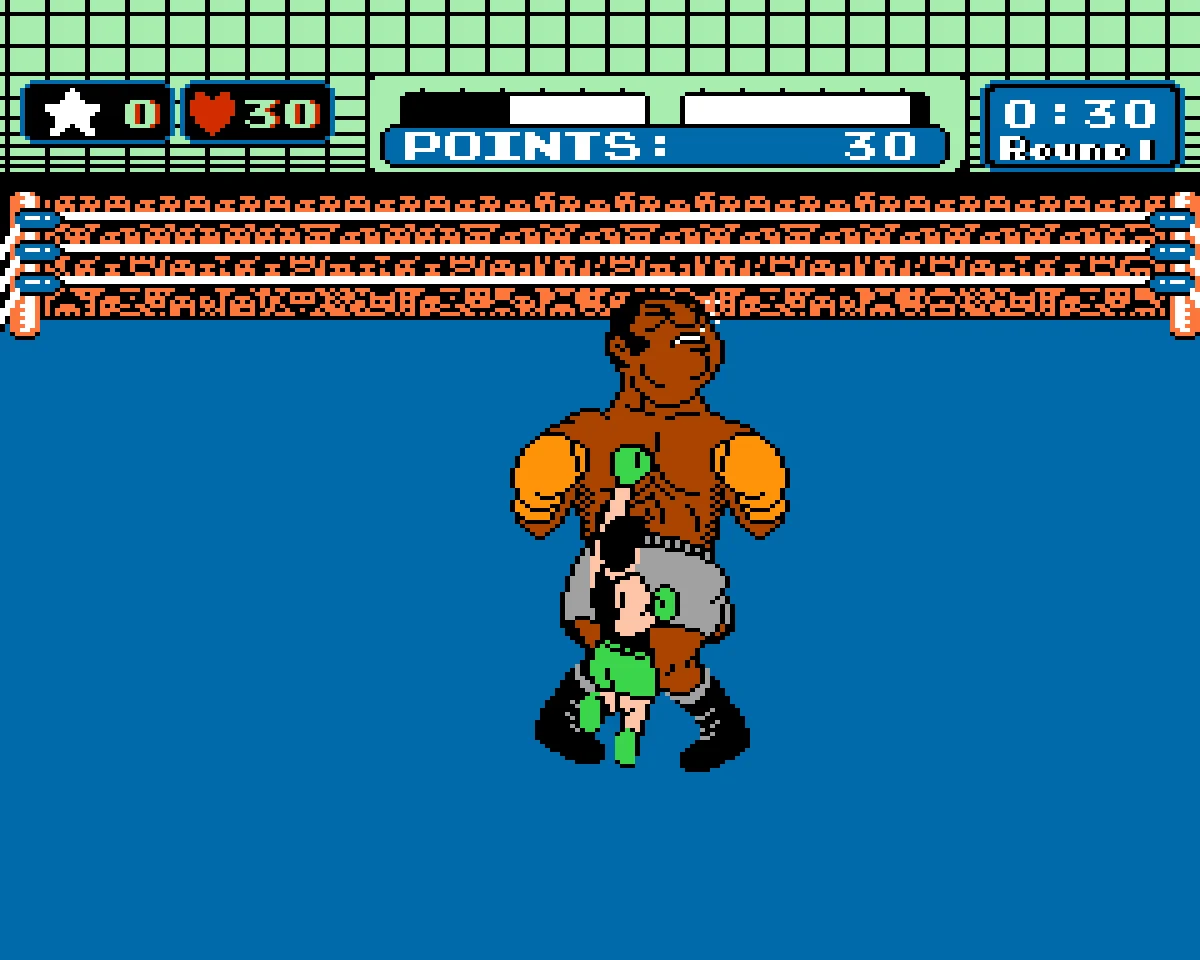
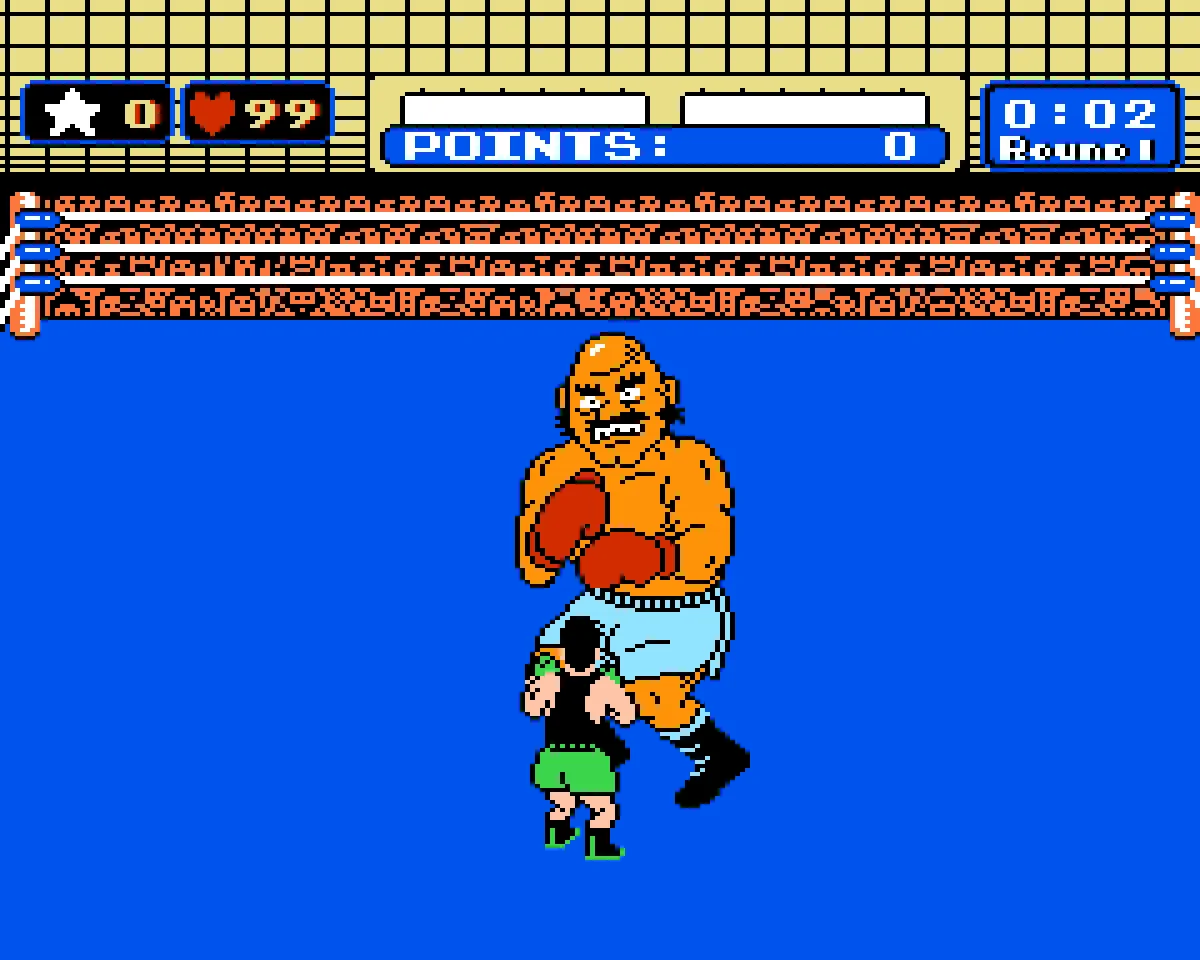
Sources & references
Our original guide draws on the references below. Check the edition at the top of this page before following controls or unlock requirements.
- Mike Tyson's Punch-Out!! NES Instruction Manual
- Mike Tyson's Punch-Out!! NES Instruction Manual PDF
- Block - Punch-Out!! Wiki
- Mike Tyson's Punch-Out!! - Guide and Walkthrough — GameFAQs
- Mike Tyson's Punch-Out!! The Dream Fight — StrategyWiki
- Mike Tyson's Punch-Out!! Gameplay — StrategyWiki
- Mike Tyson's Punch-Out!! - Guide and Walkthrough
- Mike Tyson’s Punch-Out!! NES Instruction Manual
- Mike Tyson's Punch-Out!! NES RAM Map
- The W.V.B.A. Circuits
- Mike Tyson's Punch-Out!! Miscellaneous and Cheats
- Punch-Out Walkthrough — GameSpot
- Mike Tyson’s Punch-Out!! — Opponent Behaviour Guide: Glass Joe
- Mike Tyson’s Punch-Out!! — FAQ and opponent strategies
- Mike Tyson's Punch-Out!! — FAQ and opponent strategies
- Mike Tyson's Punch-Out!!/Minor Circuit — StrategyWiki
- Mike Tyson’s Punch-Out!! — FAQ — NES — By Death_Hunter
- King Hippo — Mike Tyson’s Punch-Out!! Opponent Behaviour Guide
- Mike Tyson’s Punch-Out!! — Guide and Walkthrough
- Mike Tyson’s Punch-Out!! — Opponent Behaviour Guide: Great Tiger
- Punch-Out!! Featuring Mr. Dream NES Instruction Booklet: Password and Circuit Structure Reference
- Soda Popinski — Mike Tyson's Punch-Out!! Opponent Behaviour Guide for NES
- GameResources/NES/MikeTysonsPunchout/SodaStrats — TASVideos
- Bald Bull II - Mike Tyson's Punch-Out!! Walkthrough & Guide
- Mike Tyson's Punch-Out!! - World Circuit Strategy Guide
- Mr Sandman — Mike Tyson's Punch-Out!! Walkthrough & Guide — NES
- GameResources/NES/MikeTysonsPunchout/SuperMachoManStrats — TASVideos
- GameResources/NES/MikeTysonsPunchout — TASVideos
- Mike Tyson's Punch-Out!! Instruction Booklet - Nintendo NES
- Mike Tyson's Punch-Out!! - vs. Mike Tyson FAQ by brian_sulpher
- Punch-Out!! Password Guide
- Nintendo Power: Another World Circuit password instructions
- Punch-Out!! Cheats, Codes, and Secrets for NES
- Mike Tyson's Punch-Out!! NES Guide
- Mike Tyson's Punch-Out!! - Mike Tyson Guide — GameFAQs
- Another World Circuit
About the game & collecting notes
- Platform
- Nintendo Entertainment System
Step-by-step guidance to climb the WVBA ranks as Little Mac on the original 1987 NES release (Japan/USA Rev A). Learn core mechanics, how to read every opponent's tells, where and when to earn stars for uppercuts, how the password/continue system works, and the route to reach and defeat the original final boss (Mike Tyson) and unlock Title Defense.
Darryl Polo
Darryl Polo loves tinkering with emulation and revisiting retro games. He enjoys exploring how old favorites play on different setups and sharing what he learns along the way. At Joking Joystick, he writes about the games, hardware, and small discoveries that keep the hobby fun.
Our editorial standardsFound a step that needs another look? Help us improve this guide.