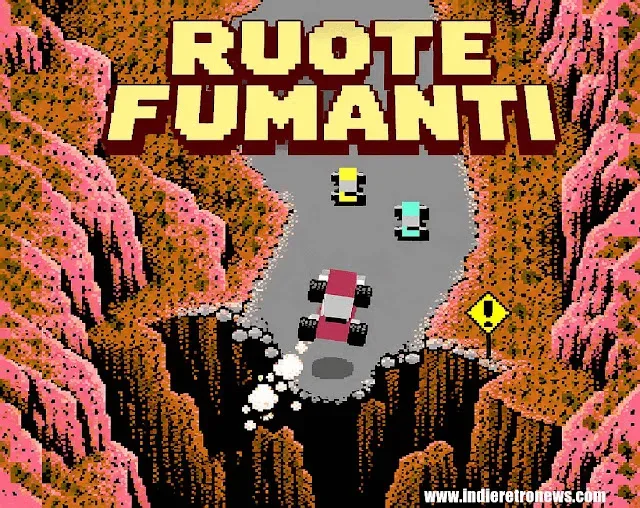
There is something inherently cheeky about asking a stock Commodore 64 to deliver a fast, crowded arcade racer in 2026. The machine is beloved precisely because its limitations are so familiar: modest memory, a processor that has inspired decades of wizardry, and graphics hardware that continues to reward developers willing to wrestle every last cycle from it. Ruote Fumanti (Smoking Wheels), a new racing game from charger0277, takes that challenge head-on with a compact 24 KB program designed for PAL C64 systems.
The headline figure is ambitious and admirably specific: the game targets 50 frames per second on unexpanded PAL hardware. It does so while presenting a road that scrolls pixel by pixel and keeping eight sprites in motion at once. Those are the kinds of technical details that matter in a game built around reflexes. A racer can have spectacular art and a catchy tune, but if a corner arrives late or the scenery shudders under pressure, the driver feels it immediately. Ruote Fumanti’s design is plainly focused on making the C64 feel quick, responsive, and properly hectic.
It is also intended to work across the ways people actually use the platform today. No memory expansion is required, with compatibility stated for original Commodore 64 hardware, flashcarts, and modern emulators. That leaves the game rooted in the original machine rather than treating it as a historical logo pasted onto a more heavily upgraded setup.
A small program with a big need for speed
At 24 KB, Ruote Fumanti is tiny by modern standards, yet the size is part of its appeal. The C64 scene has long turned constrained memory into a creative prompt, and a compact racing game has to spend its available space carefully: road effects, vehicles, collision behavior, stages, visuals, music, and the code that holds it together all compete for room. Here, the approach is a custom engine paired with custom graphics and a newly made chiptune soundtrack.
The result draws from the broad arcade-racing energy of the 1980s without simply presenting itself as an imitation of one specific cabinet classic. That distinction matters. Arcade road games of the period often excelled at immediate spectacle: a road surging toward the player, traffic appearing exactly where it is least welcome, and a machine constantly encouraging one more run. Ruote Fumanti appears to pursue that same directness, but its individual mechanics give it a more combative personality.
Rather than treating rival vehicles as passive obstacles, the game makes aggressive traffic central to the drive. Overtaking is one option, but it is not the only answer. Players can ram opponents off the asphalt or use jumps to launch over them. That turns the road into more than a sequence of braking points. It becomes a narrow, moving arena where position, momentum, and nerve all matter.
There is a useful contrast with many contemporary racers, where clean laps and carefully managed racing lines dominate. Ruote Fumanti is built around surviving and exploiting chaos. The ideal route may be clear for one second, then become a traffic jam that demands a shove, a leap, or a fast reroute. On a machine associated with tightly programmed action games, that rough-and-ready spirit feels entirely appropriate.
Stability is part of the feature set
The game’s performance claims are not presented only as a target. Testing across its eight stages and 9,600 frames reportedly found an overall dropped-frame rate of 0.1%. Six of those stages recorded no dropped frames at all. For a scrolling racer on stock PAL hardware, that is a meaningful technical result, particularly given the simultaneous sprite activity and pixel-level road movement described for the engine.
Related coverage includes Ruote Fumanti Brings High-Speed Arcade Racing to Commodore 64.
Frame-rate statistics can sound dry on paper, but they translate directly to the experience a racing game is trying to create. Smooth motion helps a player judge speed and distance. It makes it easier to read an oncoming obstacle, anticipate a bend, and decide whether a risky pass is still possible. In a title where traffic can be rammed, jumped, or avoided, stable visual timing is not merely a boast for programming enthusiasts; it supports the game’s moment-to-moment decision-making.
That emphasis also speaks to why new retro software remains compelling. Vintage hardware is not only a vehicle for nostalgia or a museum piece. It is a defined technical environment with rules developers can learn, challenge, and occasionally bend in astonishing ways. Recent projects across classic home computers continue that tradition; for another example of a new release engaging with an older Commodore platform, see The AmiGoonies’ move to Commodore Amiga.
Eight stages, and the road does not play fair
Ruote Fumanti’s eight stages are not simply backdrop changes. Each can introduce hazards designed to alter how the player approaches the route. Winter sections bring slippery ice, a familiar racing-game threat that becomes especially tense when the road is already populated by belligerent traffic. Reduced grip means a maneuver that would be safe in a dry setting may suddenly become an invitation to spin, slide, or collide.
Other routes include deep fords. These are not obstacles to crawl through at leisure: clearing them requires a jump at a minimum speed of 95 mph. It is a wonderfully arcade-minded demand. The player must commit to acceleration in order to escape the danger, making the correct response potentially more dangerous than slowing down. The decision has to be made before the hazard is under the bumper, not after.
Rock ravines offer another kind of punishment. Fall into one and the vehicle visibly shrinks into the abyss. It is a dramatic way to mark a mistake, and it reinforces the verticality implied by a scrolling road game. The threat is not always just another car occupying a lane; sometimes the track itself asks whether the player has enough control to keep all four wheels out of a very bad place.
Together, ice, fords, and ravines suggest a stage structure that values adaptation over rote repetition. The core controls may remain straightforward, but the meaning of speed and placement can change from one environment to the next. A high-speed leap is mandatory at a ford, whereas excess speed on ice could make the surrounding traffic impossible to manage. The game’s hazards therefore appear designed not only to surprise but to force players to reconsider their habits.
Every stage ends with a police cruiser problem
At the end of each stage, Ruote Fumanti switches from traffic survival to a one-on-one confrontation with an aggressive police cruiser. These encounters introduce a crucial restriction: jumping is disabled. A move that may have helped players bypass traffic earlier is removed precisely when the pressure peaks.
That leaves a simple but charged choice. Hold the racing line and attempt to outdrive the pursuing cruiser, or turn the confrontation physical and try to knock the police car off the road. The latter carries the promise of the game’s ultimate point payout, giving score-minded drivers a reason to embrace the most confrontational possible strategy. The police showdown is not described as a passive finish-line formality; it is a final test of control and audacity after each stage.
The lack of jumping is especially smart because it changes the language of play. In earlier sections, a jump can be a route through congestion or over an opponent. In the duel, the player must solve the encounter with steering, speed, positioning, and contact. It makes the stage finale feel distinct without needing an entirely different rule set.
A modern reason to dust off the breadbin
Ruote Fumanti is an encouraging example of the kind of focused new game that classic hardware can still receive. Its specifications are proudly old-school: 24 KB, stock PAL C64 support, and a 50 FPS goal. Yet its priorities remain timeless for an arcade racer: readable speed, sharp hazards, memorable stage twists, and opponents that refuse to behave politely.
Most importantly, charger0277’s game appears to understand that the best retro-inspired racers are not sustained by references alone. They need a hook that players can feel in seconds. Here, that hook is a compact, fast-moving road game in which overtaking is optional, ramming is encouraged, jumps can save a run, and every successful stage ends by asking whether the player is brave enough to pick a fight with the police.