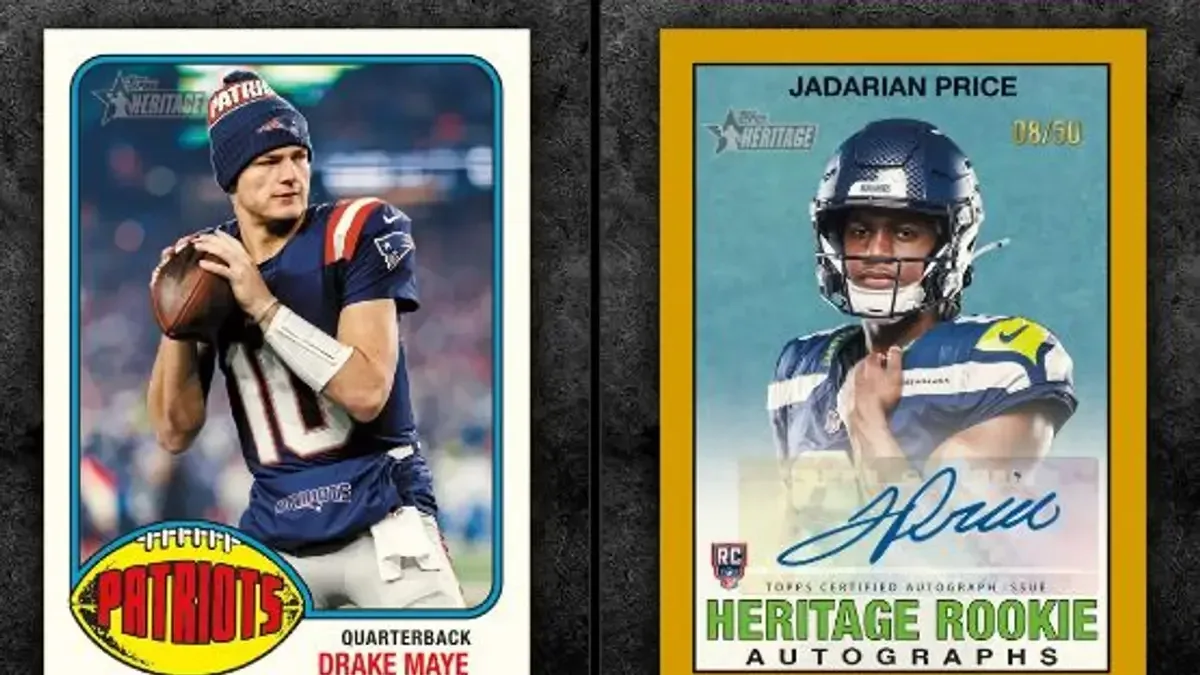
Topps Heritage Football is returning to the football-card calendar in 2026, marking the brand’s first football release since 2015. Preorders are set to open Monday, September 21. The comeback arrives after Topps obtained NFL licensing, creating room for a familiar name that collectors generally associate more closely with baseball to resume its place in football.
The central idea is not a modern redesign. Heritage is built around deliberate visual time travel, and the 2026 football edition will take its base-card look from 1976 Topps Football. That makes the set a 50-year callback rather than simply a vintage-flavored release: its borders, layout and overall presentation are intended to evoke the cards of that specific era.
For collectors, that clarity matters. A retro set can mean anything from a few nostalgia inserts to an entire product built around an older template. Here, the 1976-inspired styling is the foundation of the base set itself. Announced components also point toward a release designed to put period-referential presentation ahead of an overloaded menu of unrelated themes.
A 1976 blueprint for the base set
The base cards will mirror the 1976 Topps Football design. Early previews indicate a clean, straightforward throwback presentation, which is consistent with Heritage’s broader appeal: a player card should remain easy to recognize from a distance, even when the player, team and season are contemporary.
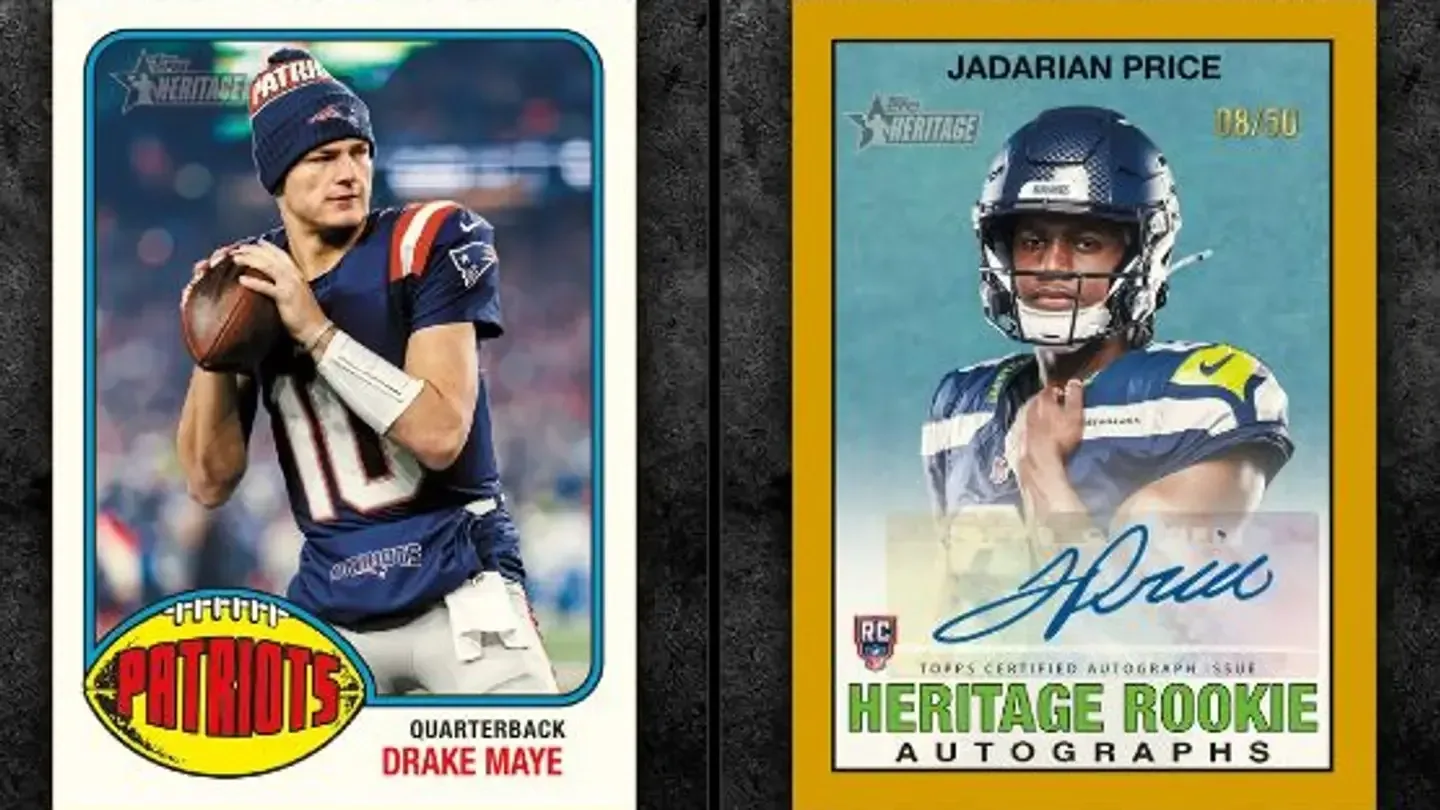
Topps has also confirmed the return of base-card image variations. An image variation uses the same basic card identity as a regular base card but changes the photograph or visual treatment. It is not necessarily a different player or a separate insert concept. Instead, it creates a harder-to-find alternate version of a familiar card, giving set builders and player collectors a second version to identify.
That distinction is useful when organizing a collection. A collector chasing the standard base checklist can treat the image variation as a separate target rather than assuming every alternate photo is a printing mistake. At the same time, the presence of variations means that completing a player run may require more than locating the most obvious base card.
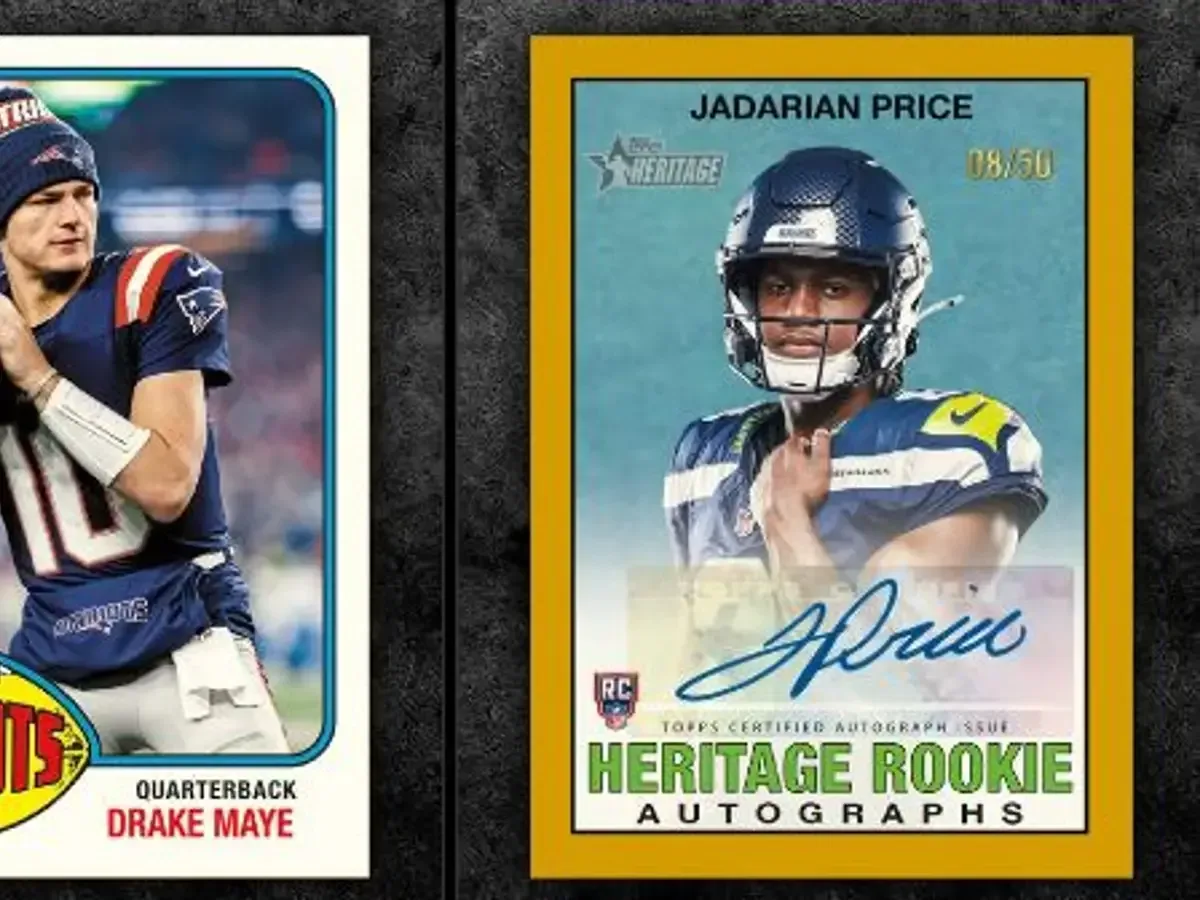
Drake Maye has been shown on a base-card image variation preview. The preview establishes that the variation format is part of the product, but it does not by itself establish a complete variation checklist, scarcity level or the full roster of players who will receive alternate images. Those details remain important unknowns for anyone planning a master set.
Inserts reach back to the 1976 NFL landscape
Several announced insert lines extend the 1976 connection in different ways. The most explicit is All-Pro Series, a 24-card insert inspired by 1976 Wonder Bread Football cards. Its subject pool is made up of All-Pro standouts from the 2025 season, combining a historical card influence with recent on-field recognition.
Related coverage includes 2026 Topps Heritage Football Marks Brand’s First Return Since 2015.
That is a useful example of how a heritage product can be retrospective without being restricted to historical players. The visual language refers back, while the checklist focus remains contemporary. For a collector who wants current NFL names but prefers a less modern-looking card, All-Pro Series appears positioned as one of the release’s most direct answers.
The Expansion takes a different route. The insert will feature cards from the 28 teams that were in the NFL in 1976, after the Seattle Seahawks and Tampa Bay Buccaneers joined the league. Justin Herbert has appeared in an early preview for the line. The concept ties the insert to the league’s footprint at the time of the design being honored, rather than simply repeating the base-card design with a new title.
Two additional inserts, New Age Performers and Through the Years, have also been announced. Their inclusion gives the product more to chase beyond its regular cards and image variations, although specific card counts, subjects and odds for those lines have not been provided in the information available so far.
An insert is a themed subset placed within a broader card product rather than the principal base checklist. Inserts often have their own design and subject criteria. In practical collecting terms, a named insert can be a focused player chase, a compact themed set, or a bonus target for someone who does not intend to pursue every base card and parallel.
Autograph chases include Real Ones, Chrome and rookie cards
Autographs will be a major part of 2026 Topps Heritage Football. Real Ones Autographs return, including the Red Ink version that has historically been a centerpiece of Heritage autograph collecting. The Red Ink designation refers to the autograph-ink color; it gives the signed card a visibly distinct form from a standard ink version and separates it as its own chase within the autograph program.
The set will also include Base Chrome Autographs for rookies and veterans. “Chrome” refers to the glossy, metallic-finish card stock and presentation associated with that branding. The concept here is a chrome counterpart that follows the paper base design, so collectors can expect continuity in the underlying 1976-inspired layout even as the finish changes.
Topps has additionally previewed Heritage Rookie Autographs, including at least a Gold parallel numbered to 50. A card marked /50 is serial-numbered within a run of 50 copies, a concrete print-limit signal rather than merely a color change. The announced Gold /50 version featuring Jadarian Price illustrates the type of numbered rookie autograph that will be part of the release.
It is worth separating what has been previewed from what has not. The announcement identifies autograph styles and confirms at least one numbered Gold rookie-autograph treatment. It does not provide a full autograph checklist, a complete list of parallels, pack odds or a stated hierarchy of scarcity across the entire product. Collectors weighing whether to preorder will still need those product details once they are published.
Player-worn memorabilia comes to Locker Room Collection
2026 Topps Heritage Football will include player-worn memorabilia cards. The announced Locker Room Collection Autograph Relics combine two collectible elements on one card: a player signature and a relic piece. Caleb Williams has been previewed for the line.
A relic card contains an embedded piece of memorabilia material. In this case, the material is identified as player-worn. That wording is specific and should not be read as a claim that the memorabilia was used in an NFL game. For collectors, clearly distinguishing player-worn from game-used material is a practical habit, particularly when comparing cards across releases or deciding which kind of memorabilia card best fits a collection.
Autograph relics tend to concentrate several pursuits into a single card: player selection, signature and memorabilia component. That does not make every example equivalent—numbering, print run and the player involved can still differ—but it explains why the format is usually a major part of a product’s higher-end chase structure.
Where Heritage fits in Topps’ 2026 football rollout
Heritage is expected to be the third Topps football release of the 2026 season. 2026 Topps Flagship Football arrived August 21 and included rookie cards for Fernando Mendoza and Drew Allar. 2026 Bowman Football is scheduled for September 30 and will place NFL and collegiate stars in the same set, including Texas quarterback Arch Manning.
That sequence helps define Heritage’s role. Flagship establishes the standard Topps football-card format, while Bowman is positioned around a blend of NFL and college subjects. Heritage instead offers a design-led alternative, using a recognizable historical model to frame current players and contemporary collecting formats.
Topps has also begun issuing Topps Now football cards since obtaining licensing. Week 1 cards included Arizona Cardinals rookie running back Jeremiyah Love and Kansas City Chiefs tight end Travis Kelce. The contrast is notable: Topps Now is a rapid-response card format centered on recent moments, whereas Heritage is structured around a fixed vintage inspiration and planned subsets.
The 2026 lineup is therefore not just a return of a dormant football brand. It gives collectors multiple approaches under the same license: conventional flagship cards, a college-and-NFL mix through Bowman, timely Topps Now releases, and a 1976-styled Heritage product. Brand licensing can shape which names and visual identities appear on cards, an issue with echoes beyond cards in sports-related intellectual-property disputes such as this recent Yankees logo dispute.
What collectors can reasonably plan for now
Collectors interested in 2026 Topps Heritage Football can already identify the product’s core lanes: the 1976-style base set, base image variations, All-Pro Series, The Expansion, New Age Performers, Through the Years, several autograph formats, and player-worn Locker Room Collection Autograph Relics.
- Base-set collectors should account for image variations as a distinct part of the chase.
- Vintage-design fans have a clear reason to focus on Heritage, since the 1976 Topps Football look drives the release.
- Autograph collectors can watch for Real Ones, Red Ink, Base Chrome Autographs and Heritage Rookie Autographs, including the announced Gold /50 level.
- Memorabilia-card collectors should note the player-worn designation on Locker Room Collection Autograph Relics.
- Team and player collectors may find The Expansion especially useful if they want a subset connected to the 28-team NFL of 1976.
What remains unconfirmed is just as important: a full checklist, complete parallel details, pack configuration, odds, card counts beyond the 24-card All-Pro Series, and a release date were not included among the announced information. Preorders opening September 21 establish the next calendar marker, but they do not answer every question that affects a collecting plan.
Still, the essential pitch is unusually well defined. Topps Heritage Football is returning after an 11-year absence with its identity intact: old-school card design, contemporary NFL subjects, alternate-image collecting, signature chases and memorabilia cards. For a product named Heritage, that may be exactly the point.