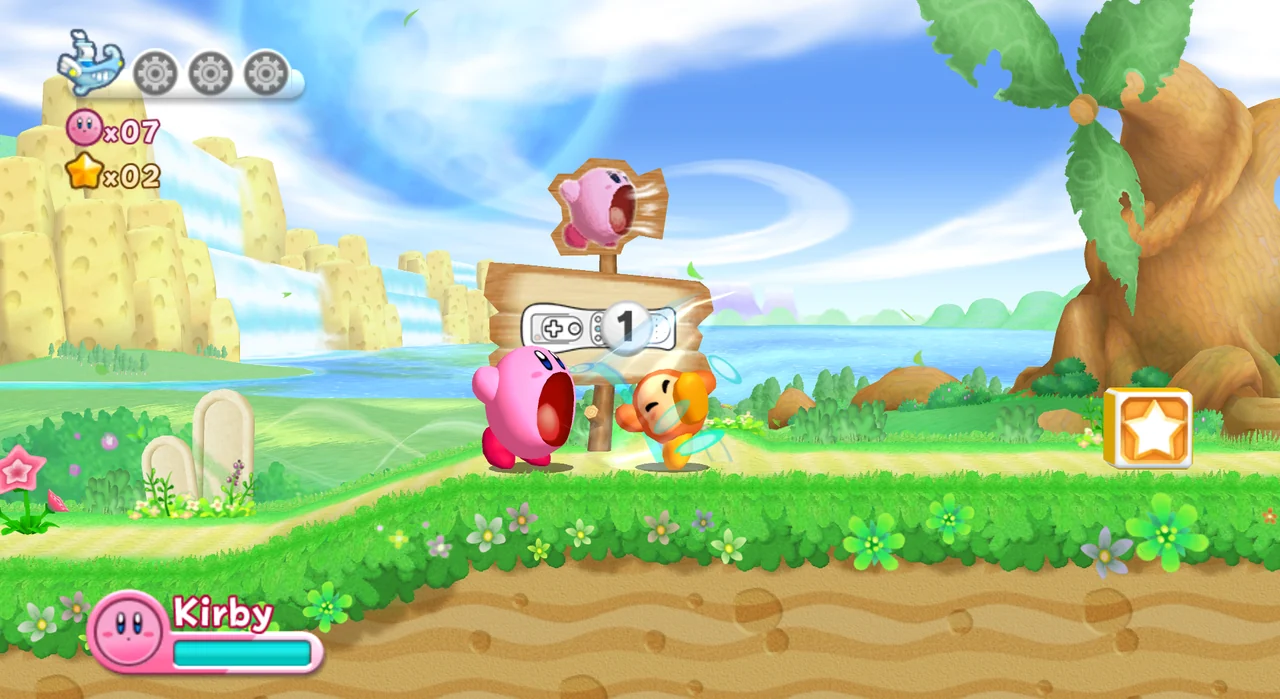
Super Mario Galaxy on the original Nintendo Wii and Super Mario Sunshine on the original Nintendo GameCube are not simply two versions of the same 3D platforming formula. They use different ideas to shape almost every jump. Galaxy turns movement into a conversation with gravity, while Sunshine gives Mario a water pack that changes how he crosses, cleans and reads an environment.
The practical choice comes down to friction. If you want a clear objective, frequent changes of scenery and stages that usually point toward their intended route, Galaxy is the safer starting point. If you enjoy revisiting connected spaces, searching for environmental clues and mastering a tool that can rescue or complicate a jump, Sunshine may be the more rewarding challenge.
The quick decision: guided spectacle or open-ended island movement
Galaxy organizes play around individual galaxies and named missions. A typical objective belongs to a compact, highly themed route, and the game regularly introduces a visual idea before asking you to use it. Planetoids, launch points and gravitational surfaces create dramatic transitions, but they also tend to communicate where the next meaningful action is. This makes Galaxy a strong fit for players who dislike wandering through a large area while trying to remember what they were supposed to accomplish.
Sunshine connects its objectives through Isle Delfino and its shared locations. Episodes change the immediate task inside a familiar place, so returning to the same area does not necessarily mean repeating the same kind of activity. That structure supports discovery, alternate routes and environmental memory, but it can also make the game feel less direct. You may understand the broad destination while still needing to determine which local object, ledge or condition matters now.
Neither structure is automatically better. Galaxy reduces search friction by breaking its adventure into focused assignments. Sunshine makes the setting feel more coherent and gives exploration greater weight. Choose Galaxy if you want each mission to establish its own rhythm. Choose Sunshine if revisiting a location and noticing how its systems interact sounds more appealing than moving through a sequence of isolated set pieces.
- Choose Galaxy for focused, strongly framed objectives.
- Choose Sunshine for connected locations and repeated environmental discovery.
- Do not treat Galaxy’s guided structure as a sign that every challenge is easy; its timing and gravity sequences still demand precision.

The original controls change what movement feels like
The original Galaxy release expects a Wii Remote and Nunchuk. Mario’s spin is performed by shaking a controller, and the pointer is part of ordinary play rather than an optional menu convenience. The pointer can collect Star Bits, target Pull Stars and interact with selected objects. That means Galaxy divides attention between analog movement, pointing and motion input. Players comfortable with the Wii control scheme may find this natural; players who prefer every action on a traditional gamepad may need a longer adjustment period.
Sunshine uses the GameCube controller’s analog stick, camera controls and face buttons, with FLUDD functions layered over Mario’s established movement. The water pack is not only an attack or a cleaning accessory. Its nozzles alter how Mario approaches a space, whether he is cleaning a surface, hovering to correct a jump or using water to affect an obstacle. The control burden is therefore less about motion input and more about remembering which tool state matches the problem.
This distinction matters when deciding what kind of complexity bothers you. Galaxy’s input scheme can feel unusual because the Wii Remote pointer and shake are always relevant. Sunshine’s scheme is more conventional, but its movement vocabulary is broader once FLUDD becomes part of every route. A player may prefer Sunshine’s buttons and analog stick while still finding its situations harder to parse.
- Galaxy uses the original Wii Remote and Nunchuk control model.
- Sunshine uses the original GameCube controller and FLUDD nozzle functions.
- Do not apply control options from Super Mario 3D All-Stars to these original-platform editions.
Galaxy makes gravity part of the route
Galaxy’s planetoids change the meaning of direction. Mario can run around curved surfaces, launch between bodies and move through areas where the next safe landing is shaped by gravitational fields rather than a conventional floor. A jump is not always about crossing a gap from left to right. It may be about reaching another surface whose orientation changes as soon as Mario lands.
That unfamiliarity creates an early learning cost, but Galaxy often compensates with strong visual communication. The next planet, launch point or platform is frequently placed as the obvious subject of the current scene. Gravity is strange, yet the route can remain readable because the stage design focuses attention on the next transformation. Once the player accepts that a wall, ceiling or small planetoid can become the new ground, the system becomes a source of momentum instead of confusion.
The tradeoff is that Galaxy often asks for timing under unusual physical rules. Missing a jump, misjudging a launch or failing to account for a curved surface can cost a life even when the objective was visually clear. Players who dislike learning a new spatial rule may prefer Sunshine’s more familiar ground. Players who dislike searching may find Galaxy’s strange physics easier to tolerate because the game more often shows what the physics is for.
- Expect Galaxy to challenge your sense of floor, ceiling and direction.
- Read launch points and nearby gravitational surfaces before committing to a jump.
- Choose Galaxy when unusual physics is more attractive than a large search space.

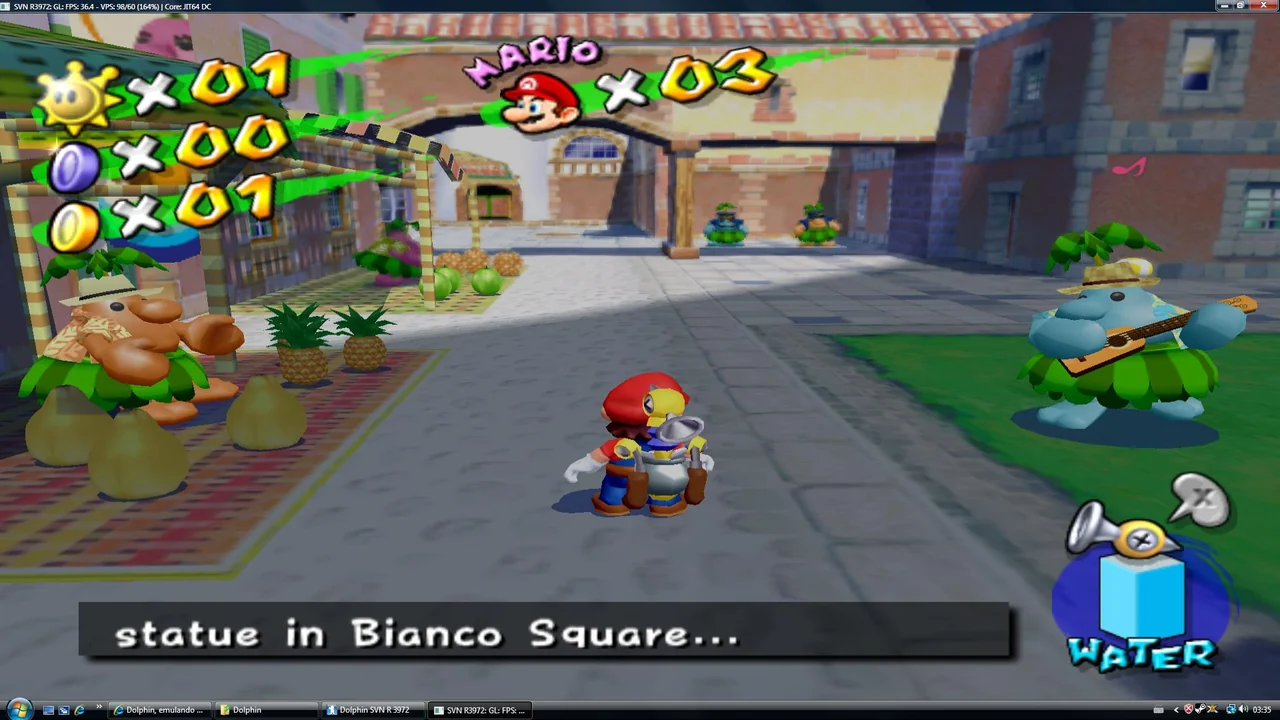
Sunshine turns every jump into a FLUDD decision
FLUDD changes Sunshine’s movement in two opposing ways. Its Hover Nozzle can correct a jump, soften a mistake and help Mario cross a gap that would otherwise require a more exact landing. Water can also influence enemies, objects and contaminated areas, so the pack is part of the environment’s logic rather than a separate combat tool.
That flexibility can make ordinary traversal expressive. A player can approach a ledge with a plan for a running jump, then use water to adjust the result. Other situations ask for a different nozzle or temporarily take FLUDD away, forcing Mario to rely on ordinary jumps, wall jumps and platforming skills. This contrast is central to Sunshine’s difficulty profile. The water pack may make one section forgiving while making the next section feel much less forgiving because its assistance is unavailable.
The complexity is not only mechanical. You also need to recognize whether the current problem is asking for cleaning, hovering, vertical movement or a normal Mario maneuver. A player who enjoys experimenting with a tool will find useful freedom here. Someone who wants movement rules to remain consistent from one stage to the next may regard nozzle selection and FLUDD restrictions as unnecessary friction.
- Treat FLUDD as a traversal system, not only as a way to clean surfaces.
- Expect some challenges to reduce or remove the pack’s movement assistance.
- Choose Sunshine if correcting a jump with a tool sounds satisfying rather than disruptive.
Camera workload: supported framing versus manual repair
Camera friction is one of the clearest differences between these games. Galaxy’s stages are usually shaped around a particular route, a distinct planetoid or a compact set piece. The camera still requires attention, especially when Mario moves around curved surfaces or approaches an edge, but the geometry often narrows the number of plausible directions. The game is more likely to frame the important platform, launch point or hazard as part of its presentation.
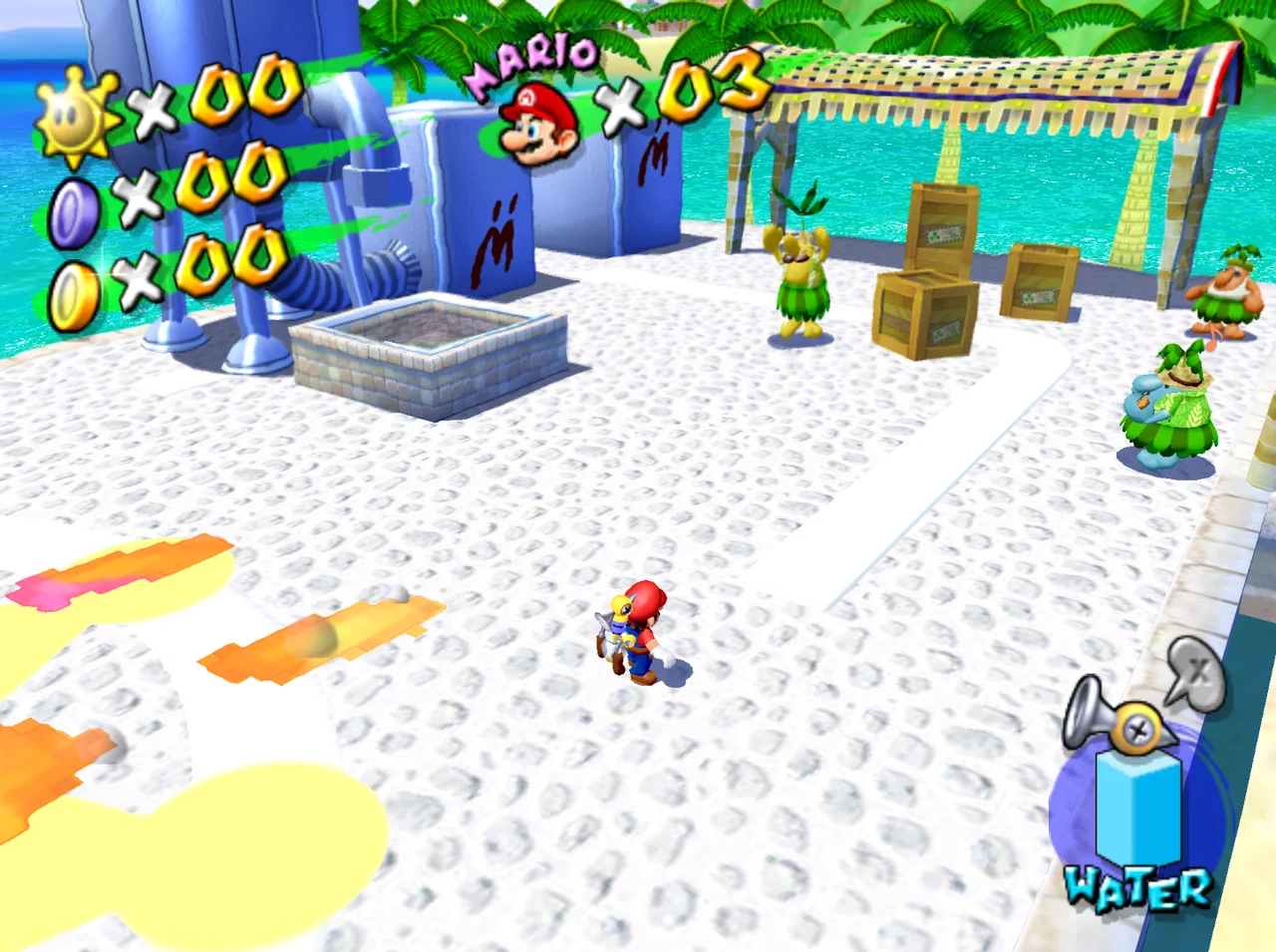
Sunshine more often places Mario in broad outdoor areas, vertical structures and spaces that must be approached from several angles. The player may need to reposition the view before lining up a jump, spraying a target or judging the distance to a ledge. When Mario, FLUDD and the camera all demand attention, a failed attempt can feel like a perspective problem rather than a movement problem. That distinction matters if you are especially sensitive to losing track of Mario or the next landing.
This is not an argument that Galaxy has no camera problems or that Sunshine makes every view unusable. It is a difference in workload. Galaxy generally asks you to interpret a camera that supports a designed route. Sunshine more often asks you to actively repair the view while also deciding how to move. Players with low tolerance for manual camera management should start with Galaxy.
- Before blaming a jump in Sunshine, check whether the camera is showing the intended landing angle.
- Use environmental landmarks to maintain orientation in connected areas.
- Pick Galaxy if camera correction is more frustrating to you than learning gravity.
Mission clarity and the cost of looking around
Galaxy’s named missions provide a useful mental boundary. You know which assignment you selected, and the stage commonly reinforces that assignment through its layout, hazards and sequence of set pieces. The game still hides optional discoveries and asks you to observe carefully, but the main question is often how to complete the current route rather than what the route is.
Sunshine’s episode structure gives each location a larger memory. A familiar beach, harbor or village can support different objectives depending on the selected episode. That makes the world feel layered, but it also means that the immediate task may depend on context. A player who rushes through a space may miss a visual clue or fail to notice that the selected episode changes what is available.
Sunshine’s broader collectible layer adds another form of ambiguity. Shine Sprites are the main progression goal, while red-coin challenges and Blue Coins create additional reasons to inspect areas and remember unusual conditions. That is excellent for explorers and completion-minded players. It is less comfortable for anyone who wants the game to identify every meaningful task without requiring a separate memory of the environment.
- Galaxy is better for players who prefer a mission to explain its short-term purpose.
- Sunshine is better for players who enjoy searching after the obvious route is complete.
- Do not confuse optional collectible opacity with the clarity of the main objective.
Difficulty friction comes from different sources
Galaxy’s most common pressure points are timing, momentum and spatial rules. The player may understand the goal but still need to execute a sequence around moving hazards, changing gravity or narrow landing zones. Its stages can feel demanding without being directionless. Failure usually teaches something about timing, route reading or the behavior of the current set piece.
Sunshine’s friction is more uneven. FLUDD can make traversal forgiving, but camera positioning, vertical spaces, episode context and FLUDD-less platforming can raise the demand sharply. Some challenges test ordinary movement after the water pack has taught you to rely on correction. Others ask you to manage a camera and a movement tool at the same time. The result is a game whose difficulty can feel less predictable from one objective to the next.
That makes a universal difficulty verdict misleading. Galaxy is often the better fit for someone who wants challenge presented in a clearer package. Sunshine can be easier during a hover-assisted crossing and harder when the game expects precise platforming without that assistance. The useful question is not which game has fewer failures, but which kind of failure you find understandable enough to try again.
- Choose Galaxy for timing and gravity challenges with stronger immediate framing.
- Choose Sunshine if uneven demands are acceptable in exchange for more movement freedom.
- Treat camera errors, unclear objectives and execution errors as different kinds of difficulty.
Galaxy’s second-player option is assistance, not equal co-op
Galaxy’s original Wii release includes Co-Star Mode, but it should not be described as two players controlling equal characters. One player controls Mario. A second player uses another Wii Remote to perform selected pointer-based actions, collect Star Bits, help indicate directions and interfere with certain enemies or hazards.
The second player can also make Mario jump or spin in selected situations, but Mario remains the primary character and the first player remains responsible for navigating the stage. The mode is therefore closer to an assist role than to the two-character platforming found in games designed around equal players.
That distinction affects who should choose Galaxy for a shared session. Co-Star Mode can give a younger, less experienced or less physically confident player meaningful participation without requiring them to control Mario’s full movement set. If you want a cooperative game where both participants move independently through the stage, this is not that experience. If you want one person to play while another provides targeted help, Galaxy offers a distinctive option.
- Galaxy’s Co-Star Mode does not give the second player an independently controlled character.
- Describe it as pointer-based assistance and environmental help.
- Do not use later multiplayer expectations to judge the original Wii mode.
Completion pressure: Stars, Shines and the point where collecting changes
Galaxy’s progression is built around collecting Power Stars from missions across its galaxies. The structure encourages movement between distinct challenges, and the player can usually understand which mission is active and what kind of stage it represents. Optional discoveries still reward curiosity, but the adventure’s organization keeps the central progression relatively legible.
Sunshine’s Shine Sprites are tied to episode objectives across Isle Delfino, while red-coin tasks and Blue Coins add layers beyond the most direct route. Blue Coins in particular can turn environmental observation into a long-term memory exercise because their relevance may not be obvious when you first enter a location. That is appealing if you like returning with a new idea, but it can feel like unfinished business rather than a cleanly signposted challenge.
For a first playthrough, the difference is simple: Galaxy makes it easier to focus on the next mission, while Sunshine invites you to keep a mental list of what a location might still contain. Completionists should decide whether they prefer many self-contained assignments or a connected world with overlapping collectible demands.
- Choose Galaxy for a cleaner separation between one mission and the next.
- Choose Sunshine if revisiting locations and tracking layered collectibles is part of the appeal.
- Do not assume that ignoring optional items makes both games feel equally structured.
Which game should you play first?
Pick Super Mario Galaxy first if you want a 3D Mario adventure with strong visual direction, focused mission framing and a movement concept built around gravity. It suits players who can tolerate an unusual control method and timing-heavy sequences but would rather not spend long periods searching a broad hub for the next meaningful task. It is also the better choice for a shared session when one person wants to assist without taking over Mario’s movement.
Pick Super Mario Sunshine first if you want an island setting that rewards inspection, a traditional GameCube control scheme and a movement tool that changes how Mario crosses space. It suits players who enjoy learning a flexible system, correcting jumps with Hover and returning to familiar areas with a new objective. It is a poorer fit if camera repositioning, unclear mission context or sudden FLUDD restrictions quickly turn experimentation into irritation.
If both kinds of friction sound interesting, Galaxy is the more approachable first step and Sunshine is the more demanding follow-up. That order lets you learn the broad language of 3D Mario through clearer assignments before tackling a game that asks you to combine movement, camera control, environmental reading and tool management more often.
- Choose Galaxy for clearer objectives, gravity-based set pieces, guided routes and assist-player support.
- Choose Sunshine for FLUDD experimentation, connected spaces, environmental searching and traditional GameCube input.
- Play both in sequence if you want to compare two different answers to the problem of moving Mario through three dimensions.
Super Mario Galaxy and Super Mario Sunshine do not divide neatly into easy and hard. Galaxy’s friction is concentrated in gravity, timing, motion controls and unusual spatial rules. Sunshine’s friction is more often created by camera work, objective context, vertical movement and the changing availability of FLUDD.
The best choice is the game whose mistakes you will understand. If a clearly framed gravity sequence sounds preferable to searching a connected island, start with Galaxy. If discovering how a water pack can reshape a familiar space sounds more exciting than maintaining a perfect camera angle, start with Sunshine.