Girl Group arrives with the fluorescent confidence of a turn-of-the-millennium music-video marathon: bold colors, big personalities, familiar pop nostalgia and a determined belief that a huge final performance can solve almost anything. Rebel Wilson directs, writes and stars in this U.S.-U.K. comedy, which uses a fallen pop singer’s second chance as the route into a youth-band competition story. The ingredients are immediately recognizable, and that is both the movie’s intended comfort and its chief limitation.
At 103 minutes, Girl Group moves with restless, joke-forward momentum. It wants to be a cheerfully excessive crowd-pleaser, all costumes, choreography, throwback references and personalities colliding in rehearsal rooms. There is nothing wrong with aiming for light entertainment. The problem is that the film regularly mistakes volume for escalation. It has a promising setup involving fame, failure, generational shifts in pop stardom and the messy business of mentoring, but it only intermittently lets those ideas develop beyond their broadest outlines.
From Gurlfriends to a youth-center reset
The story begins in 1997, when five school friends in London prepare to perform together as Gurlfriends. The opening gives the group a quick, glossy origin story: nerves backstage, an encouraging teacher played by Sally Hawkins, then a successful performance that launches the friends toward pop celebrity. A rapid montage covers the group’s rise and the fracture that follows when Tassie, Wilson’s character, leaves to pursue a solo career.
Tassie’s solo ambitions do not work out. Years later, she has fallen into alcoholism and is confronted with an especially bitter humiliation: Gurlfriends are preparing for a reunion without her, having installed another performer in her place. That premise has enough built-in sting to sustain a sharper comedy. It could explore the strange afterlife of manufactured pop fame, the tension among former bandmates, or the way a public identity can outlive the person who created it.
Instead, the script soon reroutes Tassie into court-ordered community service at a youth center. There, she is placed in charge of a group of young performers preparing for a competition that may bring them a recording opportunity. Tassie recognizes talent, but she also sees a possible route back to relevance. Her coaching therefore becomes inseparable from her own ego, as she pushes the teenagers toward a stylized version of the late-1990s and early-2000s pop machine that made Gurlfriends famous.
That mentor-and-underdog structure makes Girl Group easy to follow, even when it is not especially surprising. Tassie must gradually learn that the young singers are not props for her comeback narrative. They have their own creative instincts, ambitions and identities. The film knows exactly where this sort of story needs to go. It is less successful at making the route feel personal rather than pre-programmed.
The younger performers are the movie’s strongest hook
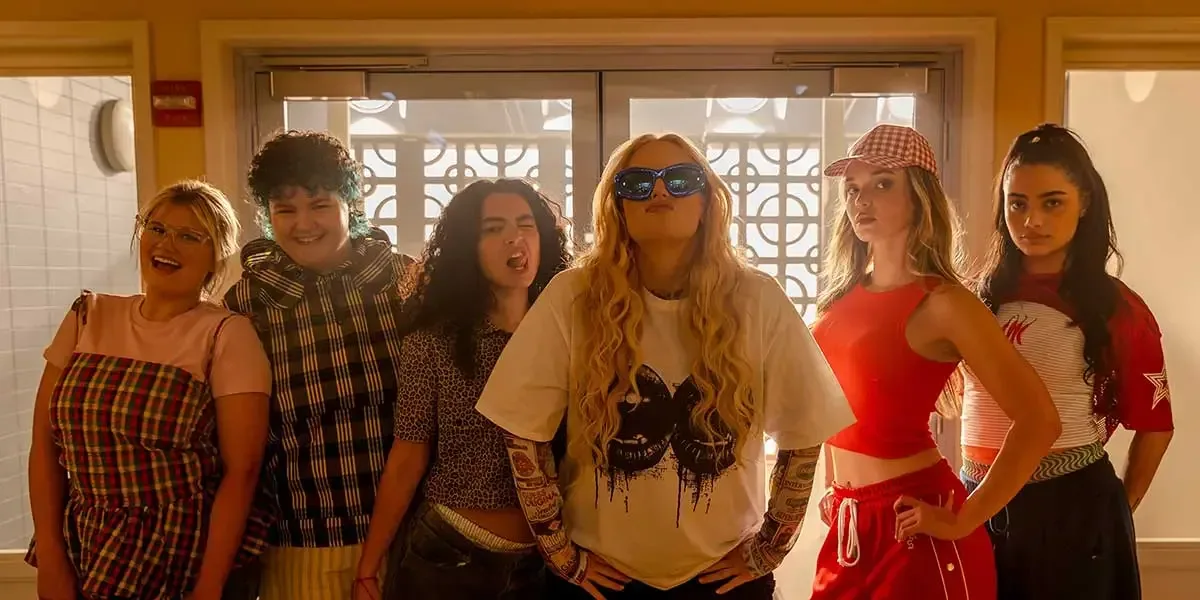
The most persuasive element is the youth ensemble. Their interaction has an ease that gives the movie a warmer center than its louder comic detours. When the performers are allowed to react to one another, work through their differences or simply occupy the same space as friends and collaborators, Girl Group hints at a more engaging film: one centered on a cohort of young outsiders building confidence on their own terms.
Chabely Ponce stands out as a singer-songwriter type with an acoustic guitar, bringing a grounded quality to a movie that often strains for heightened silliness. Lilah Pate is also effective as the group’s leader, projecting the kind of focus and resilience the story needs. Their work suggests characters with full lives beyond the standard competition-movie milestones.
Unfortunately, those threads often get displaced by Tassie’s antics. Wilson gives a big, uninhibited performance that fits the heightened register she has built for the film, but the writing keeps returning to exaggerated reaction shots, physical clowning and one-liners that do not always earn their place. The result is a frequent imbalance: the teenagers are positioned as the emotional future of the story, yet the movie repeatedly pulls attention away from them.
One scene involving an aggressive, nonconsensual kiss is particularly ill judged. It lands awkwardly in a film otherwise determined to be breezy, and it does not appear to be handled with the care such a moment requires. That choice undercuts the genial, empowering atmosphere the young ensemble otherwise helps create.
A pop-culture premise that avoids its sharpest questions
Girl Group gestures toward a genuinely worthwhile contrast between the pop industry of Tassie’s era and the perspectives of the Gen Z artists she mentors. The younger characters question the presentation of Gurlfriends and point to the male gaze that shaped much of the earlier group’s image. There is a real conversation waiting there about who controls a pop star’s branding, how female performers are marketed, and why nostalgia can obscure the compromises behind an apparently carefree hit song.
But the film leaves that material mostly untouched. It raises the issue, then keeps racing toward the next gag or musical beat. A comedy does not need to turn into a lecture to confront something meaningful; indeed, a sharper comic approach could have made the generational disagreement more pointed. Here, the potential is visible, but the movie seems reluctant to let discomfort interrupt its party.
That reluctance also shapes its humor. The screenplay leans heavily on bawdy bits, with occasional current-celebrity references thrown into the mix. Some viewers may find the unapologetic crudeness part of the appeal, but many of the jokes feel old-fashioned rather than daring. There are also repeated size-related jokes, including a line invoking Sabrina Carpenter, that sit uneasily alongside the film’s otherwise celebratory approach to female friendship and self-expression.
Jennifer Coolidge appears as Gurlfriends’ manager and brings committed comic energy to the role. Her character promotes a product called Splurt, a nutrition bar with laxative consequences, setting up the sort of public-bathroom-panic gag that signals exactly what kind of comedy is being offered. Coolidge, as usual, understands how to make heightened absurdity playable. Even so, the material is not always worthy of the commitment.
A formidable roster, unevenly used
The supporting cast includes a genuine collection of pop-world names. Melanie Chisholm, Nicole Scherzinger, Shaznay Lewis and Ashley Roberts all bring a knowing layer to a story about the lingering appeal and internal volatility of a girl group. Scherzinger and Roberts have connections to The Pussycat Dolls, Chisholm is widely known as Mel C of the Spice Girls, and Lewis performed with All Saints. Their presence gives the movie a useful pop-history texture, although it does not transform the relatively slight treatment of the former-bandmates plot.
Randall Park, Sheridan Smith, Jamie-Lee O'Donnell, Judi Love, Guz Khan, Keith Duffy and Chris Colfer are among the additional cast, while Hawkins makes a brief impression in the opening material. The film is clearly stocked with performers capable of selling a punchline, a sentimental beat or a stage-ready pose. The issue is not a lack of talent; it is that the screenplay does not consistently give that talent scenes with enough shape to play.
The musical finale is designed as the grand payoff, but it becomes overly extended. A strong final number should gather character stakes and musical momentum into one satisfying release. Here, the repeated performances and presentation can feel like the film is trying to force a sense of event status after the drama has already delivered its most obvious turns. The songs and staging maintain a bright surface, yet the sequence does not achieve the emotional lift it is chasing.
Bright, busy, and hard to remember
Visually, the movie embraces gaudy pop maximalism rather than realism, which is an appropriate choice for a comedy about an ex-star trying to revive an outdated idea of fame. Tim Maurice-Jones handles cinematography, Jane Moran and Brian Scott Olds edit, and Michael Yezerski provides the music. The craft departments maintain a fast, colorful presentation that rarely leaves the audience uncertain about the desired mood: this is meant to be a sugar-rush escape.
For viewers looking for an easygoing late-night watch, that straightforwardness may be enough. Girl Group has likable young leads, energetic performers, pop nostalgia and an uncomplicated message about listening to the people one claims to lead. It also openly occupies the same broad comfort-comedy territory as a certain a cappella franchise, even including a reference to watching Pitch Perfect. Those looking for another film review of a flashy show-business story with more spectacle than depth can also read our take on The Stunt Driver.
Still, Girl Group never fully turns its shiny setup into a memorable comedy. Its best idea is the connection between Tassie and the young group, particularly once the teens start asserting ownership over their own sound and image. The film too often treats that relationship as secondary to jokes that are louder than they are funny. There is plenty of fizz, a capable cast and a welcome enthusiasm for pop performance. What is missing is the confidence to let its most appealing characters take center stage.
Film details
- Title: Girl Group
- Running time: 103 minutes
- Director and screenwriter: Rebel Wilson
- Producers: Rebel Wilson, Matt Williams and Stella Bulochnikov
- Executive producers: Ryan Kroft, Michael Rapino, Christopher Scott and Jules Powell
- Cinematography: Tim Maurice-Jones
- Editors: Jane Moran and Brian Scott Olds
- Music: Michael Yezerski
- Festival screening: Toronto Film Festival, Gala Presentations, September 11, 2026