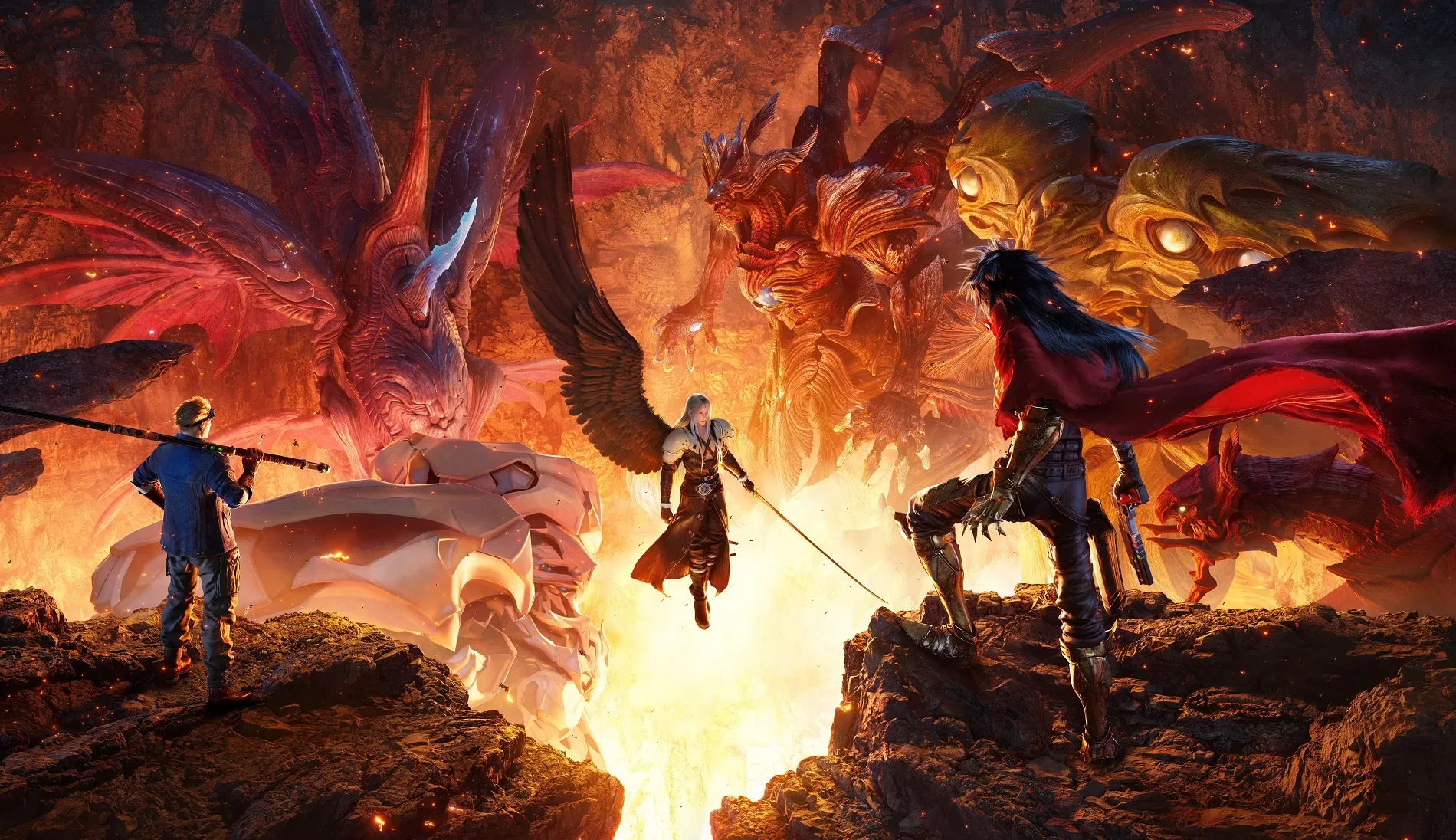
The memes landed before the party did. When Final Fantasy 7 Revelation revealed that its heroes would leap from the Highwind and skydive toward the world below, fans immediately compared the moment to Fortnite’s familiar pre-match plunge. Cloud Strife, naturally, was soon imagined asking the most inevitable question in modern gaming: where are we dropping?
It turns out the joke had a kernel of truth. Director Naoki Hamaguchi has confirmed that Fortnite was part of the inspiration behind Revelation’s airborne exits. The clarification matters because the Highwind is expected to be a central system in the third and final installment of the Final Fantasy 7 remake trilogy, not simply a flashy one-off scene. The team appears to be adapting one of the original game’s defining travel tools for a much more physically detailed version of the world.
Hamaguchi’s wording also leaves room for the larger design challenge. He said the developers drew a bit of inspiration from Fortnite, rather than suggesting Revelation is trying to turn its airship into a battle royale bus with a very expensive engine problem. That distinction is important. The comparison is obvious in the sight of a group launching from a high-altitude vehicle, but the Highwind’s role is rooted in Final Fantasy 7’s own history.
The Highwind has always meant freedom
In the original PlayStation RPG, the Highwind is the party’s great late-game symbol of mobility. It lets players traverse the global map and reach places that had previously been inaccessible. Its arrival expands the adventure’s sense of scale: locations become destinations instead of distant scenery, and the world feels newly open for business, secrets, side activities, and pressing planetary concerns.
That older game could handle the transition in a wonderfully direct fashion. Move the airship to a point on the map, disembark, and the party is where it needs to be. There was no requirement to explain the exact mechanics of getting from the deck to the ground. The original’s stylized world map and technical limits made that abstraction feel natural.
Revelation is working under very different expectations. Modern big-budget games often seek continuity between travel, terrain, animation, and player control. If the Highwind floats above a fully rendered world, a simple menu command that deposits the group on the surface may feel less seamless than it did in the PS1 era. Letting the party jump, fall, and land is an immediately readable solution. It preserves the original function—choose a destination and leave the ship—while making the transition look like an event.
That is where Fortnite’s influence fits. Its drops have made aerial deployment an instantly understood piece of game language. A player sees a vast landscape below, chooses a landing area, and begins a descent that turns geographic choice into spectacle. Revelation’s version may evoke that same visual shorthand, even though its purpose is tied to exploration in a role-playing game rather than an opening scramble for gear and survival.
“We did get a bit of inspiration from Fortnite, [we] won’t lie about that,” Hamaguchi said.
Related coverage includes Final Fantasy 7 Revelation Director Confirms Fortnite Helped Inspire the Highwind's Skydives.
It is a refreshingly plain acknowledgment for a comparison that had already become impossible to avoid. The reveal itself supplied the visual setup, and fans supplied the punchline. Rather than sidestepping the connection, Hamaguchi has effectively confirmed that the Highwind’s skydiving presentation and Fortnite share some design DNA.
Not a genre swap, but a smart translation
The key phrase is “a bit.” A game can borrow a familiar idea without adopting the structure surrounding it. Nothing in the confirmation indicates that Final Fantasy 7 Revelation is becoming a battle royale, that the Highwind will function as a competitive lobby vehicle, or that its travel system will copy Fortnite wholesale. The known premise is much narrower: players will be able to fly around the world, select an area to visit, and have the party dive down from the airship to the map below.
That approach is actually a practical answer to a remake-series question. How do you recreate a beloved global traversal mechanic when the world is no longer represented as a compact abstraction? The answer seemingly combines player choice, visible scale, and a transition that makes physical sense on screen. It also gives the Highwind a stronger sense of presence. It is not merely a cursor-moving convenience; it is a place the group occupies before committing to the next stop.
There is an amusing circularity here. Final Fantasy 7 is a foundational name in console RPG history, while Fortnite has become one of the medium’s biggest cross-cultural reference points. The Highwind sequence now brings those two eras together in a single leap. Players who know the original can recognize a classic travel fantasy being preserved. Players fluent in current multiplayer vocabulary can instantly read the drop as a destination-selection moment. And everybody else can appreciate that a party of heroes with swords, guns, and an extremely large shuriken has elected to exit an airship by hurling itself into the sky.
The crossover irony is hard to miss
The Fortnite comparison is especially funny because Final Fantasy 7 has not had the sort of formal Fortnite collaboration that might have made the resemblance feel like a deliberate corporate wink. That absence stands out in a game known for collaborations with an enormous range of properties and personalities.
Final Fantasy 7, meanwhile, has crossed paths with battle royale-adjacent territory elsewhere. Apex Legends received a major Final Fantasy 7 crossover and already features squads descending from the sky. There was also Final Fantasy 7: The First Soldier, the now-defunct battle royale game. In other words, the series has brushed against the genre’s ideas before; Revelation’s Highwind mechanism just happens to resemble the genre’s most universally recognizable drop sequence.
That context makes the memes less a random act of internet pattern-matching and more an understandable response to a familiar visual. Fortnite did not invent the basic idea of parachuting or skydiving into a game world, but it made the drop phase one of the clearest rituals in contemporary games. Revelation is tapping into a visual language players already understand, then applying it to an airship fans have associated with Final Fantasy 7 for decades.
What the reveal says about Revelation’s ambitions
Revelation still has much to explain about the exact scope, limitations, and flow of Highwind travel. The confirmed information establishes the broad concept, not every interaction around it. It is not yet clear how many regions can be approached this way, whether every landing zone will be equally flexible, or what other tasks players may perform aboard the ship. Those are details for the game itself to establish rather than assumptions to make from a reveal sequence.
What is clear is that the Highwind is being treated as a major answer to the trilogy’s escalating sense of scale. The remake project has moved from Midgar’s dense opening act to a broader world in Final Fantasy 7 Rebirth, and the final entry has the task of carrying that journey to its endpoint. A controllable airship is a natural next step, both because the original game set that expectation and because it can connect a large world without making fast travel feel entirely invisible.
There is also a tonal advantage to the approach. Final Fantasy 7 has always balanced apocalyptic stakes with moments that are unabashedly playful, strange, or grandiose. The idea that the party’s next expedition begins with a dramatic synchronized dive is a good fit for that mixture. It is serious enough to support immersion, ridiculous enough to be memorable, and almost guaranteed to keep producing “where we droppin’?” jokes until release—and probably well afterward.
For readers following the broader PlayStation news cycle around major games, there is also coverage of PlayStation’s store-credit settlement and what may happen next.
For now, Hamaguchi’s confirmation gives the Highwind reveal an entertainingly direct footnote. The internet saw a Fortnite-shaped outline in Revelation’s skydiving party. The director has said that, at least in part, the internet was right. The Highwind remains Final Fantasy 7’s airship, its exploration tool, and its symbol of freedom—but it has picked up a little contemporary drop-zone energy on the way down.